
We explain how temporary propping underpinning keeps a building stable so you can fix a failing foundation without risk.
Our engineering teams design practical, cost-effective measures that sit within standard construction practice. We select methods that suit soils, site access and the planned permanent works.
When immediate support is needed, we install shoring and support systems to hold the structure in position. We monitor movement and adjust loads while concrete work or piling is completed.
As Underpinning Melbourne — Structural Preservation Specialists — we prioritise safety, VBA-compliant certification and clear fixed-price quotes. Email Chris: chris@underpinning-melbourne.com.au.
Key Takeaways
- Propping is a short-term measure to secure a home before permanent repairs.
- We use engineering-led solutions tailored to Melbourne soils and council rules.
- Work ties into concrete underpinning, restumping and piling for long-term stability.
- We prioritise safety, monitoring and VBA‑compliant certification throughout.
- Free no‑obligation assessments and transparent fixed‑price quotes are available.
Why temporary propping matters for Melbourne foundations today
In Melbourne’s clay soils, short-term support stops a small defect becoming a major failure. We act quickly to assess risk, calculate safe loads and recommend an immediate course of action.
What homeowners need to know right now
We give clear, honest advice about urgency, scope and cost drivers. Our engineers inspect support points, model load paths and explain the likely pathway from short-term support to permanent foundation repair.
How temporary works protect structure and safety during repairs
Measured works prevent progressive damage. We protect occupants, utilities and finishes while keeping essential access for ongoing construction and maintenance work.
- Melbourne clays shrink and swell, stressing the structure.
- We coordinate with councils and insurers for compliance.
- Monitoring keeps you informed during live projects.
| Benefit | What we do | Outcome |
|---|---|---|
| Immediate safety | Engineer-led assessment and measured supports | Occupants protected and further damage avoided |
| Compliance | Work sequenced to BS 5975 principles | Council and insurer coordination |
| Minimal disruption | Staged works and clear communication | Access and services maintained |
Understanding temporary propping underpinning
Engineered support systems keep a building safe while permanent repairs are designed and installed. We use plain language to explain the process and what you can expect day to day.
What temporary propping refers to in construction work
Refers propping to engineered supports installed for a defined construction period. These supports protect structures and prevent further damage while trades work.
How propping supports loads while permanent works are done
Engineers calculate load requirements and identify safe bearing points. The design shows where to place the props and how much load each must carry.
- It is often used to carry loads while damaged elements are repaired or replaced.
- We used support points that deliver safe load paths back to competent bearing.
- The system supports structures so permanent underpinning can proceed safely.
- Movement is monitored and limits are set. We act if thresholds are approached.
- We coordinate with your structural engineer and keep documentation for VBA and council.
These solutions are tailored to each site. We explain how the supports work, what you will see on site, and when removal happens after verification.
When to use a temporary propping system during underpinning
If you spot new stepped cracks or doors that stick, act quickly to assess risk and stabilise the structure. We respond calmly to urgent issues and plan measured works that limit disruption to your home.
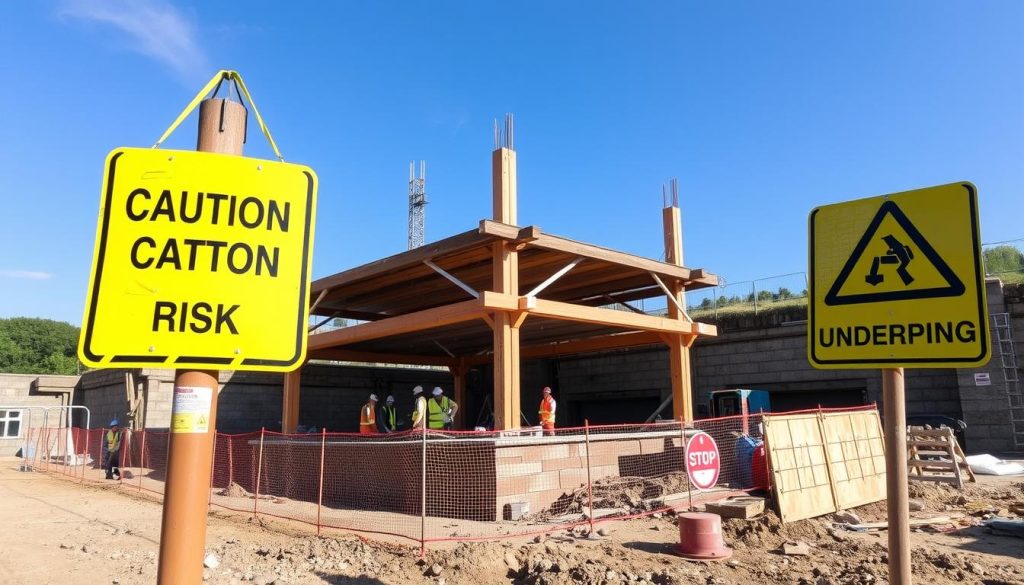
Warning signs: wall cracks, sticking doors, sagging floors
Call us if you see stepped brick cracks, sagging floors or doors that jam. These are common indicators that load paths have shifted.
Early assessment tells us if emergency action is needed now or if a planned approach suits your project.
Emergency propping versus planned propping
Emergency work can regain short‑term stability and prevent collapse. Planned measures let us sequence work and reduce time on site.
We issue clear risk assessments and set exclusion zones before any props are installed.
Refurbishment, façade retention and cut‑and‑carve scenarios
Building props are essential during façade retention and cut‑and‑carve refurbishments. They shore walls, lintels and floors while elements are altered or retained.
We tailor applications for live homes, rentals and investor projects and provide a detailed project plan from stabilisation to permanent repair.
- Call us if you see stepped brick
- We coordinate utilities and access to keep your home functional
- We advise what can remain occupied and what must be isolated
Engineering-first planning and design
Our design process starts with a clear engineering brief and a practical assessment of how loads will travel through the building.
Calculating loads, support points and load paths
We calculate the load each element must carry and mark safe support points on site.
Engineers map direct load paths to competent bearing strata or existing foundations.
Independent checks verify sizing, connections and overall stability.
Designing for buildability, access and sequencing
We design a system that fits access limits and the planned build sequence.
Work is coordinated with your builder to avoid clashes and keep the project efficient.
De‑propping is scheduled only after permanent strength is confirmed by test or certificate.
Standards and compliance: VBA and BS 5975 principles
Our method statements and inspection regimes align with VBA requirements and BS 5975 principles.
We plan monitoring, trigger levels and contingency actions. We also lodge paperwork for council and insurer compliance when needed.
- Our engineer calculates loads and defines safe support points.
- We map clear load paths to competent bearing strata.
- Independent checks verify sizing and stability at all stages.
- We document method statements and inspection regimes.
We prioritise safety, structural integrity and VBA‑compliant certification. We coordinate engineering reports as required to keep you informed and your property safe.
Types of props used and their applications
We match each job with the prop system that gives predictable strength and easy access. Our choices reflect Melbourne homes, clay behaviour and site limits.
Steel modular props, shore 400-style systems and needle beams
Steel towers and modular props give adjustable, high‑capacity support. They suit confined yards and tight access.
Shore 400-style systems handle heavy loads and speed up install. We consider shore hire availability when planning lead times.
Needle beams transfer loads across openings. They let us pick up masonry while new supports are formed.
Back propping for slabs and suspended floors
Back propping supports slabs during concrete pours and curing. We coordinate pours, curing and connectors to protect the new concrete.
Façade retention frames during structural alterations
Façade retention frames protect street elevations during internal rebuilds. These specialist systems are often used on older Melbourne terraces.
Custom propping for deep excavations and basement works
For deep excavations we specify braced tower systems and tie‑ins for lateral support. Designs follow BS 5975 and link into the build sequence for safety.
- Steel towers and modular props provide adjustable support.
- Shore 400-style systems suit heavy, repeatable installations.
- Needle beams pick up masonry over openings quickly.
- Back propping protects slabs during pours and strengthening.
| Prop type | Common applications | Key benefit |
|---|---|---|
| Modular props | Confined sites, staged works | Adjustable, quick install |
| Shore 400 systems | Heavy loads, repeat installs | Predictable speed and capacity |
| Needle beams | Masonry openings, façade work | Direct load transfer |
Solid base, bearing and stability safety
A secure bearing surface under each support is the first rule for safe, long‑lasting works.
We prepare a solid base with spreaders or a grillage to prevent punching and to spread the load into competent ground.
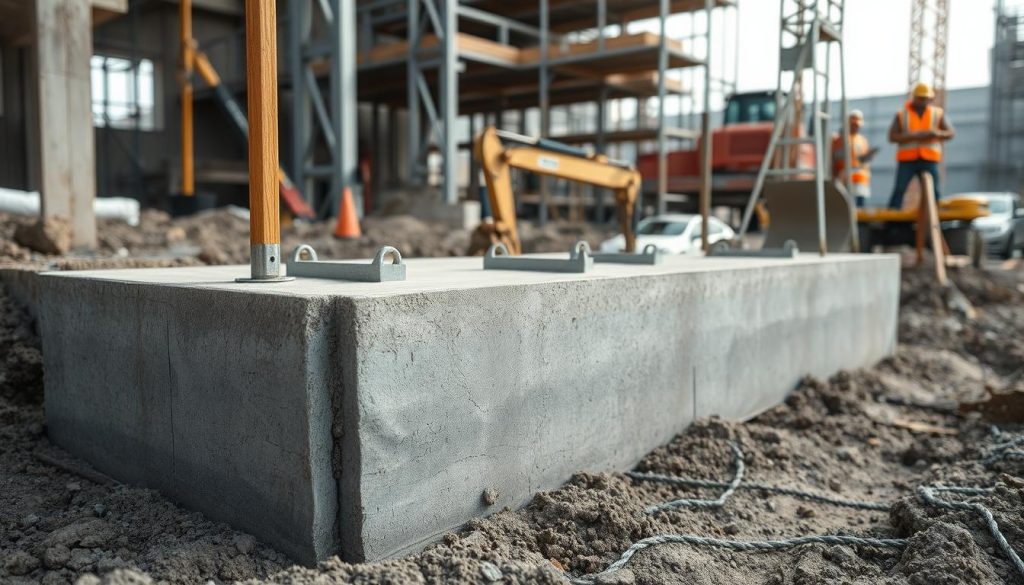
Achieving a solid base and sufficient bearing capacity
We test bearing where soils are variable or water‑affected. Tests guide pad size and grillage layout.
Posts and beams are sized with safety factors for ongoing strength. We support strengthen weak spots before any load transfer occurs.
Lateral stability, bracing and preventing progressive collapse
Bracing resists lateral forces and out‑of‑plumb risks. We design systems to prevent progressive collapse at every stage.
- Prepare a solid base with spreaders or grillage to prevent punching.
- Test bearing where soils vary or are water‑affected.
- Add bracing to resist lateral forces and out‑of‑plumb risks.
- Size posts and beams for required strength with appropriate factors.
- Control settlement with checks at defined intervals and monitoring.
| Action | Why it matters | Outcome |
|---|---|---|
| Spreaders / grillage | Distribute load to firm strata | Reduced punching and settlement |
| Bracing | Resist lateral movement | Improved stability safety |
| Monitoring & sign‑off | Verify permanent capacity | Safe de‑propping and certification |
We protect finishes with pads and spreaders and keep escape routes clear. De‑propping is signed off only when permanent capacity and safety are verified.
Step‑by‑step: how installation works on site
We begin each job with a measured site check to mark safe support points and to plan the sequence. Our aim is to regain stability quickly and keep you informed at every step.
Site assessment and marking support points
We inspect, measure and mark support points. Engineers identify safe load paths and set exclusion zones. This assessment guides the installation and any immediate emergency action.
Props installed, tightened and verified for load-bearing capacity
We set bases, assemble frames and get the props installed to plan. Connections are torqued and tightened to achieve design capacity.
We verify load-bearing capacity with checks and documented inspections before any further work done.
Monitoring movement and adjusting the system used
Movement is monitored daily. We adjust the system used if trigger levels approach limits. Records are kept for VBA and insurer sign-off.
Integration with underpinning stages and de-propping
We stage pins and coordinate de-propping with curing and permanent works. Services and finishes are protected and access is kept open where safe.
- We inspect and mark support points and safe load paths.
- We assemble frames and get props installed as planned.
- We verify load-bearing capacity and record inspections.
| Step | Action | Outcome |
|---|---|---|
| Assessment | Survey & mark support points | Clear plan and exclusion zones |
| Installation | Bases set, props installed and tightened | Designed load-bearing capacity achieved |
| Monitoring | Daily checks and adjustments | Movement controlled and documented |
| Integration | Stage pins, cure and de-propping | Safe handover to permanent repairs |
Email Chris: chris@underpinning-melbourne.com.au
Integrating propping with underpinning methods
Our teams align temporary supports with the chosen repair method to keep frames and suspended slabs secure during construction.
Concrete underpinning and staged pins
Concrete pours are staged and pinned. A propping system holds loads between pours so new concrete cures without extra movement.
Restumping and reblocking with temporary support
When restumping or reblocking is required, we provide local support while stumps are replaced. Props installed keep floors level and safe.
Resin injection stabilisation and load transfer
Resin injection can lift and stabilise small sections. Localised support manages movement while the resin cures and the load transfers.
Screw piling beneath walls and slabs
Screw piling often needs needle beams or transfer frames to move loads clear of works. We select modular props or transfer members to suit access and geometry.
- Back propping keeps slabs safe during curing and load transfer.
- We check loads and load‑bearing capacity at each stage.
- Connections are confirmed and recorded when props installed pass inspection.
- Façade retention is maintained where heritage rules apply.
- De‑propping occurs only after compressive strength and certificates are verified.
| Method | Role of propping | Outcome |
|---|---|---|
| Concrete staged pins | Hold loads between pours | Safe cure and transfer |
| Restumping | Support while stumps changed | Level floors restored |
| Screw piling | Transfer via needle beams | Stable foundations under walls |
We align propping with the permanent solution you choose and coordinate engineering reports so you have clear records and safe handover.
Risk management and site safety during construction
Every worksite needs clear controls to keep people safe and structures stable during repairs. We are VBA‑registered and insured. Our approach makes safety central to the project.

Permit-to-work, exclusion zones and inspection regimes
We operate a permit‑to‑work system for all temporary works. Permits define responsibilities and authorised activities.
Exclusion zones keep pedestrians and neighbours clear. We maintain safe pedestrian routes and brief trades on changed access.
Inspections happen at defined intervals. Connections, bracing and bases are checked and recorded for council and insurer audits.
Monitoring loads, deflection limits and vibration
We monitor loads, deflection and vibration with set trigger levels. Monitoring protects occupants and prevents progressive damage.
Risk assessments are updated as the project evolves. Deliveries are scheduled to avoid overloading suspended areas.
- Documented inspection regimes and permits
- Briefings for all trades on load paths
- Clear certification and a maintenance record at close‑out
| Action | Why it matters | Outcome |
|---|---|---|
| Permit‑to‑work | Defines responsibilities | Safer construction work |
| Monitoring | Tracks loads and deflection | Early alarms and corrective action |
| Documentation | Audit and insurance evidence | Compliant project handover |
Minimising disruption while work is done
Our aim is to keep your home liveable while construction work proceeds. We plan works so you keep access to essential rooms and services where it is safe to do so.
Sequencing rooms, utilities and access for occupants
We sequence rooms to keep kitchens, bathrooms and main living areas functional. Where isolation is necessary, we provide temporary services and clear guidance.
We choose solutions and a system that fit tight access and live occupancy. Modular props install quickly in confined spaces and reduce time on site.
Noise, dust and timing considerations
We time noisy tasks around your routine where possible. Low‑dust methods and protective sheeting protect finishes and air quality.
We promise honest communication and daily updates so you know what happens next.
- Sequence rooms to keep essential spaces available during the work done.
- Plan utilities isolations and set up temporary services where needed.
- Choose solutions that suit live occupancy and tight access.
- Time noisy tasks outside peak family hours where practical.
- Use low‑dust techniques and protective sheeting for cleanliness.
- Stage applications so children and pets remain safe throughout.
- Coordinate shore hire logistics to keep the programme moving.
- Use modular props and apply back propping and needle beams only when required.
- Provide daily communication and clear handover when work is complete.
| Timing | Impact on occupants | Mitigation |
|---|---|---|
| Day works | Noise & access changes | Schedule noisy tasks; give notice |
| Short closures | Utilities isolated | Provide temporary services |
| Staged access | Restricted movement | Sequence rooms and safe routes |
We coordinate with your structural engineer and trades to preserve stability and continuity during refurbishment. For an early estimate of costs and to plan the work done, try our underpinning cost calculator.
Email Chris: chris@underpinning-melbourne.com.au
Project timelines, costs and transparency
Clear timelines and honest costings let you plan confidently from emergency stabilisation to full repair.
We provide free assessments and fixed‑price quotes with full transparency. Our in‑house design team engineers systems to meet each project requirement and to keep work on programme in line with BS 5975.
From emergency response to permanent repair
We separate urgent stabilisation from long‑term foundation repairs. This approach keeps interim measures limited in scope and allows you to see a clear path from immediate safety to the permanent solution.
Fixed-price quotes and what affects the price
- We define a clear programme from assessment to de‑propping and final handover.
- Fixed‑price quotes list inclusions, exclusions and provisional items.
- Costs depend on spans, access, loads and duration on site.
- Shore hire periods, transport and availability affect pricing and timing.
- Modular props reduce labour and can lower overall costs.
- Permanent repair choice — underpinning, restumping or piling — affects programme length.
- We coordinate engineering reports to speed approvals and issue final certification.
No upselling — ever. Email Chris: chris@underpinning-melbourne.com.au.
Why choose Underpinning Melbourne for temporary propping
Our team brings decades of hands-on expertise to protect homes and investment properties across Melbourne.
We are Structural Preservation Specialists with 20+ years’ experience. Our engineering teams design and deliver support that links immediate safety to long-term repair.
Fully VBA registered, insured and council-compliant methods
We operate with full VBA registration and comprehensive insurance. All work follows council requirements and BS 5975 principles for safe sequence and documentation.
Honest assessments — we never upsell
We give straight advice. You get a clear report and options that match risk, budget and buildability. Our one accountable team manages design, approvals and delivery.
- 20+ years protecting Melbourne foundations and structures.
- We coordinate shore hire modular equipment and modular props to suit site access.
- We handle concrete work, restumping, resin and screw piling as needed.
- We protect finishes, manage construction access and minimise disruption.
- We provide certification, engineering reports and clear paperwork.
| Feature | Benefit | Outcome |
|---|---|---|
| VBA registration & insurance | Compliant delivery | Council and insurer confidence |
| Engineer-led design | Clear load paths and support | Safer, verifiable works |
| Integrated delivery | Single accountable team | Minimal delays and disruption |
Email Chris: chris@underpinning-melbourne.com.au. For a prompt site visit, contact us.
How to get started: free assessment and contact
Start with a free assessment so we can quickly scope risk and recommend practical stabilisation steps. Early engagement with our engineers speeds safe work sequencing and reduces unexpected delays on site.
Free no‑obligation structural assessments
We offer a no‑cost structural check and a clear fixed‑price quote. Our team coordinates any required engineering reports for council or insurer approval. This keeps your project compliant and on track.
Book a site inspection or email photos today
Send photos for a fast preliminary review and practical advice. We can often confirm if urgent action is needed or schedule a site inspection to assess installation logistics.
- Book your free no‑obligation structural assessment now.
- We review photos for quick preliminary advice.
- We schedule a site inspection to assess risks and installation.
- We provide a clear fixed‑price quote with options and timelines.
- We coordinate engineering reports where required for approvals.
Contact details
Email: chris@underpinning-melbourne.com.au
We move quickly to restore safety and peace of mind for your home and projects.
Conclusion
We combine engineering checks and practical methods to keep loads controlled and work flowing. Our team secures the building so construction proceeds safely and with minimal disruption. You keep clear records and certified sign‑off at handover.
We match applications and system choice to site access. We design for load control, a solid base and verified connections. Where needed we integrate façade retention, back propping, needle beams, modular props and shore hire to suit the work.
Movement is monitored and adjusted before limits are reached. We certify inspections and de‑propping once concrete strength and compliance are confirmed. For peace of mind and a clear plan, Email: chris@underpinning-melbourne.com.au.