
We help homeowners secure their homes with proven foundation solutions that prevent further movement.
We are Underpinning Melbourne, Structural Preservation Specialists with over 20 years local experience.
Our team explains engineering options simply. We assess your site, outline safety outcomes and give a fixed-price quote.
You get a clear plan designed for your needs and VBA-compliant certification for lenders and insurers.
We favour soil reinforcement methods that strengthen existing footings and restore levels. We also coordinate structural reports and minimise disruption to your area.
Call Chris for a free, no-obligation structural assessment. Call Chris: 1300 970 930 or Email Chris: chris@underpinning-melbourne.com.au.
Key Takeaways
- We deliver engineered foundation solutions with a calm, safety-first approach.
- Free site assessments and transparent fixed-price quotes.
- Documentation meets VBA, council, lender and insurer needs.
- Experienced local team with 20+ years handling Melbourne geology.
- We minimise disruption and protect your property value.
Specialist jet grouting for Melbourne foundations
Our team preserves homes with an engineering-first approach that calms owners and secures foundations.
Our mission is clear: protect your home with an engineering-led plan that restores safety and lasts.
- VBA-registered and insured: approvals, inspections and certification proceed smoothly.
- Council-compliant delivery: we coordinate engineers and documentation to keep your site on track.
- Minimal disruption: crews work efficiently in tight access and sensitive structures with low vibration.
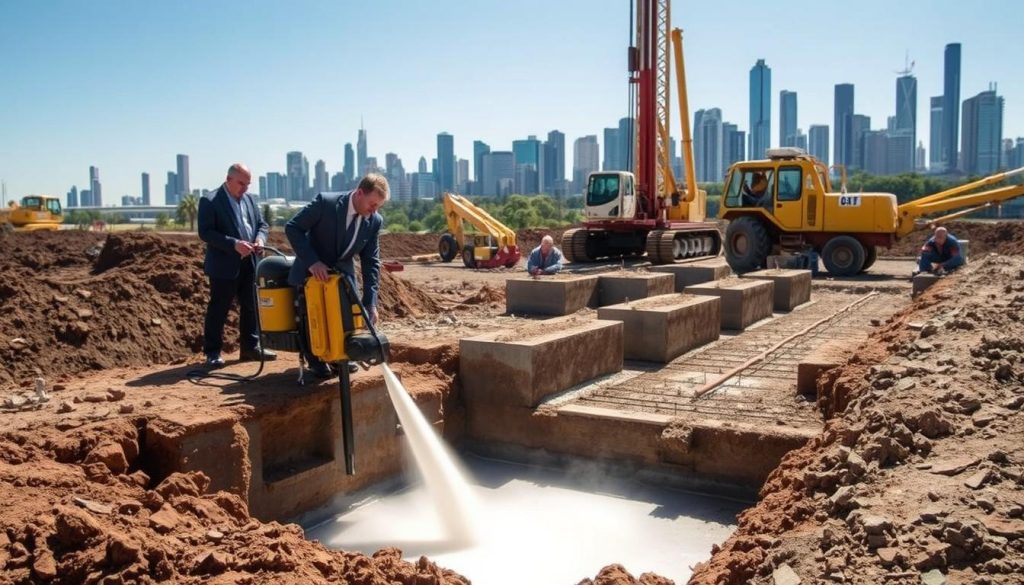
High-pressure injection improves unsuitable soils beneath foundations so structures can carry load again. We tailor solutions to the movement drivers, not just symptoms.
| Feature | Benefit | Typical Outcome |
|---|---|---|
| Engineering-led design | Targeted repair | Long-term stability |
| VBA & council compliance | Smooth approvals | Market-ready reports |
| Efficient site work | Lower disruption | Faster completion |
Start with a free assessment and a fixed-price quote you can rely on. Call Chris: 1300 970 930 or Email Chris: chris@underpinning-melbourne.com.au.
What is jet grouting underpinning and when is it ideal?
We form in‑situ Soilcrete columns and panels by injecting high-speed grout to mix with native soil. This creates a designed mass with improved bearing and low permeability.
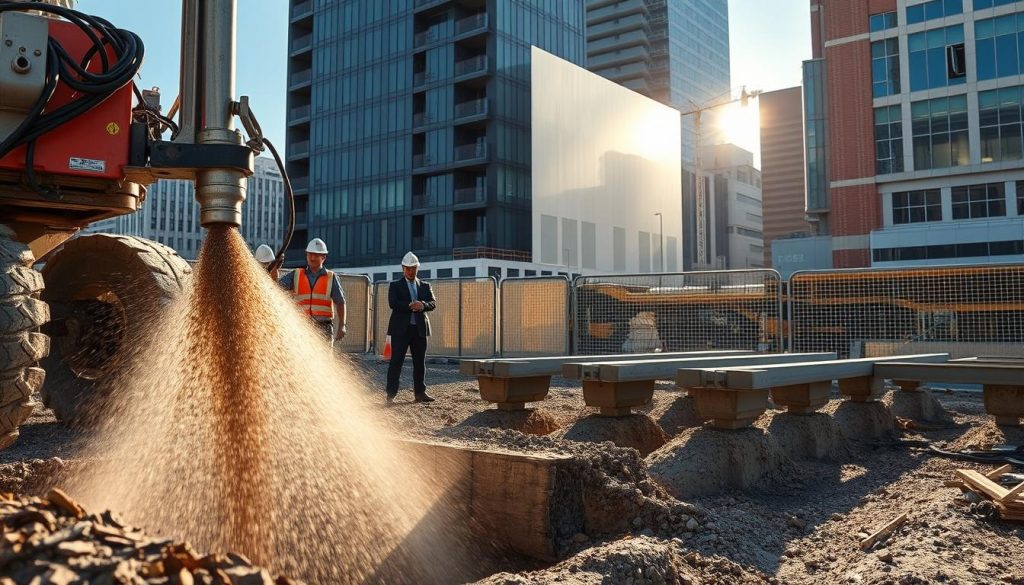
Soilcrete columns and panels: creating strength and low-permeability barriers
The process advances a drill-mounted monitor to depth. High-velocity injection erodes and mixes soil as the tool rotates and rises. Engineers control rotation and flow to meet design strength and permeability.
Best for unstable or water-bearing soils and tight-access excavation support
This method suits unstable or water-bearing soils where open trenches are risky. It also works in tight access and low-headroom sites, reducing disruption compared with large excavations.
| Application | Benefit | When to choose |
|---|---|---|
| Underpinning existing foundations | Improved bearing; reduced settlement | Weak or mixed ground beneath footings |
| Groundwater control | Low-permeability seal | Sites with persistent inflow or seepage |
| Excavation support | Temporary retention without large shoring | Tight-access or constrained urban sites |
We assess ground conditions and recommend the best options. Where another method suits your goal better, we will say so. Book a free assessment or check costs with our cost calculator.
Jet grouting underpinning Melbourne: how the process works
A monitored drill and controlled injection convert weak ground into designed support beneath your home.
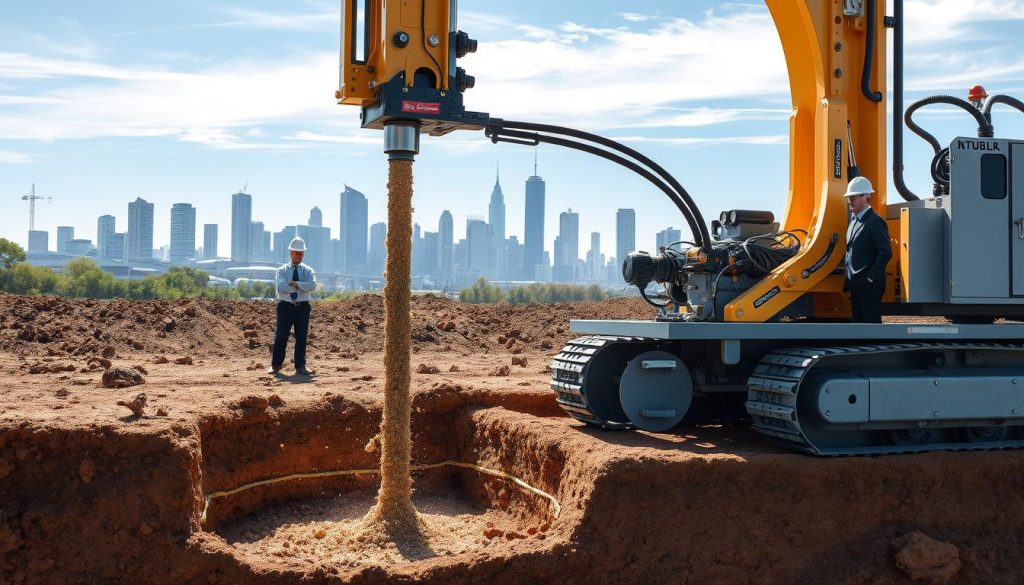
High-velocity jets erode and mix in-situ soils to form Soilcrete
We advance a grouting monitor to the design depth and begin high-velocity injection. The tool rotates and is raised in a controlled way to erode and mix soil with grout.
This creates a Soilcrete mass with improved bearing and reduced permeability.
Single, double and triple fluid systems explained
Single-fluid systems inject slurry grout directly for simple mixes. Double-fluid adds an air shroud to improve erosion. Triple-fluid uses a water jet and air shroud while injecting grout separately.
We select the system based on soil type and performance requirements to balance erosion efficiency and control.
Column geometry, target depths and production control
Columns are typically about 400 mm diameter and can overlap to form panels. We treat to depths up to 10 m and use pressures up to 200 bar where sandy ground requires it.
| Activity | Typical Value | Purpose |
|---|---|---|
| Column diameter | ~400 mm | Consistent load transfer |
| Treatment depth | Up to 10 m | Reach bearing strata |
| Injection pressure | Up to 200 bar | Erosion and mixing efficiency |
| Validation | Test columns & instrumentation | Prove diameter and early strength |
- We log rotation speed, lift rate and injection flow in real time for quality control.
- Steel sections can be added for higher bending capacity.
- Field validation proves geometry and strength before full production.
We manage spoil, grout returns and site safety to protect your property. For a site inspection and clear as-built records, contact us or Call Chris: 1300 970 930 or Email Chris: chris@underpinning-melbourne.com.au.
Applications, limits and alternatives to consider
We match site demands to practical repair options so you get predictable stability with minimal disruption.
Retaining excavations and underpinning existing foundations
Underpinning existing foundations and retaining excavations to ~4 m
Overlapping columns form low‑permeability walls that can retain excavations to about 4 m while protecting nearby structures from vibration.
In weak ground, we install 400 mm columns to the required depth to limit water inflow and provide safe temporary support.
Hybrid systems for greater retained heights: concrete piles with grout infill
For taller retained heights or higher bending demands, we design hybrid walls using closely spaced structural piles as the primary element.
Concrete piles form the main skeleton while high‑pressure columns infill between them. This improves global wall integrity and helps exclude groundwater.
When concrete underpinning, resin injection or screw piling may be preferable
We offer a full range of services: Concrete Underpinning, Restumping & Reblocking, Resin Injection, Screw Piling, Wall Crack Repairs and Structural Engineering Reports.
Resin injection fills voids but follows paths of least resistance. If it fails, it can limit later concrete underpinning options.
- Practical limit: overlapping columns retain excavations up to ~4 m for low‑vibration works.
- Hybrid option: structural concrete with infill columns for higher heights and improved wall integrity.
- Alternatives: concrete underpinning for targeted load transfer, resin injection for void repair, and screw piling for deep bearing.
We assess expected depth, groundwater behaviour and risk. Then we recommend the best solution that balances cost, program and long‑term stability.
Call Chris: 1300 970 930 or Email Chris: chris@underpinning-melbourne.com.au for a clear plan and honest advice—no upselling.
Design, safety and quality assurance on Melbourne sites
We start with a conservative design and an on‑site validation phase. Most projects include sacrificial or less sensitive columns to confirm diameter and early strength before full production.
Field validation: proving column diameters and early strengths
We install test columns and perform early strength checks. This proves the design meets the project requirements. Independent reviews confirm compliance and documentation.
Instrumentation and monitoring of drilling and injection parameters
Rigs are instrumented to record rotation, lift rate and flow. Real‑time logs keep the process within approved limits. You receive monitoring reports at key hold points.
Protecting adjacent structures: low vibration, minimal disruption
We monitor nearby walls and structures to detect movement early. Works use low vibration methods to protect heritage facades and sensitive finishes.
- Site safety controls: spoil management, exclusion zones and emergency readiness.
- Sequenced construction: maintains access and services for occupants and neighbours.
- Outcome: verified strength, documented integrity and reduced risk for insurers and councils.
We prioritise safety, structural integrity and VBA‑compliant certification. Call Chris: 1300 970 930 or Email Chris: chris@underpinning-melbourne.com.au for a clear, fixed‑price quote.
Why choose Underpinning Melbourne for jet grouting
We bring practical, documented methods to each project so you know the outcome before works start. Our approach reduces surprise costs and protects your home with engineering-backed choices.
20+ years’ local experience, VBA-compliant certification and engineering reports
We have delivered solutions across the area for two decades. Our team is VBA registered and insured. You receive engineering reports that meet council, lender and insurer needs.
Free no-obligation structural assessments and fixed-price quotes
Book a free assessment and get a fixed-price quote. Transparent pricing and a clear program mean you know the time and cost before works begin.
Core services to match your ground conditions
We coordinate one contractor to manage reports, permits and inspections. This improves efficiency and saves time on complex foundation projects.
- Underpinning and concrete underpinning
- Restumping & reblocking; resin injection
- Screw piling and wall crack repairs
Book an inspection
Call Chris: 1300 970 930 or Email Chris: chris@underpinning-melbourne.com.au to arrange a site visit and honest advice.
Conclusion
A tailored soil treatment program gives homeowners predictable outcomes and peace of mind.
We form in‑situ Soilcrete columns and panels to improve weak ground beneath your foundation. The method controls injection, column geometry and depth to restore bearing and reduce settlement.
Field validation and real‑time monitoring confirm diameter, early strength and system performance. Where required, we combine concrete piles with grout infill for taller retained walls without high vibration.
Book a free assessment and get a fixed‑price quote. For a short guide on repair choices see our restumping vs underpinning comparison. Call Chris: 1300 970 930 or Email Chris: chris@underpinning-melbourne.com.au.