
We help you decide on a commercial solution to fix foundation issues and protect your home.
We are Underpinning Melbourne — Structural Preservation Specialists with 20+ years’ experience. We deliver engineered underpinning and other methods to stabilise foundations and stop structural issues from worsening.
Our team offers clear, VBA‑compliant guidance when walls crack or your house shows movement. We coordinate structural engineering reports, certification and council‑safe methods. Expect a calm, honest assessment and a fixed‑price quote after a free, no‑obligation inspection.
Choose the right approach for your property, from resin injection or screw piles to restumping or traditional pins. For a quick cost guide, try our underpinning cost calculator.
Call Chris: 1300 970 930 or Email Chris: chris@underpinning-melbourne.com.au
Key Takeaways
- We provide engineered solutions that protect your building and restore stability.
- Free, no‑obligation assessments lead to transparent fixed‑price quotes.
- We coordinate engineer reports and VBA‑compliant certification for council needs.
- Options include resin injection, screw piles, restumping and traditional underpinning.
- Our focus is safety, minimal disruption and long‑term outcomes with 20+ years’ experience.
Engineering-led mass concrete underpinning Melbourne for safe, compliant foundations
We deliver engineered foundation solutions that focus on safety and long‑term performance.
Our mission: calm, structural solutions that protect your home
We are VBA‑registered and fully insured. Our team explains work in plain language. We design each underpinning job to match the site, the structure and the soil.
Free assessments, fixed‑price quotes and VBA‑compliant certification
Book a free, no‑obligation assessment and receive a transparent fixed‑price quote. We provide full engineering documentation and council‑ready certification.
- We engineer solutions to the site and load paths found.
- We recommend the least invasive underpinning where possible.
- When needed, we design concrete underpinning for deeper bearings.
- We manage permits, VBA compliance and council liaison.
- With 20+ years’ experience, our team keeps you informed and avoids unnecessary work.
Call Chris: 1300 970 930 or Email Chris: chris@underpinning-melbourne.com.au
Do you need underpinning? Signs of foundation issues to watch
Recognising subtle movement in your house helps prevent long-term structural damage. We reassure anxious homeowners with clear guidance and no-pressure advice. Send photos for a fast initial review and we will advise how urgent an inspection is.
Wall cracks, sticky doors, sloping floors and gaps
Watch for stepped cracks in brick walls, widening plaster fissures and window arch cracking. Sticky doors or windows and sloping floors often mean uneven settlement or subsidence.
Gaps between skirtings and floors, or cornice separation, suggest movement in the structure. Horizontal cracks near mid-walls can imply differential ground movement or footing rotation. New or growing cracks combined with binding doors often mean you need underpinning.

When cracks, subsidence and movement become structural problems
We assess whether damage is cosmetic or a sign of structural issues. Our inspection confirms cause and the safest remedy before damage escalates.
- We identify moisture, tree roots or drainage defects contributing to movement.
- You receive a clear plan, timeframes and next steps after our site inspection.
- For a quick start, send photos and book a fast.
What is mass concrete underpinning and when is it the right method?
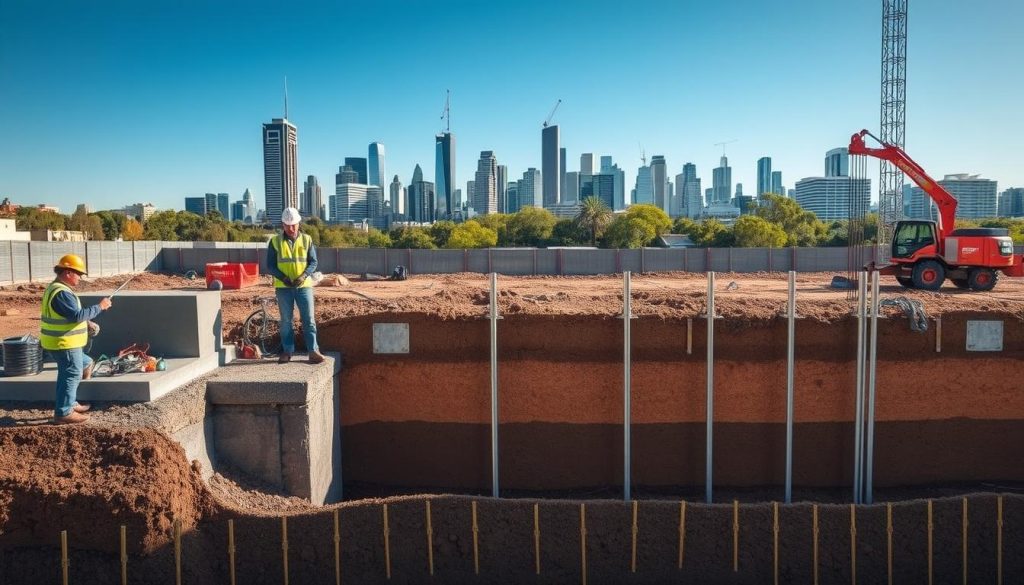
The method uses staged excavation and poured pads to shift loads to firmer ground. It is a traditional approach that reconstructs support beneath existing footings.
We use clear sequencing and engineering control. Each stage keeps the building stable while new support cures.
The traditional underpinning method explained
Staged excavation beside the footing exposes the base for new pinning. We form and pour reinforced pads beneath the wall to transfer load down to deeper, stronger ground.
The process includes controlled excavation, pour timing and monitoring. Engineers confirm pad size using soil bearing data before work starts.
Best-fit scenarios: deeper bearings, localised failure, access constraints
This method suits localised failure, where deeper bearing is required, or where access prevents larger rigs. Excavation is carefully braced to protect the building.
- Useful for pockets of weak soil or compressible layers that need deeper founding.
- Effective where machinery cannot reach and manual access is necessary.
- We monitor levels and manage spoil, curing and council documentation.
| Situation | Why this method | Key control |
|---|---|---|
| Localised footing failure | Pinning transfers load to firm ground | Sequential pours and monitoring |
| Deeper bearing required | Pads reach stronger soil layers | Engineer-specified pad dimensions |
| Tight access or confined sites | Works can proceed without large rigs | Manual excavation and bracing |
We deliver VBA documentation and certified results. Call Chris: 1300 970 930 or Email Chris: chris@underpinning-melbourne.com.au.
Underpinning methods compared: concrete underpinning vs resin injection and screw piling
Different repair methods give different trade-offs in cost, time and soil improvement. We explain how each option works so you can choose with confidence.
Resin / geopolymer injection
Injection uses targeted fills to compact weak ground. Technicians drill small, 16 mm holes and place resin to fill voids under footings or slabs.
This is fast and minimally invasive. It often re-levels floors and closes cracks with less disruption and shorter time on site.
Traditional excavation and pours
Traditional underpinning requires staged excavation and poured pads beneath the footing. Engineers specify pad size from soil data.
The process is robust for deeper bearing but can be slower and more intrusive. It may not improve the surrounding soil fabric.
When screw piles outperform
Screw piles reach deeper strata with limited spoil. They suit poor soils or higher loads and give reliable capacity where shallow fixes fail.
- We compare cost, time, access and long‑term performance.
- We match method to your building, foundation loads and soil behaviour.
- Call Chris: 1300 970 930 or Email Chris: chris@underpinning-melbourne.com.au
The underpinning process we follow
Our process begins with a precise site inspection to map the cause and extent of movement. We gather level surveys, photos and a soil assessment so engineers have clear data.
Site investigation and soil assessment
We inspect footings, walls and visible cracks. Bore logs or test pits confirm soil type and bearing depth.
Engineering design, council compliance and VBA documentation
Engineers specify pad sizes, depths and reinforcement. We prepare VBA paperwork and lodge council permits when required.
Execution: excavation, pours, curing and staged pinning
Work proceeds in staged pins to protect the structure. Excavation is controlled, pours are timed, and curing follows engineer guidance.
Quality assurance: monitoring levels and structural performance
We monitor levels during work to confirm load transfer to the new foundation. Our team protects interiors and updates you daily.
- Handover: compliance certificates, photos and as-built details.
- Advice: drainage and tree management to protect long-term performance.
| Stage | Action | Key check |
|---|---|---|
| Investigation | Inspection, level survey, soil testing | Clear cause and bearing depth |
| Design | Engineer plans and VBA documentation | Pad sizes, reinforcement, approvals |
| Execution | Sequenced excavation, pours, curing | Level monitoring and bracing |
| Handover | Certificates, photos, maintenance advice | Compliance and records |
Call Chris: 1300 970 930 or Email Chris: chris@underpinning-melbourne.com.au
Foundation movement in Melbourne: causes we see most
Changes in ground moisture often drive the distress we see in residential foundations.
Reactive clay soils absorb water and expand in wet times. In drought they shrink and harden. This cycle causes both heave and settlement that moves footings and cracks walls.
Reactive clay soils: shrink‑swell cycles in drought and rain
Clay soils in many suburbs swell when wet and pull away when dry. The repeated movement stresses footings and can open cracks in plaster and brickwork.
Poor drainage, leaking pipes and erosion creating voids
Poor drainage or leaking pipes wash fines from silty and sandy clay. Over time this forms voids beneath pads and leads to subsidence and uneven settlement.
Overloading slabs and inadequate founding on fill
Loads beyond the soil bearing capacity crack slabs and accelerate settlement. Footings founded on uncontrolled fill can consolidate and sink as the fill settles.

AS2870 requires correct founding into natural clay below controlled fill. This reduces long‑term movement and helps avoid recurring damage.
- Reactive clay swells and shrinks with seasons, moving footings.
- Blocked drainage or leaking pipes create voids and subsidence beneath foundations.
- Overloaded slabs can crack and worsen settlement.
- Fill that was not compacted properly will compress and sink.
- Nearby excavations or tree roots can remove support and change moisture patterns.
| Cause | How it affects foundations | Typical sign |
|---|---|---|
| Reactive clay | Shrink‑swell cycles move footings up and down | Stair‑step cracks in brickwork; sticking doors |
| Poor drainage / leaking pipes | Washes fines, creates voids and undermines support | Localised subsidence; sudden floor dips |
| Inadequate fill / overloading | Fill consolidates; soil exceeds bearing capacity | Cracked slabs; uneven floors |
| Adjacent works / trees | Undermines or alters moisture balance | New cracks near excavations; seasonal movement |
We assess site grading, roof discharge and stormwater paths to reduce future risk. Our designs address soil behaviour, not just visible cracking. For a clear next step, Call Chris: 1300 970 930 or Email Chris: chris@underpinning-melbourne.com.au.
Underpinning cost in Australia: what affects your quote today
Understanding likely costs helps you plan repairs without surprises. We explain typical ranges and the factors that shape a final price.
Typical ranges: from minor works to complex rectifications
Minor stabilisation jobs can start near $5,000 where access and soil are favourable.
Complex rectifications with severe subsidence often sit between $15,000 and $30,000. Large properties or major structural damage can exceed $50,000.
Key cost drivers: damage extent, soil, access and method
Price depends on the severity of damage, the chosen method and local soil behaviour.
- Access limits increase labour and protection requirements.
- Reactive soil or deep bearing needs raise material and time costs.
- Methods such as injection or reinforced pours change the program and cost.
- Time on site, curing and staged work affect preliminaries and the total job cost.
| Project type | Typical cost | Why |
|---|---|---|
| Minor stabilisation | $5,000+ | Simple access, small cracks, limited subsidence |
| Complex rectification | $15,000–$30,000 | Severe movement, difficult soil, restricted access |
| Major structural repair | $50,000+ | Large building scope or extensive reinforcement |
We provide free inspections and transparent fixed-price quotes. Our fixed-price quote explains scope, inclusions and exclusions before you commit. Book a free, fixed‑price quote and get a clear budget for your property.
Call Chris: 1300 970 930 or Email Chris: chris@underpinning-melbourne.com.au
Timeframes and disruption: how long does the job take?
We’ll give you a clear timeline before any work starts so you can plan with confidence. Our schedule balances speed with safety and compliance.
Concrete underpinning duration vs resin injection turnaround
Injection often finishes in days. Technicians use small, 16 mm holes and targeted resin placement. This usually means minimal disruption to your home routine.
Concrete works need staged excavation, pours and curing. That extends the job and increases site impact. We stage work to keep the building supported.
Minimising disruption to gardens, paths and everyday use
We protect gardens and paths and plan access routes. Where possible we keep essential rooms usable and limit noisy tasks to set times.
- Daily updates on progress and next steps.
- Isolation of dusty or noisy tasks and end-of-day clean down.
- Coordinated deliveries and waste removal to reduce neighbour impact.
| Method | Typical time | Site impact |
|---|---|---|
| Resin injection | 1–3 days | Low; small drill points, minimal spoil |
| Traditional excavation | 2–4+ weeks | Higher; excavation, pours, curing and spoil management |
| Phased works | Varies by job | Maintains support while reducing simultaneous disruption |
Call Chris: 1300 970 930 or Email Chris: chris@underpinning-melbourne.com.au
Why choose Underpinning Melbourne for structural preservation
Choose a team that blends technical skill with honest, no‑nonsense advice for your property. We focus on safe, tested outcomes that protect your building and keep disruption low.
VBA‑registered, insured and council‑compliant methods
We are fully VBA Registered and insured. That means council paperwork, certificates and compliance are part of the work we deliver.
20+ years’ experience and honest, no‑upsell assessments
Our team brings 20+ years of structural preservation experience to every job. You get clear assessment, straight advice and only the repairs you actually need.
End-to-end: structural engineering reports and certification
We manage assessment, engineering, permits and certification under one roof. Our designs protect the foundation and structure with clear, testable assumptions.
- Compliant and durable: we follow council requirements and evidence‑based methods.
- Minimal disruption: we schedule work to suit your house and minimise site impact.
- Aftercare: advice on drainage and maintenance to protect your home long term.
Call Chris: 1300 970 930 or Email Chris: chris@underpinning-melbourne.com.au
Book your assessment: get a transparent, fixed-price solution
Book a quick site inspection and get a clear, fixed-price solution tailored to your foundation needs.
Free, no‑obligation structural assessments give you fact-based advice without pressure.
Call Chris on 1300 970 930 or email chris@underpinning-melbourne.com.au
Click to call or email with photos to speed the review. Our team reviews images and often gives a preliminary response the same day.
Fast site inspections across Melbourne—send photos to start
Book your free inspection and receive a clear, fixed-price quote. We prioritise urgent jobs where cracks are growing or doors have shifted suddenly.
- Short lead times for inspections across the metropolitan area.
- Concise scope, inclusions and a program before any work starts.
- We explain underpinning options, likely timeframes and site preparation needs.
- Documentation for lenders or council is confirmed at handover.
| What you get | Typical response | Why it helps |
|---|---|---|
| Free inspection | Within days | Fast clarity on urgency and next steps |
| Fixed-price quote | Written within 48 hours after inspection | Removes billing surprises and defines scope |
| Site-ready plan | Includes program and key milestones | Helps you schedule the job and manage time |
| Certification & handover | On completion | Compliance for property records and lenders |
Contact us today to stabilise your house and protect your investment. Call Chris: 1300 970 930 or Email Chris: chris@underpinning-melbourne.com.au.
Conclusion
Protecting your home starts with a clear, engineer‑led plan that targets the root cause of movement.
We design underpinning solutions that suit your soil and foundation condition. Our team selects the best method—traditional underpinning, resin injection or piles—based on site data and risk.
Work is VBA‑compliant and documented from inspection to certificate. We manage excavation, drainage and finishes to reduce disruption and guard against future subsidence.
Early action limits structural damage and cost. Book a free inspection and receive a fixed‑price plan tailored to your property.
Call Chris: 1300 970 930 or Email Chris: chris@underpinning-melbourne.com.au.