
We offer needle beam underpinning Melbourne services to stabilise and protect your house.
We are Underpinning Melbourne — Structural Preservation Specialists. Our mission is to save Melbourne homes from foundation failure using an engineering-led, calm approach.
Reactive clay and drought can cause subsidence and cracking in local foundations. We assess your property, explain the risks, and propose clear solutions that meet VBA and council rules.
Our company provides free no‑obligation structural assessments, fixed‑price quotes and coordinated engineering reports. You deal with one experienced team from inspection to completion.
Call Chris: 1300 970 930 or Email Chris: chris@underpinning-melbourne.com.au.
Key Takeaways
- We stabilise your foundation with certified, engineering-led services.
- Free assessment, fixed-price quote and coordinated engineering reports.
- Work meets VBA and council requirements to protect property value.
- Over 20 years of experience delivering complex stabilisation projects.
- We manage permits, inspections and the whole job to keep it simple.
- Clear timing, regular updates and practical advice to prevent recurring issues.
Needle beam underpinning in Melbourne: what it is and when you need it
When foundations show movement, a piled beam system can restore load transfer and protect your property.
What it is: A reinforced concrete bar ties piles placed beside a wall to existing footings. It transfers load from the old foundation into new piles. This allows the wall and building to remain in service while work proceeds.
Common triggers and signs
Reduced soil strength, adding an extra storey, or nearby excavation can all create risk. These events may cause subsidence, cracking and uneven floors.
If you see misaligned doors, stair changes or wall cracks, you may need underpinning after a professional assessment. We confirm the cause first and avoid unnecessary works.
- How it helps: supports heavy masonry without wall demolition.
- Process: engineering design, staged jacking, inspections and concrete pours.
- Safety: service-location checks and a clear daily plan to protect your house.
| Trigger | Typical sign | Recommended action |
|---|---|---|
| Adding an upper storey | New cracks and increased load | Engineer assessment and piled support |
| Nearby excavation | Sudden settlement or leaning walls | Immediate survey and temporary support |
| Changing soil moisture | Gradual settlement and sticky doors | Soil investigation and tailored method |
Melbourne’s reactive clay, drought and drainage issues that lead to subsidence
Seasonal moisture change in local soils is the root cause of many foundation problems. We focus on diagnosing what drives movement so solutions last.

Clay shrink-swell cycles causing footing heave and settlement
Local clay absorbs water and swells in wet periods then shrinks in drought. These cycles stress footings over time.
The result is differential movement and visible cracks or uneven floors. Left unchecked, this leads to larger damage.
Poor drainage, leaking pipes and water erosion undermining soil strength
Poor site drainage and leaking pipes wash fines from beneath footings. Voids form and bearing capacity drops.
Persistent ponding against walls accelerates erosion and increases the risk of long‑term subsidence.
Trees, vegetation and adjoining construction changing site moisture
Large trees extract moisture and new construction can change how water flows on your site. Both alter the moisture balance around foundations.
We inspect site moisture, pipe condition and landscaping before recommending work. Our report includes targeted maintenance and advice to protect your property over time.
- We protect your house by fixing causes, not just symptoms.
- For cost guidance use our underpinning cost calculator.
How needle beam underpinning works on your property
Our team installs piles beside the wall and casts a reinforced concrete tie to transfer load from old footings to new supports. This method keeps the building in service while we work.
We follow a clear, staged process so you know what happens and when. We engage an engineer, agree the contract and apply for permits before any excavation starts.
Piles beside the wall with a reinforced concrete tie
We excavate to the engineer’s plan and locate services to protect the site. Inspectors check holes before we pour the first batch of concrete.
Targeted excavation, jacking, staged pours and vibration
We pour half the concrete, allow time to set, then jack the foundations to the required level. Temporary supports hold the house while we finish the work.
Minimising disruption while restoring levels and integrity
- Quality control through staged pours, vibration and inspections.
- We manage permits, inspections and documentation for VBA compliance.
- The construction sequence restores bearing capacity and protects foundations.
- We reinstate surfaces and remove spoil so the job is left clean and compliant.
For a fast assessment and guidance on the process, contact our team via book a site inspection or call Chris: 1300 970 930.
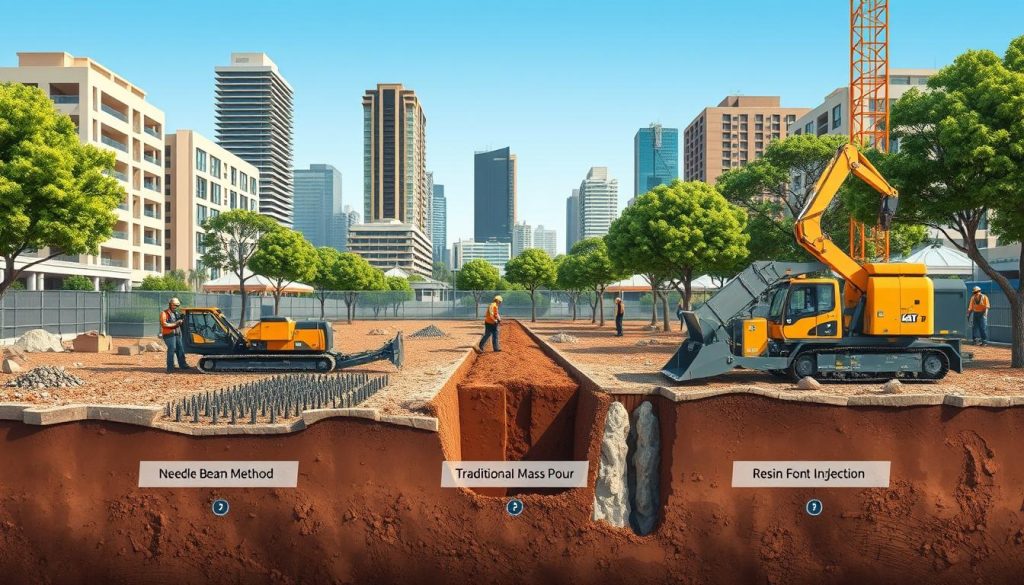
Choosing the right method: needle beam vs traditional mass pour vs resin injection
Different repair methods suit different problems — we match the method to the cause and site.
Traditional mass pour excavates sections to depth and fills with concrete. It is robust for shallow bearing issues. Expect more excavation and longer time on site, but reliable concrete strength where access allows.
Resin injection for low-disruption lifting
Resin injection uses small 16 mm holes drilled about 1500 mm deep. The resin expands to fill voids and lift slabs rapidly. It avoids heavy excavation and suits slab repair and fast service with minimal mess.
Screw piling, pile-and-beam and deeper solutions
Where bearing failure extends deep, pile-and-beam or screw piles provide lasting capacity. Screw piling and brackets work well when access prevents larger rigs. We favour the least invasive, most permanent option for your property.
- We weigh soil data, movement patterns and access.
- We outline costs, likely time, expected lift and constraints.
- Every solution includes a safety plan and quality checks.
| Method | Best for | Site impact | Typical outcome |
|---|---|---|---|
| Mass pour | Shallow footing repair | High excavation and time | Strong concrete repair |
| Resin injection | Slabs, voiding, lift | Low disruption, quick | Fast stabilise and lift |
| Screw piling / pile & beam | Deep support beside walls | Moderate machinery, targeted | Durable deep bearing capacity |
Our calm, engineering-led process aligned to VBA and council requirements
We begin by mapping the site and testing soils so engineers can design a lasting repair.
Site investigation and engineering reports
We perform a full site investigation. This includes soil testing and moisture tracking.
Structural engineers prepare a report that supports permits and shows scope.
Permits, inspections and council-compliant construction
We lodge permits and book inspections. GPR service mapping is completed before drilling or excavation.
Inspectors check excavations before concrete placement and sign off at key stages.
Clear scopes, fixed-price quotes and managed delivery
You receive a clear scope and a fixed-price quote with expected timeframes.
Our team coordinates the whole process so trades and inspections run smoothly.
Final re-levelling, crack repairs and quality assurance
We monitor levels during lift and re-check after curing. Holes are re-grouted and sites cleaned.
Quality assurance includes photos, inspection records and certifications for your file.
- Post-works support and maintenance guidance to protect your property and home.
- Fixed documentation and engineer reports on completion for council and VBA compliance.
| Stage | What we do | Why it matters |
|---|---|---|
| Investigation | Soil tests, GPR, surveys | Defines design and reduces risk |
| Design & permits | Engineer reports and applications | Ensures council-compliant works |
| Construction | Inspections, monitored lifts | Maintains safety and quality |
| Completion | Re-levelling, repairs, files | Restores use and provides certainty |
Why choose Underpinning Melbourne — Structural Preservation Specialists
Our experienced team puts safety, compliance and clear advice first for every job.
With 20+ years’ experience we are VBA registered and fully insured. This gives you lender confidence and peace of mind.
20+ years’ experience, VBA registered and fully insured
Our company has provided reliable stabilisation and foundation service across the region for two decades.
Skilled teams deliver underpinning, restumping and pile-and-beam solutions. Inspectors and engineers sign off every stage.
Honest assessments — we don’t upsell unnecessary works
We give clear advice and written scopes. If no structural work is needed, we tell you so.
Clients often thank us for punctuality, clean work and handling permits and inspections “by the book.”
- VBA registered: compliance and certified practice.
- Insured: protection for your home and property.
- Local team: experience with soils, regs and complex sites.
| Credential | What it means | Client benefit |
|---|---|---|
| 20+ years experience | Proven methods and repeatable results | Confidence in lasting repairs |
| VBA registered & insured | Meets regulatory and lender requirements | Reduced risk and smoother approvals |
| Engineer-backed team | Measured outcomes and documented reports | Clear records for councils and buyers |
Choose a company whose service is second none. Call Chris: 1300 970 930 or Email Chris: chris@underpinning-melbourne.com.au.
Services that support needle beam underpinning projects
We coordinate multiple trades and approvals so repair work proceeds smoothly from inspection to final sign‑off.
Core services cover concrete pours, restumping, resin lifting and screw piling. Each service is selected to suit soil, access and the building’s needs.
Concrete underpinning, restumping and reblocking
Concrete underpinning is ideal where access allows a mass pour for lasting bearing capacity.
Restumping and reblocking renew subfloor support and re‑level timber floors in an older house.
Resin injection and screw piling solutions
Resin injection gives low‑disruption lift for slabs and voiding. Screw piling provides deeper founding where access is tight.
Wall crack repairs and structural engineering reports
We repair finishes after levelling and supply engineer reports to certify design, permits and inspections.
- Our team sequences the project to align trades and inspections with your schedule.
- We protect gardens and leave the site tidy when the job is complete.
- You get a documented scope and one point of contact for the whole service.
| Service | Best for | Typical outcome |
|---|---|---|
| Concrete underpinning | Shallow footing repair | Durable bearing and re‑levelling |
| Resin injection | Slab voiding and lift | Fast stabilise with low disruption |
| Screw piling | Deep founding, tight access | Permanent deep support |
| Restumping & reblocking | Timber houses | Re‑levelled floors and renewed supports |
Get started: free assessment, fixed quote and expert advice
Start with a free, no‑obligation assessment and get a clear fixed quote you can rely on. We review photos remotely for fast guidance. When needed, we follow with a formal site inspection and engineer report.

Book a site inspection or email photos for fast guidance
If you prefer quick advice, email photos and details first. Our team gives prompt feedback and outlines likely options.
When a site visit is needed, we schedule a time that suits your family and work. Service locating is done before drilling or excavation to protect utilities.
Call Chris on 1300 970 930 or email chris@underpinning-melbourne.com.au
Call or email to arrange an inspection or to get your fixed quote. Our office and field guys keep communication clear and punctual.
- Book a free assessment and receive a fixed quote for your project.
- Email photos first for initial advice before a site visit.
- Our team explains options, timings and access so you can plan around home life.
- We coordinate engineering, permits and inspections to save you time.
- On the day, site guys protect services and leave the area tidy.
- We stay available for questions and updates throughout the service.
For fast assistance and a reliable quote, contact our company team today. Expect practical solutions and plain-English advice tailored to your property.
Conclusion
We restore stability to foundations with engineered repairs and clear communication. Our team diagnoses soil causes such as clay cycles, poor drainage and nearby excavation. We then recommend the right solution — from traditional underpinning to resin injection — backed by structural engineers.
Expect a managed process with staged works, inspected concrete pours and documented levels. We offer free assessments, fixed‑price quotes and full compliance so your house and property are protected long term.
Ready to protect your home? Compare restumping vs underpinning. Call Chris: 1300 970 930 or Email Chris: chris@underpinning-melbourne.com.au.