
We provide engineered solutions to stop subsidence and protect your home. Our mission is clear: save houses from structural failure with a calm, engineering-first approach.
We assess movement patterns, wall cracks and moisture paths before recommending works. Our services include concrete underpinning, resin injection, screw piling and certified reports. We design pressure grouting to improve weak ground and support existing concrete elements with engineered certainty.
We are fully VBA registered and insured with 20+ years’ experience. You get a fixed-price scope that meets council requirements and VBA standards. Call Chris: 1300 970 930 or Email Chris: chris@underpinning-melbourne.com.au for a free structural assessment.
Key Takeaways
- We offer engineered, permanent solutions that protect property value.
- Our approach begins with a detailed assessment of movement and cracks.
- All works are VBA‑compliant, council‑aligned and fully documented.
- We minimise disruption with planned, clean site practice.
- Fixed‑price quotes and coordinated engineering reports give you certainty.
Underpinning Melbourne: Pressure Grouting Services Built for Melbourne Conditions
Our team delivers engineered subgrade solutions tailored to local soil and climate. We act as Structural Preservation Specialists. Our approach is calm, engineering‑first and focused on lasting repair.
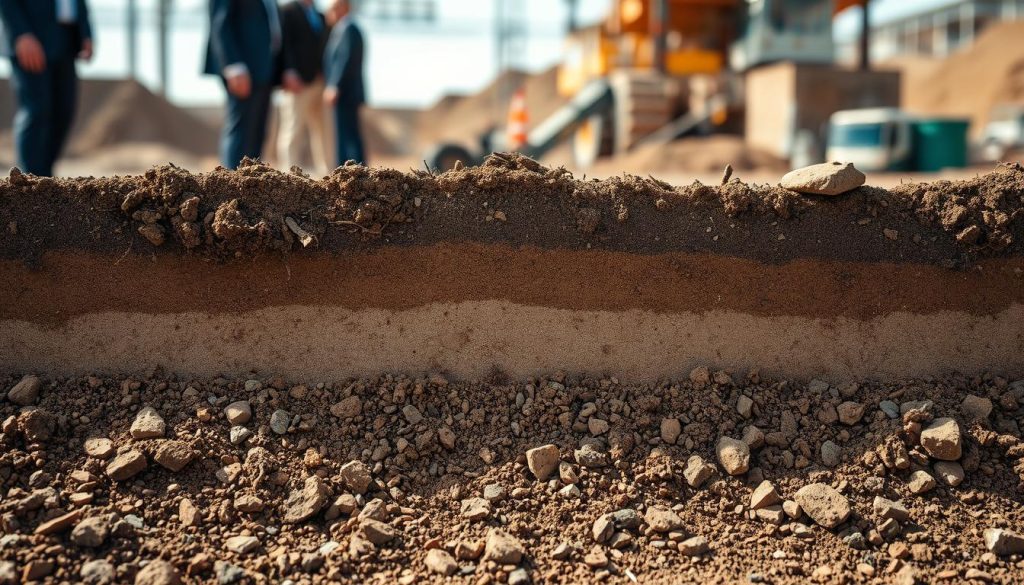
We coordinate independent structural reports and use council‑compliant methods so you get clear, documented outcomes. We are VBA registered and insured. We never upsell unnecessary work.
- We start with a methodical inspection that respects your time and privacy.
- A senior specialist explains structural behaviour, likely causes, and the safest pathway.
- We organise engineering reports where needed and provide a transparent fixed‑price quote.
- Our registration and insurance protect your family and assets during repair of concrete and subgrade elements.
Who we help: homeowners spotting stair‑step cracks, stuck doors, sloping floors or damp patches. We recommend practical solutions that balance durability, cost and site limits. Book a free no‑obligation assessment. Use our cost calculator, Call Chris: 1300 970 930 or Email Chris: chris@underpinning-melbourne.com.au.
Pressure grouting foundation Melbourne: how it works, when it’s ideal, and why it’s different
We build subsurface curtains that control movement and exclude groundwater. By injecting controlled mixes through ports, we densify weak soil and create overlapping columns beneath concrete. This fills voids and gives uniform support where excavation would be risky.
High-energy injection and column formation
Our high‑energy injection forms roughly 400 mm columns to depths near 10 m where required. Injection pressures can reach up to 200 bar to treat difficult horizons without large excavations.
Where this technique is preferred
The method suits sandy or soft sites, tight boundaries and vibration‑sensitive works. It avoids noisy excavation and protects neighbouring assets while improving bearing capacity.
Hybrid systems and performance benefits
For retained heights beyond about 4 m we combine closely spaced concrete piles with grout columns. Steel sections can be added for lateral stiffness. The hybrid improves wall continuity, stability and waterproofing for basements and trenches.
- Overlapping columns reduce differential movement and increase bearing capacity.
- Controlled mixes target void filling and seal moisture pathways.
- Low‑permeability barriers limit water inflow and aid construction waterproofing.
Applications, problems we solve and how pressure grouting pairs with other solutions
We use targeted injection columns to close voids and bring uniform support beneath affected structures.
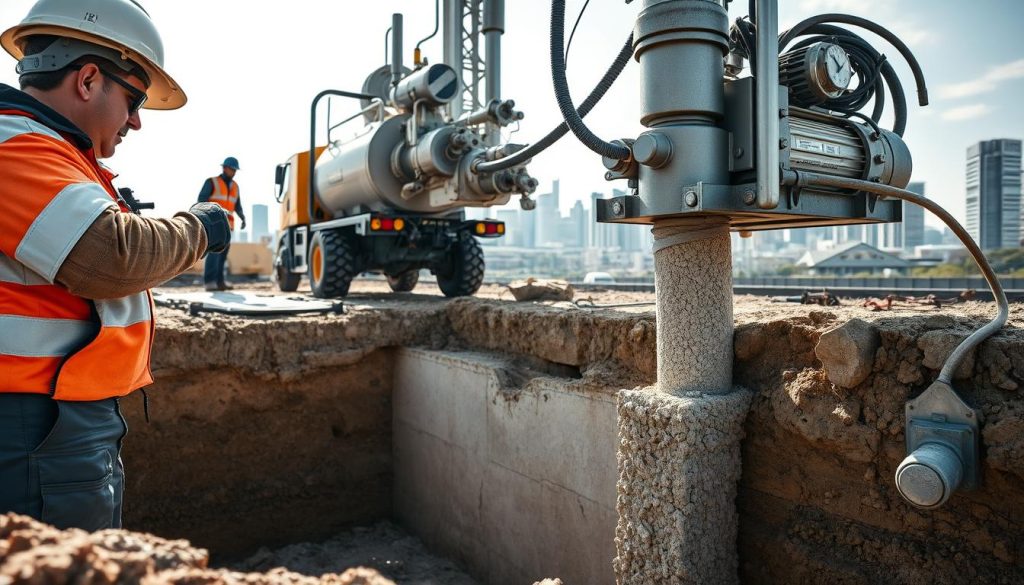
Stabilisation and repair: void filling, settlement mitigation and waterproofing
We stop ongoing settlement and restore contact under footings with controlled void filling.
Our services address floor slumps, footing gaps and damp ingress by improving the treated ground beneath slabs. This reduces washouts and limits further movement.
Closed seepage paths lower permeability and help waterproofing near walls and slabs. Crack control follows, improving the performance of masonry and concrete finishes.
Grouting vs resin injection vs underpinning: choosing the right method
Different methods suit different goals. Resin injection seals fine cracks and gives a fast return to service.
Epoxy and cementitious grout types offer strong adhesion and long-term chemical resistance for repair and bedding. Compaction mixes improve bearing where access is limited.
Concrete underpinning is the right solution when deeper bearing strata are required or footings must be enlarged. We often pair piling or underpinning with grout infill to improve continuity and reduce leakage.
- We select methods based on soil profile, nearby structures and vibration sensitivity.
- Recommendations weigh lifecycle cost, programme and verification testing to prove stability.
| Issue | Best technique | Benefits |
|---|---|---|
| Voids under slab | Grout infill | Restores contact, reduces washouts |
| Fine cracks in concrete | Resin injection | Fast cure, minimal disturbance |
| Insufficient bearing depth | Concrete underpinning | Deeper support, long-term stability |
| High retained heights | Piles with grout infill | Enhanced wall continuity and low-permeability barrier |
Our process, pricing and what to expect on site
We begin every job with a clear, practical inspection that pins down symptoms and likely causes.
Our free no‑obligation assessment reviews photos, visible signs and any past reports you have. We explain the likely issues and the most durable repair options in plain terms.
Following assessment, we outline the process step by step. This covers access needs, plant on site, protection for gardens and finishes, and how we minimise disruption.

- We provide a transparent, fixed‑price quote. The quote lists scope, materials, tests and exclusions.
- Where needed, we coordinate a structural engineering report and manage council‑compliant submissions.
- On site we mark injection points, confirm service locations and protect concrete and timber finishes.
- We monitor pressures and volumes during grouting to verify performance and protect adjacent assets.
- When required, we include concrete repairs to footings, steps and minor slabs in the same programme.
You will receive certification, completion photos and maintenance advice. We are VBA registered and insured. We never upsell unnecessary work. To book a site inspection, book a site inspection, Call Chris: 1300 970 930 or Email Chris: chris@underpinning-melbourne.com.au.
| Stage | What we do | Outcome |
|---|---|---|
| Assessment | Review symptoms, photos and reports | Clear scope and recommended method |
| Quote & reports | Fixed price and engineering coordination | Council‑compliant documentation |
| On‑site works | Set out injection points, protect finishes, monitor volumes | Voids closed, improved stability and waterproofing |
| Handover | Testing, photos, certificates and advice | Verified performance and insurance value |
Conclusion
We deliver engineered repairs that restore safety and long-term stability to homes. Our team blends practical construction know-how with careful testing and independent certification. You get council-compliant outcomes and minimal disruption.
We use targeted injection and grouting where it suits the site, and concrete repairs or underpinning when deeper support is needed. Treatments address weak soil, close voids and improve bearing with durable material.
Book a free assessment for a fixed-price scope you can trust. Find out more about our services. Call Chris: 1300 970 930 or Email Chris: chris@underpinning-melbourne.com.au.