
We explain how sandy soils affect your home’s safety today and what you can do to protect value and livability.
Our team are structural preservation specialists. We use an engineering-first approach to assess risk in this region. We focus on safety, compliance and permanent solutions.
Deep sand in this location behaves very differently to clay. It drains well but can shift under load. That changes load paths and settlement mechanisms beneath houses.
We provide concrete underpinning, restumping and reblocking, resin injection, screw piling, wall crack repairs and engineering reports. We calm concerns with clear advice and VBA-compliant certification.
Book a free, no‑obligation assessment now. Call Chris: 1300 970 930 or Email Chris: chris@underpinning-melbourne.com.au.
Key Takeaways
- Sandy soils in the Sandbelt region need specialist assessment to prevent damage.
- We use engineering-led methods to preserve structures with minimal disruption.
- VBA‑compliant certification protects value and insurability.
- Free structural assessments and fixed‑price quotes are available.
- Call or email Chris to book a site inspection or send photos for review.
What is Melbourne’s Sandbelt and why it matters for your home
Properties between Brighton and Frankston sit on deep, free‑draining sands that behave differently from nearby clay soils. These sands form a triangle that stretches east toward Clayton and Springvale. The location of your property affects footing design and long‑term movement.
From Brighton to Frankston, Clayton and Springvale
The region runs along Port Phillip Bay, then inland to Clayton and Springvale. Sand thickness can reach up to 80 metres in places. We map these boundaries so you can confirm your property’s risk profile.
Sandy loam origins and the Brighton Group explained
The soil here comes from Brighton Group sandstones laid down about 20 million years ago. Later wind and waves shaped those deposits into remnant dunes and sandy loam layers.
- Free‑draining ground: good for runoff but different for footings.
- Climate effects: seasonal moisture cycles change performance.
- Local context: many homes near golf courses sit on similar sandy profiles.
We speak plainly about these conditions and design engineered solutions that match your soil and climate. As VBA‑registered specialists, we provide honest assessments and certified recommendations. Call Chris: 1300 970 930 or Email Chris: chris@underpinning-melbourne.com.au.
Geology 101: Sandy loam to depths of up to 80 metres
Beneath many homes in our region lie layered sands formed by ancient seas and wind. These remnant coastal dunes built up over the last 6,000 years and now form deep bodies of sand in places.
Remnant coastal dunes and prehistoric marine deposition
Prehistoric marine deposition laid fine sand, then wind reworked it into dunes. Over time this produced thick sandy deposits linked to the Brighton Group.
How sand stratification influences load-bearing and settlement
Layered sands vary in density. Denser layers carry load well. Loose lenses can settle more and cause uneven movement.
- Drainage: sandy soil drains quickly, lowering moisture heave risk but increasing settlement potential where compaction is poor.
- Perched water: sand lenses can create local water tables and capillary breaks that affect footings.
- Investigations: we test N-values and density to set safe bearing stresses and design drainage-aware details.
Sandbelt versus Clay Belt: contrasting subsoils across Melbourne
Compared with the heavy clay to the east and north, sand behaves differently under load. Clay swells and holds water. Sand drains and shifts.
| Property | Sandy ground | Clay ground |
|---|---|---|
| Drainage | High — fast percolation | Low — slow runoff |
| Settlement risk | Moderate where loose; manageable with compaction | Low settlement but high heave potential |
| Design focus | Density, N-values, edge drainage | Moisture control and moisture-proof barriers |
| Local clues | Golf courses and remnant dunes | River flats and clay plains |
We simplify geology into practical footing choices. Our designs combine local mapping and site tests so water movement does not undermine edges or cause piping. That gives you a safe, permanent solution.
Drainage, climate and wind: how local conditions affect foundations
Local climate patterns and shoreline winds change how soil behaves under your home. We assess those forces and design to prevent long‑term damage.

Excellent drainage benefits—and hidden risks for footings
Free‑draining sands reduce waterlogging and surface runoff. That is a benefit for most properties.
But fast percolation can wash fines from beneath footings. That increases settlement risk if unmanaged.
Port Phillip Bay winds and seasonal moisture cycles
Coastal wind adds uplift and lateral loads to lightweight structures. Seasonal drying contracts near‑surface sand while heavy rain can move fines and cause local erosion.
Our response: we detail edge isolation, controlled stormwater works and subgrade protection. We specify roof runoff management and connected downpipes to keep footing zones dry.
- Design for durability: compliant site drainage upgrades with structural works.
- Compliance assured: we verify council standards and supply VBA documentation.
- Practical maintenance: simple checks of downpipes and gutters keep engineered outcomes stable.
We focus on safety, compliance and lasting performance so you can relax. Call Chris: 1300 970 930 or Email Chris: chris@underpinning-melbourne.com.au.
Sandbelt identity through golf: what courses teach us about soil performance
Course architects use local sand behaviour to shape firm greens and stable bunkers for consistent play.
Firm, fast fairways and greens show how free‑draining sand sheds water quickly and evenly. That same drainage principle helps us design reliable subgrade details for your home.
Sharp-edged bunkering and firm greens as a drainage analogue
Sharp-edged bunkers keep their shape because well‑prepared sand resists slumping. Greens stay true because of careful compaction and layered subsoils.
These maintenance practices translate to residential work: clear drainage, edge protection and controlled compaction prevent edge softening and settlement.
Royal Melbourne, Kingston Heath and Victoria GC—soil-driven design
Courses such as Royal Melbourne and Kingston Heath exploit sandy loam for fast play and consistent shots. They show how design adapts to local sand behaviour to deliver repeatable results.
- What we learn: firm turf equals firm load transfer; loose lenses cause uneven movement.
- Maintenance insight: subgrade preparation at a golf club mirrors our pad‑level compaction and drainage details.
- Practical outcome: apply these lessons and achieve durable, VBA‑compliant footing solutions for your property.
| Feature | Golf course example | Residential lesson |
|---|---|---|
| Drainage | Fast fairways and greens | Edge drainage and roofwater control |
| Bunkering | Sharp edges, stable profiles | Compaction and subgrade protection |
| Wind effect | Playability shaped by bay winds | Lateral loading and erosion control near edges |
sandbelt melbourne foundations: common structural symptoms we see
Small changes in ground support often show up first as hairline cracks and doors that stick.
Wall cracking, sticking doors and uneven floors
Fine-line cracks by windows and doors usually point to differential settlement in variable-density sand. These cracks may be cosmetic, but they can also mark shifting load paths.
Sticking doors, rippled cornices and uneven floors often mean local loss of support at edges or corners. We check framing and footings to separate causes.
Heave, settlement and differential movement patterns
Heave and settlement produce distinct patterns. Low spots, sloping floors and widening corners tell us where support is changing.
Plumbing leaks, altered landscaping or poor drainage can wash fines and create voids. Those voids speed perimeter settlement if left unchecked.
- Fine-line wall cracking near openings often reflects differential settlement.
- Sticking doors & uneven floors may indicate local loss of edge support.
- Plumbing or stormwater changes can scour subsoil and cause voids.
- We separate cosmetic from structural with calm, engineering-first checks.
- Our reports map movement, explain mechanisms and recommend the least disruptive fix.
| Symptom | Likely cause | Immediate action |
|---|---|---|
| Fine cracks by openings | Differential settlement in sand layers | Site gauge, photo record and targeted probe |
| Doors sticking, uneven floors | Local loss of support at edges or voiding | Local underpinning or targeted stabilisation |
| Corner drop or sloping | Scour from leaks or redirected runoff | Repair plumbing, restore drainage, then assess |
We reassure homeowners with clear diagnostics and no‑upsell guidance. Call Chris: 1300 970 930 or Email Chris: chris@underpinning-melbourne.com.au.
Historic sand mining and landfill sites: geotechnical implications
Old extraction pits and infilled parcels can hide uneven soils that react differently under load.
Sand mining in this region began in the 1880s. Many pits were later used for landfill. That history means filled ground may contain compressible or contaminated materials compared with natural sand or adjacent clay.
Variable fill, consolidation and contamination considerations
Key risks: unpredictable settlement, variable bearing and possible contaminants. We review location history and council records to flag past mining or filling near your site.
Our scopes may include test pits, DCP and geotechnical drilling. These checks confirm bearing conditions and locate transition zones where movement can concentrate.
- Former pits backfilled with mixed material can settle unpredictably.
- Old landfill may need deeper founding or ground improvement and environmental checks.
- We design to bypass poor fill or densify loose layers to avoid future consolidation.
| Issue | Likely effect | Our response |
|---|---|---|
| Variable backfill | Uneven settlement under loads | Targeted testing and bypass or engineered footing |
| Old landfill | Contamination risk and compressible layers | Environmental checks, deeper founding or remediation |
| Sand–clay transition | Concentrated movement at boundaries | Design edge details and subgrade improvement |
We protect your home with due diligence. All works follow council and EPA requirements where contamination is suspected. We document findings and deliver VBA‑compliant certification and clear remediation pathways. For a budget guide, try our cost calculator.
Our mission: calm, engineering-first structural preservation
We centre every job on engineering judgment and a calm, practical process. Our aim is to protect homes and restore certainty for owners today.
Safety, structural integrity and VBA-compliant certification
Safety comes first. We diagnose problems with measured tests and clear reports. Then we design work that lasts.
Compliance matters. All major jobs include VBA‑compliant certification and documented signoff.
- We lead with engineering to diagnose, design and deliver permanent outcomes.
- Your home’s safety and structural integrity come first, backed by VBA certification.
- Our team brings 20+ years’ experience in the sandbelt region and complex courses of work.
- We coordinate structural engineering reports and approvals to streamline the project.
- Transparent, fixed‑price quotes and clear scopes are provided before work begins.
- We minimise disruption, protecting gardens, services and daily routines on site.
- We never upsell; we prescribe only what your home needs to be safe and compliant.
- Book a free structural assessment and get calm, practical guidance now.
| Commitment | What you get | Why it matters |
|---|---|---|
| Engineering-first approach | Site tests, reports and tailored designs | Permanent, certifiable outcomes |
| Experience | 20+ years on local projects | Faster, more accurate diagnosis and delivery |
| Transparency | Fixed-price quotes and clear scopes | No surprises; easier budgeting |
| Compliance | VBA‑compliant certification | Protects value and insurability |
Ready to talk? Contact us or Call Chris: 1300 970 930 or Email Chris: chris@underpinning-melbourne.com.au.
Concrete underpinning tailored for sandy subgrades
Underpinning offers a measured, staged response to ongoing settlement that keeps movement within tight, controllable limits. We design concrete pins and pads to reach competent bearing levels and share loads safely.
When to underpin versus relevel: honest assessments
We choose underpinning over relevel when settlement is active or when bearing capacity is inadequate. Relevel suits one-off, shallow settlements; underpinning suits ongoing movement or deep compromise.
Key practical signs: repeated movement, widening cracks, or loss of edge support. We test bearing and then recommend the least intrusive fix.
Council-compliant methods and minimal disruption on site
Our approach uses sequenced pins to support structure while we grout and cure. This controls deflection during every course of work.
- We extend footings or add pads to reach competent soil or deeper sand layers.
- Shuttering, staged excavation and low‑mobility grouts limit sand inflow during works.
- Edge drainage upgrades often accompany underpinning to stop future piping.
- All methods meet council requirements and carry insurance, warranties and certification.
- We keep sites tidy and work around your schedule to minimise disruption.
| Aspect | Our method | Benefit |
|---|---|---|
| Sequenced pins | Temporary support, staged excavation and grouting | Controlled movement, safe load transfer |
| Sand inflow control | Shuttering and low‑mobility grout | Stable excavation face, reduced loss of fines |
| Drainage | Edge drains and roofwater management | Reduced future erosion and piping |
| Compliance | Council‑approved methods and records | VBA‑compliant certification and marketable warranties |
We deliver council‑compliant underpinning with minimal disruption, backed by insurance and certification. Call Chris: 1300 970 930 or Email Chris.
Restumping and reblocking in Sandbelt suburbs
We stabilise timber and concrete stumped homes with staged, low‑impact work. Our goal is to keep you in the house while we fix support issues.
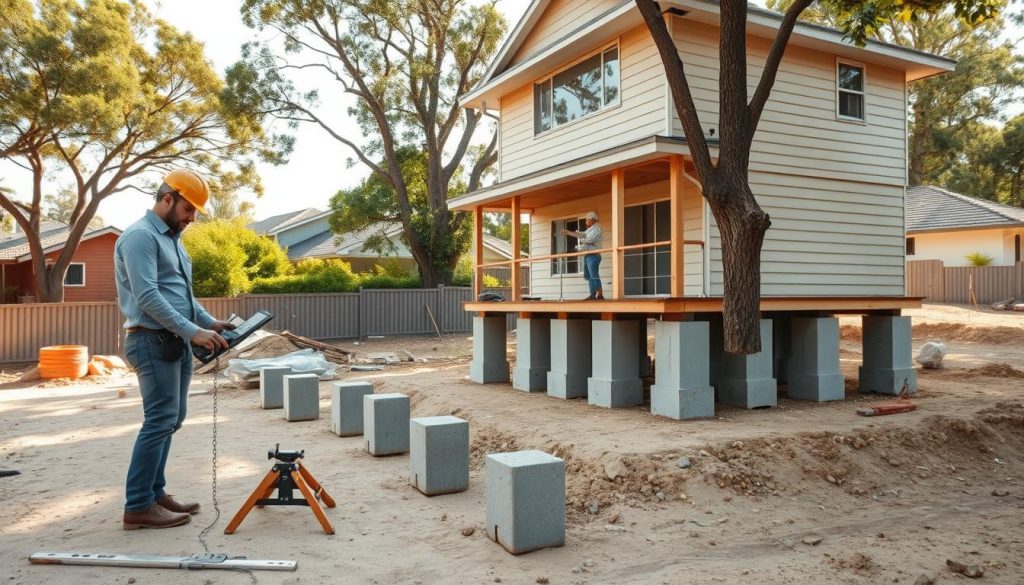
First, we inspect stump condition, bearing in sand and subfloor ventilation. Then we recommend reblocking for isolated failures or restumping when movement is widespread.
Larger pads or collars can spread loads within loose sand and improve long‑term stability. We design details to suit local water table variation near nearby courses, golf course precincts and golf club areas.
- Temporary propping keeps doors, windows and floors aligned during works.
- We renew ant caps, tie‑downs and damp‑proofing to avoid future deterioration.
- Our crew removes spoil cleanly and reinstates access points with care.
- You receive a fixed‑price quote and VBA‑compliant documentation on completion.
For a clear comparison of when to restump rather than underpin, see our guide on restumping vs underpinning. Read about restumping vs underpinning.
| Issue | Typical solution | Benefit | Disruption |
|---|---|---|---|
| Single failed stump | Reblocking and pad replacement | Local repair; cost-effective | Low—short access works |
| Grid-wide movement | Restumping with larger pads or collars | Whole-house alignment and lasting stability | Medium—staged works keep house usable |
| High water table or variable sands | Engineered pads and drainage details | Reduced settlement risk and improved durability | Medium—includes drainage upgrades |
Ready to book? Call Chris: 1300 970 930 or Email Chris: chris@underpinning-melbourne.com.au.
Resin injection for targeted stabilisation and void filling
For small to medium voids, polyurethane resins offer a fast, low‑impact stabilisation option. We use resin to restore bearing and stop progressive settlement without major excavation.
Advantages in free-draining sands
Resin works quickly. It expands to fill cavities and compacts surrounding sand. That delivers uplift and immediate support.
Works are generally spoil‑free and low vibration. This protects gardens and nearby services. It is ideal on tight sites near a golf course or golf club precinct.
Designing for variable sand lenses and water tables
We tailor mixes to site conditions. Designs account for loose lenses, occasional cemented layers and seasonal water table shifts.
In corridors near Kingston Heath and similar course corridors, deep sands often favour piling or combined approaches. We choose resin, screw piles or both where needed.
Testing and certification for peace of mind
We prove capacity. Where required, we verify outcomes with torque checks, static load tests or dynamic verification.
- Screw piles: used when deeper capacity is needed and shallow founding is unreliable.
- Site protection: spoil‑free injection preserves gardens and services.
- Neighbourhood awareness: bunkers and bunkering lines guide access and planning on golf club edges.
- Certification: full engineer sign‑off and as‑built records supplied for council and lenders.
Call Chris: 1300 970 930 or Email Chris: chris@underpinning-melbourne.com.au for a free assessment and an engineered, certifiable solution.
Wall crack repairs and structural engineering reports
We start every repair by measuring movement and tracing the forces behind each crack.
First, we monitor and investigate. That gives us measured data, not guesses.
Then we coordinate an engineering report that explains mechanisms and a clear repair pathway.
Diagnose the cause before prescribing the fix
We focus on cause, not symptoms. Monitoring and targeted probes show whether a crack is active. Reports define movement and list compliant repairs.
- We stabilise first, then repair. Stitching alone fails if movement continues.
- Repairs we use: stitching, repointing, lintel remediation tied to ground works.
- Reports often point to poor drainage and variable sand layers near local golf courses and golf club precincts.
You receive a staged plan. It balances risk, budget and compliance. We set timelines and explain what happens day by day.
| Stage | Action | Outcome |
|---|---|---|
| Investigation | Monitoring, probes, engineer report | Clear cause and risk rating |
| Stabilisation | Temporary propping, targeted underpin or resin | Movement arrested and capacity restored |
| Repair | Stitching, repointing, lintel works tied to footing remedial | Durable cosmetic and structural repair |
| Certification | Engineer sign-off and as-built records | VBA‑compliant documentation for lenders and council |
Practical local insight: We reference nearby courses and the wider region to explain why problems appear where they do. That helps you understand the fix and trust the outcome.
Call Chris: 1300 970 930 or Email Chris: chris@underpinning-melbourne.com.au for a free assessment and engineer-led repair plan.
Why choose Underpinning Melbourne in the Sandbelt region
Clients pick us because we deliver permanent, engineered fixes without drama. We aim to protect your home and its value with clear, council‑compliant work.

20+ years’ experience, fully VBA Registered and insured
More than two decades of local experience guides every decision. We are VBA registered and carry full insurance for your protection.
Engineer-led testing, reports and certification come standard with our work.
No upselling—transparent, fixed-price quotes
We provide clear scopes and fixed prices. You get no surprises and no pressure to buy extras.
- We manage reports, permits and inspections for you.
- Council‑compliant methods and documented sign‑off.
- Local knowledge near golf club and country club precincts informs our designs.
| Feature | Benefit | Why it matters |
|---|---|---|
| VBA registration & insurance | Certified, secure delivery | Protects value and lender requirements |
| 20+ years local work | Efficient, proven methods | Reduced risk and faster outcomes |
| Fixed‑price quotes | Budget certainty | No hidden costs |
Choose the structural preservation specialists trusted across the region. Call Chris: 1300 970 930 or Email Chris: chris@underpinning-melbourne.com.au.
Service area and notable Sandbelt locations
From bayside streets to inland corridors, we know where sandy profiles influence house performance.
We serve Brighton, Mentone, Black Rock, Cheltenham, Heatherton, Mordialloc, Frankston and Clayton South. That local coverage helps us spot likely causes fast and act with confidence.
From Brighton, Mentone and Black Rock to Frankston and Clayton South
Homes beside golf club precincts share similar free‑draining soil and coastal wind exposure. We assess each site on its own merits.
Country club settings often map to remnant dunes. Valley golf corridors near waterways can show higher water tables and variable sand density.
Near world-class courses: Royal Melbourne, Kingston Heath, Metropolitan
World‑class courses such as Royal Melbourne, Kingston Heath and Metropolitan reveal how deep sands behave.
Observed bunkers and local bunkering styles give clues about subsoil. We use those cues in our probes and test pits.
- Local suburbs: Brighton, Mentone, Black Rock, Cheltenham, Heatherton, Mordialloc, Frankston, Clayton South.
- Golf club precincts: similar sandy profiles guide our designs.
- Coastal wind: we plan bracing, connections and serviceability limits accordingly.
- Valley golf corridors: expect different water tables and adapt methods suburb by suburb.
| Feature | What we observe | How we respond |
|---|---|---|
| Bunkers / bunkering | Sharp edges, well‑drained profiles | Targeted probes and edge drainage details |
| Country club terrains | Remnant dunes near homes | Geomorphic mapping and pad design adjustments |
| Valley golf corridors | Higher local water table | Deeper founding or subgrade improvement |
Our local knowledge helps us anticipate likely shots at issues such as edge erosion or voiding before they escalate. For a free assessment, Call Chris: 1300 970 930 or Email Chris: chris@underpinning-melbourne.com.au.
Free structural assessment and how to book today
Start with a free, engineer-led assessment to know exactly what your home needs. We give clear, no‑obligation advice and outline a compliant plan you can trust.
Call Chris on 1300 970 930 or email chris@underpinning-melbourne.com.au
Call for immediate support or to book a site inspection. We offer flexible times, including outside normal hours when needed.
Book a site inspection or email photos for swift advice
If you prefer fast feedback, email clear photos and the property address. We review symptoms, drainage and wind exposure and reply with practical next steps.
- Free, no‑obligation assessment tailored to your location and soil conditions.
- We check symptoms, drainage and nearby courses or golf club precincts that can affect risk.
- Transparent, fixed‑price quotes with scope, staging and certification details.
- Quick photo reviews give initial guidance before a site visit.
- We schedule site inspections promptly and coordinate access where needed.
Your peace of mind starts with one call. Call Chris: 1300 970 930 or Email Chris: chris@underpinning-melbourne.com.au for fast, certified support and a clear plan.
Conclusion
We deliver clear, engineered answers so you can act with confidence. Our work stops small movement from becoming costly failure.
The sandbelt courses and world‑class golf examples inform every detail we design. That local insight, paired with 20+ years’ practice and VBA registration, gives durable, drainage‑aware solutions across the region.
We protect your home’s safety, value and compliance with measured tests, fixed prices and certified sign‑off. Book a free assessment and receive a transparent plan you can rely on.
Underpinning specialists — Call Chris: 1300 970 930 or Email Chris: chris@underpinning-melbourne.com.au.