
We protect your foundation before any cut begins by offering engineered solutions that keep your home safe during planned excavation.
We are Underpinning Melbourne, Structural Preservation Specialists. Our team delivers VBA‑compliant methods, fixed-price quotes and coordinated engineering reports to give you certainty.
Reactive clay and poor drainage can cause heave or settlement. We assess soil, monitor levels and recommend concrete, pier or modern resin solutions to suit the building and the project scope.
Our process is staged to limit disruption, protect utilities and maintain access in tight inner‑suburb sites. We provide free, no‑obligation structural assessments and clear timeframes before any work begins.
Start now: Call Chris: 1300 970 930 or Email Chris: chris@underpinning-melbourne.com.au.
Key Takeaways
- We secure your foundation with VBA‑compliant solutions and engineering oversight.
- Free structural assessment and fixed‑price quote before the project starts.
- Resin, concrete or pier methods chosen to match soil and building needs.
- Work staged to reduce disruption and protect utilities on tight sites.
- Clear certification and council‑ready documentation provided on completion.
Specialist underpinning for safe basement excavation in Melbourne
Our team protects your home’s structure with council‑compliant, VBA‑registered methods. We bring 20+ years’ experience and insured services to every project.
We start with a free structural assessment and a transparent, fixed‑price quote. Early intervention lowers risk where adjoining cuts may affect footings.
We coordinate engineering reports, moisture tracking and soil testing. This helps select the right method and keeps your foundation stable during the work.
- Council‑ready documentation and VBA registration.
- Clear timing, staged works and tidy site management.
- Real‑time monitoring and movement limits explained to you.
| Service | What we do | Benefit |
|---|---|---|
| Free assessment | Site inspection, moisture map, report | Budget certainty and early risk ID |
| Fixed‑price quote | Defined scope and inclusions | No surprise costs |
| Engineering coordination | Design mark‑ups and compliance checks | Smooth approval and safe works |
Watch for early signs such as sticky windows or new cracking. Call us early and we will respond quickly.
Call Chris: 1300 970 930 or Email Chris: chris@underpinning-melbourne.com.au.
When do you need underpinning for basement excavation Melbourne
Identifying risk early keeps your house safe during nearby digs and deeper site works. We inspect promptly when you spot change. Early action limits damage and cost.
Common triggers include an adjoining cut that reaches below your footing, deeper digs that take support from edge beams, reactive clay shrink‑swell and leaking pipes that wash away bearing soil.
Common triggers: neighbouring cuts, deeper digs and undermined footings
- You may need underpinning when a neighbouring excavation loosens supporting soil beneath footings.
- Deeper digs can undermine edge beams unless works are staged and supported.
- Reactive clay movement and poor drainage often start new cracks in walls and skirting lines.
Early warning signs: cracked walls, sticking doors and windows, uneven floors
Telltale signs include fresh cracks in walls, sticking doors and windows and sloping or uneven floors. These signal subsidence or loss of support.
| Trigger | Signs | Immediate action |
|---|---|---|
| Adjoining excavation below footing | New cracks, gaps at cornices | Inspect, set monitoring points, shore footings |
| Reactive clay and moisture change | Doors jam, uneven floors | Moisture mapping, stabilise soil |
| Poor drainage or leaks | Local settlement, soft spots | Repair services, strengthen bearing soil |
| Construction vibration or heavy loads | Progressive movement, widening cracks | Restrict loads, monitor and brace |
We reassure anxious homeowners by identifying risks early and offering practical, engineered options that suit the house and property constraints. We also brief your builder so sequencing protects your home while the cut advances in safe stages.
Engineering-led underpinning methods for basement projects
Our engineering-led approach matches method to risk and site limits. We aim to keep your foundations stable with minimal disruption. Every plan is VBA‑compliant and staged to precede each cut.
Core services include concrete underpinning, resin injection and screw piling. Each method targets specific ground and load needs.
- Concrete underpinning: increases footing depth and bearing capacity where deeper support is required.
- Pier systems: transfer loads to competent strata for much greater depths and variable ground.
- Resin injection: small 16 mm holes inject a two‑part expanding resin to fill voids, densify clay and control lift with survey monitoring.
- Screw piling: ideal where access is tight, headroom is limited or spoil removal must be minimised.
We choose solutions based on soil conditions, excavation depth and structural load paths. We monitor levels continuously and adjust sequence, pitch or spacing to protect your home. We certify the installed solution so your builder can proceed without delay. See our cost estimator to plan the work.
Ground and site conditions that influence the right solution
Choosing the right method starts with a clear read of soil, water and load paths on site.
Reactive clay can swell when wet and shrink in drought. This movement causes heave or subsidence that stresses your foundation.
Poor drainage, flooding or leaking services can wash fines and create voids beneath footings. Adjoining cuts below a footing edge also loosen bearing soil and trigger settlement issues.
We test soil and map moisture to predict seasonal movement. Ground stiffness and depth to competent strata guide which solution and spacing we propose.

Practical checks that shape the plan
- Access, headroom and nearby structures limit equipment and influence method choice.
- We analyse load paths to find where the building is most sensitive.
- We confirm services with drawings and GPR to avoid strikes during works.
| Risk | What we do | Outcome |
|---|---|---|
| Reactive clay | Moisture mapping and targeted stabilisation | Reduced seasonal movement |
| Water leaks / poor drainage | Repair advice and soil densification | Void removal and restored support |
| Adjoining excavation | Shore, stage cuts and monitor levels | Protected foundation and house safety |
We document conditions and controls. This gives your property and builder a clear risk plan before works start. Call Chris: 1300 970 930 or Email Chris: chris@underpinning-melbourne.com.au.
Our underpinning process for basement excavation, step by step
We follow a clear, step-by-step process that keeps your foundation stable while nearby works progress. Our approach is calm, engineered and staged to minimise disruption to your home.
What we do first is a site assessment with soil testing and moisture mapping. This diagnosis shows the cause of movement and sets safe limits for levels.
Design and mark-out to protect services
We provide a fixed-price quote with scope and sequence. Locations are surveyed and checked with GPR to avoid water, gas, power and data lines.
Installation with continuous monitoring
During the job we drill, inject resin through 16 mm ports or install screw piles depending on the foundation need. Survey gear monitors lift and level changes in real time.
Quality checks and handover
We regrout or cap ports, carry out re-levelling and perform final quality checks. The work area is left tidy. We document levels, materials and test results for certification and council compliance.
- Calm, documented process from assessment to handover.
- Continuous level monitoring keeps the job within safety limits.
- Clear certification and guidance for the next excavation stage.
See also our notes on restumping vs underpinning tool. Call Chris: 1300 970 930 or Email Chris: chris@underpinning-melbourne.com.au.
Council and VBA compliance, safety and certification
We pair technical evidence with practical safety plans so your builder can proceed with confidence.
We are fully VBA registered and insured. Our team prepares council‑compliant documentation that clearly records assessment findings and methods. This gives you a traceable record of care and quality.

Documentation includes investigation reports, GPR clearances, method statements, level surveys and completion records. We submit these to council and your engineer so approvals run smoothly.
- Submission-ready documents for council and the certifier.
- Recorded foundation condition, service clearances and level benchmarks.
- Site-specific safety controls and operational method statements.
| Document | What it shows | Benefit |
|---|---|---|
| Investigation report | Soil, structure and assessment results | Clear diagnosis to guide the project |
| GPR & service clearance | Subsurface services and safe drill lines | Reduces risk of service strikes |
| Method statement & safety plan | Work sequence, controls and public protection | Ensures safe, auditable site practices |
| Completion records & certification | Level surveys, materials and test outcomes | Proof of quality for resale and warranty |
We coordinate with your builder, certifier and engineer. Communication is clear so everyone knows when excavation can safely proceed. Call Chris: 1300 970 930 or Email Chris: chris@underpinning-melbourne.com.au.
Transparent pricing factors and how we keep costs controlled
We give clear cost guidance and a fixed-price quote so you know what the job will cost before work begins.
Costs depend on the extent of works, the size of the building and access constraints. Ground and soil conditions also shape the scope. We list typical ranges to help you plan:
- Minor: $5,000–$10,000 — small, local repairs.
- Moderate: $10,000–$30,000+ — larger residential jobs.
- Commercial: $30,000–$100,000+ — complex projects and sites.
What drives cost: extent of works, structure size, materials and access
We explain the quote clearly. Price links to scope, access and material choice. Concrete volumes, pier count or resin quantities scale with load and soil needs.
Access limits and inner-city logistics can raise time on site and labour. We check services with GPR to avoid variations. This reduces the chance of extra costs later.
Minimising disruption: non-invasive options where suitable
We aim to limit disruption. Where conditions allow, we use non-invasive services and staged works to control cost and time.
- We stage with your basement program to keep the job efficient.
- We design to fix the root issues so the property avoids repeat works.
- We include allowances for uneven floors and cracks rectification after re-levelling.
- Before mobilisation we provide a fixed-price quote with an inclusions schedule.
Call Chris: 1300 970 930 or Email Chris: chris@underpinning-melbourne.com.au. See our fixed-price quote process and scope examples.
Why choose Underpinning Melbourne for your basement project
You can rely on experienced practitioners who manage monitoring and sequencing to reduce risk to your home. We are VBA registered and fully insured. Our team brings over 20 years’ experience and local knowledge.
We give honest assessments and no upsell. We only recommend the work your house needs. That keeps costs clear and avoids needless disruption.
End-to-end support means we coordinate engineering reports, design checks and council sign-off. We also handle repairs after re-levelling so walls and finishes are addressed.
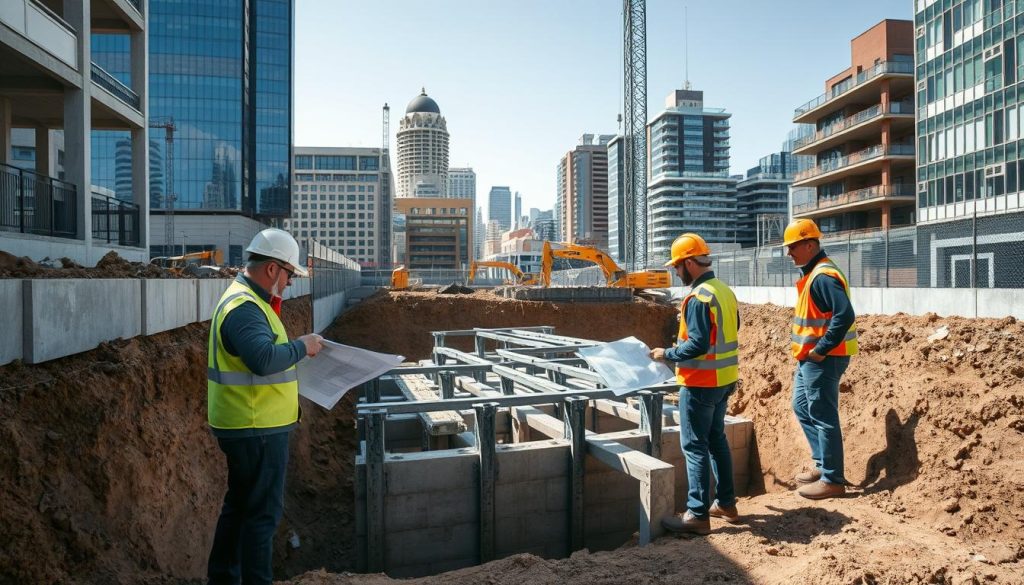
What our team delivers
- Deep experience with reactive soils and tight-access inner‑city sites.
- Clear communication about movement tolerances and monitoring checks.
- Integration with your builder so excavation work proceeds safely and efficiently.
- Fast response if doors bind or new movement appears during nearby work.
- Documentation that supports resale, insurance and compliance.
| Benefit | What we do | Outcome |
|---|---|---|
| Trusted advice | Honest assessment and fixed quote | Cost certainty and no upsell |
| Technical oversight | Engineering reports and survey monitoring | Safe sequencing and council sign-off |
| Finish repairs | Follow-on repair and re-levelling works | House restored and habitable |
| Local specialists | Melbourne geology and heritage experience | Solutions that suit your property |
Call Chris: 1300 970 930 or Email Chris: chris@underpinning-melbourne.com.au.
Related structural preservation services for your project
We deliver coordinated repair and finish work that returns your house to safe, everyday use. After re-levelling we sequence fixes to limit disruption and protect finishes. You get clear reports and a tidy site.
Wall crack repairs and damp-proofing post re-levelling
Many cracks close after levels are corrected. Where they do not, we use resin crack injections and targeted damp-proofing. This stops leaks and restores presentation.
Restumping and reblocking for timber-floor homes
We replace failing stumps and reblock to lift timber floors to the correct level. This stabilises the structure and improves ventilation under the floor.
- We complete wall crack repairs after re-levelling, including resin injection and damp-proofing where needed.
- We offer restumping and reblocking to stabilise timber floors and restore correct levels.
- We assess residual issues, check subfloor drainage and sequence repairs to protect services and finishes.
- We provide structural engineering reports when lenders, insurers or council require documentation.
| Core service | Benefit | Outcome |
|---|---|---|
| Wall crack repair | Seals cracks and prevents moisture | Walls restored and dry |
| Restumping / reblocking | Stabilises timber floors | Floors level and firm |
| Engineering reports | Compliance and assurance | Paperwork for council or lenders |
Our team coordinates with painters and plasterers to close out the job. We keep you informed daily so your home and property return to normal quickly. Call Chris: 1300 970 930 or Email Chris: chris@underpinning-melbourne.com.au.
Conclusion
Our approach focuses on measured interventions that preserve structural stability and property value.
We restore safety and peace of mind through engineered solutions. Early assessment pins down soil conditions, signs of movement and any foundation issues.
Our team delivers a clear process that protects your home and property during the project. We use concrete, piling or resin where the job needs them and we monitor level changes at every stage.
We complete repairs after re-levelling, so floors, walls and doors present and work as they should. You get documentation that proves performance and supports compliance and resale.
Book a free assessment and a fixed-price quote now. Call Chris: 1300 970 930 or Email Chris: chris@underpinning-melbourne.com.au.