
We help you plan your extension with confidence. If you need a clear, engineering‑led solution to protect your foundation and building, we provide certified work and fixed‑price clarity.
We assess your foundation early so your addition stands on firm ground. Our team specialises in concrete pins, screw piles and resin injection tailored to site and soil conditions.
We prioritise safety and VBA‑compliant certification. You receive a calm, technical plan and a written quote after a free, no‑obligation structural assessment.
Speak to a specialist today. Call Chris: 1300 970 930 or Email Chris: chris@underpinning-melbourne.com.au.
Need a quick estimate? Use our underpinning cost calculator to gauge likely prices and prepare plans and photos for a fast, precise quote.
Key Takeaways
- We secure your foundation early so your extension rests on stable ground.
- Engineering‑led plans, VBA documentation and fixed‑price quotes give peace of mind.
- Options include concrete pins, screw piles and resin suited to local soil.
- Free, no‑obligation structural assessments speed up accurate quoting.
- Call Chris on 1300 970 930 or email chris@underpinning-melbourne.com.au to book a site inspection.
Safe, VBA‑compliant underpinning for extensions in Melbourne
Noticing uneven floors or sticking doors? These are early warning signs worth acting on.
Our mission is to save local homes from foundation failure with minimal disruption. We are VBA‑registered and fully insured. We stage work to keep your house liveable while protecting its structural integrity.
Our mission: structural integrity without disruption
Small cracks, jamming doors and gaps at skirting often point to deeper movement. Early intervention stops issues escalating and preserves your building value.
Free structural assessments and fixed‑price quotes
We inspect soil and site conditions before recommending any method. You receive a clear foundation report and a fixed‑price quote with no surprises.
- Engineering‑checked plans to safeguard your extension.
- VBA‑registered practice and insured delivery for certainty.
- We organise permits and inspections to keep work compliant and smooth.
- Clear communication from our team throughout the project.
Call Chris: 1300 970 930 or Email chris@underpinning-melbourne.com.au for a free, no‑obligation assessment.
Why extensions often need underpinning
Adding new rooms changes how loads travel through an existing footing. This alters stress patterns across the base of a building and can reveal weak spots in the original design.
New loads on existing foundations
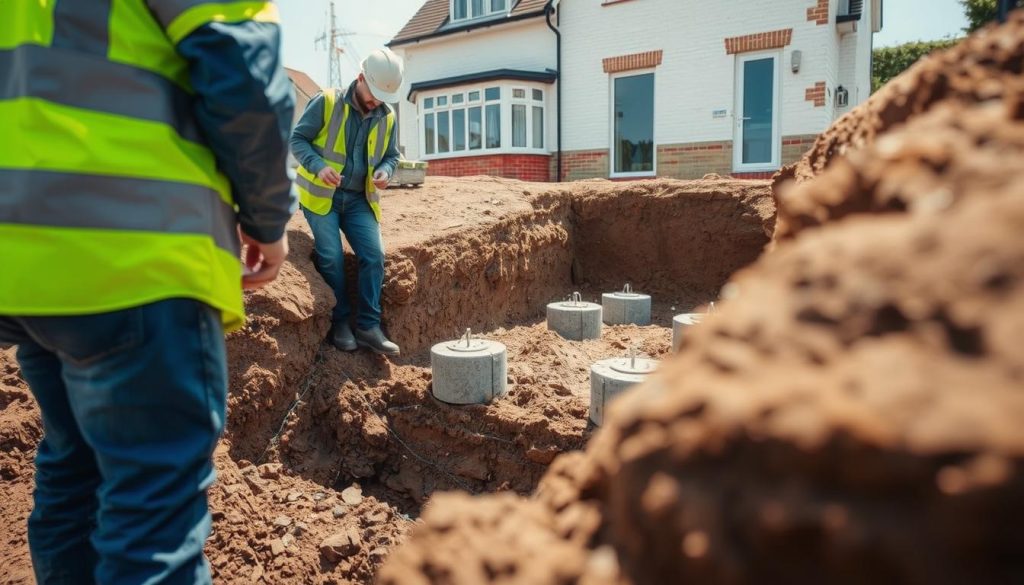
Extensions add weight that older footings were not designed to carry. Concentrated loads from upper storeys or large openings can create shear and rotation. We check the existing foundation for capacity and bearing depth before any work begins.
Reactive clay and changing soil conditions
Local clay can shrink and swell as moisture changes. Those movements lead to settlement and foundation problems if left unmanaged.
We investigate soil and groundwater to understand site behaviour. This test data guides our structural approach.
Tying in new slabs and footings to an existing foundation
Tying a new slab to an old footing needs careful detail. Poor connection causes differential movement between the house and the new area.
Underpinning transfers loads to stable layers so settlement is controlled. Our report outlines the risks and the recommended method to protect your building.
underpinning for extensions melbourne: what we deliver
We deliver engineered foundation work that restores long‑term stability to your building.
Concrete underpinning for depth and bearing capacity
Mass concrete increases foundation depth and bearing. We place staged pits and high‑strength concrete to create reliable capacity.
Result: predictable load transfer and a durable base that suits new building loads.
Screw piling and pier solutions for difficult ground
Piers and screw piles suit deep or variable soil where concrete pits are impractical.
Steel piles reach competent strata and provide near‑immediate load transfer with minimal excavation.
Resin injection for localised voids and slab lifting
Resin closes voids beneath slabs and can assist with modest re‑levelling.
We advise when resin is suitable and when structural methods are required.
Restumping and reblocking when stumps are the weak link
Restumping replaces failing stumps to restore level and support. Reblocking upgrades foundations to meet current materials and design life.
- Concrete underpinning increases depth and bearing for reliable capacity.
- Piers, screw piles and steel piles suit deep or variable soil conditions.
- Resin injection treats localised voids and can aid slab lifting.
- Restumping restores support where stumps have failed.
- All methods are engineered, documented and council‑compliant.
| Service | When used | Key benefit | Typical result |
|---|---|---|---|
| Concrete underpinning | Shallow to medium depth, poor bearing | Increases depth and bearing capacity | Stable foundations for new building loads |
| Screw piling / Piers | Deep or variable soil | Transfers load to competent strata | Immediate load path, less excavation |
| Resin injection | Localised voids under slab | Void fill and slab lift | Quick, minimally invasive levelling |
| Restumping & Reblocking | Failing stumps or timber decay | Restores support and level | Safe, code‑compliant subfloor support |
We select materials to suit exposure and design life. Our work is sequenced to protect existing foundations and maintain site stability.
Clear signs your home needs support before you build
Small changes in door operation or new wall cracks often signal deeper ground movement beneath your property.

We help anxious homeowners spot early warning signs and act before new works start. Early checks save time and limit property damage.
Cracks in walls, sticking doors and uneven floors
New or widening cracks in walls can point to movement below the foundation. Sticking doors and windows show frames are out of square.
Uneven floors or sudden dips often mean settlement at supports. Gaps at ceilings and cornices are classic signs of differential movement.
Subsidence, leaks around foundations and gaps at ceilings
- Leaks or pooling water near footings can soften supporting soil.
- External brick or stepped cracks usually mark emerging foundation issues.
- A tilting house line or sloping floors confirms subsidence risk.
Early action limits damage. We inspect, measure and photograph walls and floors to track change. Book a free assessment before you build to protect the new works. Call Chris: 1300 970 930 or Email Chris: chris@underpinning-melbourne.com.au.
| Sign | What it suggests | Immediate action |
|---|---|---|
| New wall cracks | Soil movement or settlement | Record and book an assessment |
| Sticking doors/windows | Frames out of square | Measure gaps and monitor over weeks |
| Uneven floors / dips | Support failure or subsidence | Photograph and arrange a site inspection |
| Water near footings | Soil weakening (reactive clay risk) | Fix drainage and inspect immediately |
Our engineering‑led underpinning process for extensions
A thorough site inspection and structural assessment sets the direction for every safe foundation repair.
We begin with a site inspection and a structural assessment of the foundation. Ground engineering tests confirm soil behaviour and bearing capacity. These steps identify risk and prevent further damage.
Method selection and staged works
We review data and select the best method: mass concrete, piers or screw piles. Mass concrete suits shallow repairs. Piers and screw piles reach deeper competent strata.
Safe sequencing and temporary support
Staged excavations maintain stability while we transfer loads. Temporary propping and monitoring protect walls and the wider structure. This approach keeps your house safe and liveable.
Re‑levelling, repairs and quality assurance
Once stable, we re‑level where needed and repair wall cracks. QA checks verify concrete strength, pile torque and as‑built positions.
Engineering reports and certification document every step. Our team coordinates reports and council paperwork to save time and ensure compliance.
To book a site inspection, contact us and speak with our team.
Compliance, permits and certification handled for you
We manage permits and paperwork so your project meets council rules without delay. You stay informed while we organise the technical and regulatory steps that your build needs.

VBA‑registered, insured and council‑compliant methods
We are VBA‑registered and fully insured. That means approved methods and safe delivery for any structural work you require.
Our team prepares permit forms and liaises with your council or surveyor. We handle inspection bookings to avoid delays and rework.
- We prepare permit documentation and manage lodgement.
- VBA registration ensures approved procedures and oversight.
- Insurance is held to match the building class and scope.
- One point of contact keeps updates simple and clear.
Structural engineering reports and certification
We coordinate engineers and provide the reports you need for sign‑off. You receive as‑built records and compliance certificates at project completion.
| Document | Prepared by | Why it matters | When delivered |
|---|---|---|---|
| Permit documentation | Our team with your surveyor | Allows lawful work and avoids council rejection | Before work starts |
| Structural engineering report | Registered structural engineer | Defines required works and safe load paths for the foundation | With the quote and before construction |
| Inspection records | Inspector / Site supervisor | Proof of compliance during staged works | Throughout works as scheduled |
| As‑built certificates | Engineer & our team | Needed for sale, insurance and council final sign‑off | At practical completion |
We reduce risk and keep your project on schedule. Call Chris: 1300 970 930 or Email Chris: chris@underpinning-melbourne.com.au.
Costs and factors that influence your underpinning project
The cost of stabilising a foundation varies. We explain the drivers so you can budget with confidence.
Extent of foundation problems and building complexity
The scope depends on how severe the damage is and the building size. Small local repairs cost far less than works that span multiple bays or levels.
We separate stabilisation from cosmetic repairs so you see true value in the quote.
Access constraints, location and materials used
Tight sites, inner‑city access and difficult delivery paths increase labour and time. The chosen materials — concrete, steel piles or resin — also affect the budget.
We factor soil conditions and groundwater into design and price. Ground testing often defines the method.
Typical ranges: minor to commercial‑scale works
- Minor jobs: $5,000–$10,000.
- Moderate works: $10,000–$30,000+.
- Commercial or complex projects: $30,000–$100,000+.
Key practical points:
- Scope depends on foundation issues and building complexity.
- Access limits and staging can add time and labour to the job.
- The method and materials influence final cost and time.
- We provide a detailed scope, inclusions and exclusions with every quote.
We provide transparent fixed‑price quotes and explain cost drivers in advance. Book a free assessment to receive a tailored solution and a written price. Call Chris: 1300 970 930 or Email Chris.
Integrated foundation solutions for long‑term stability
A coordinated approach to foundations and subfloor works prevents future movement. We combine structural repairs and timber work so the whole building performs as one.
Underpinning plus restumping for mixed foundations
Restumping replaces deteriorated stumps with concrete or steel to restore level floors and reliable support. Many houses have mixed supports, so we combine pit work and stump replacement to give uniform load paths.
We align new and old foundations and stumps so each element shares load. That reduces differential movement and limits future damage.
Water management and drainage to protect your investment
Moisture control is the most effective defence against reactive soils. We target water sources first and fix downpipes, grading and drainage to cut moisture swings.
- Replace stumps with durable materials to improve long‑term support.
- Drainage, downpipes and garden grading reduce soil movement.
- We specify simple maintenance owners can follow to protect their property.
Result: coordinated solutions that protect homes, limit damage and preserve value.
Why choose Underpinning Melbourne for your extension
Our team delivers clear, no‑nonsense advice so your building project runs on a stable foundation.
With 20+ years of experience we offer honest assessments and no upselling. We are VBA‑registered and fully insured. You get practical guidance on what your property needs and why.
We minimise disruption and keep tidy worksites. Our crew plans work to protect floors, walls and doors while we operate. Reliable timelines mean less time on site and fewer surprises.
What you can expect
- Free assessments and fixed‑price quotes so you can budget with confidence.
- Clear reports and coordinated engineering paperwork to speed permits and inspections.
- We integrate restumping and added stumps where level and support are needed.
- Quality materials, concrete work where required, and workmanship that keeps walls straight.
- One team that manages the job from inspection to final certificate.
Talk to us
If you need underpinning, we explain the solution in plain terms and give a written quote. Call Chris: 1300 970 930 or Email Chris: chris@underpinning-melbourne.com.au.
Learn more about how restumping compares to other methods via our guide: restumping vs other options.
Conclusion
A strong, engineered foundation stops minor movement becoming major damage.
We restore safety and peace of mind with clear, engineered solutions. Our team matches method to soil and structure, using concrete and restumping where they suit your needs.
Watch for signs such as cracks, sticking doors and out-of-level floors. Control water near footings to reduce ongoing movement and further damage.
Act early. Early intervention limits repair cost and protects your building and property value.
Book a free structural assessment and fixed‑price quote. Call Chris: 1300 970 930 or Email Chris. Send plans or photos to fast‑track advice and scope the job quickly.