
We provide safe, council‑compliant underpinning near shared walls and tight access that protects your house and neighbour’s structure.
We are Underpinning Melbourne. Our mission is to save homes from foundation failure with calm, engineering-focused solutions. The work we do targets the foundation first so the fix lasts, not just the surface.
Our VBA-registered team has over 20 years of experience. We use concrete underpinning, resin injection and screw piling so the chosen method suits the soil and site constraints.
Typical signs you may need help include cracked brickwork, sinking floors or jammed doors. We offer a free structural assessment, levels check and a fixed-price quote before any work starts.
We coordinate engineering reports, council documentation and provide certification on completion. Call Chris: 1300 970 930 or Email Chris: chris@underpinning-melbourne.com.au.
Key Takeaways
- Safety and compliance: VBA-registered team and council-ready documentation.
- Foundation-first focus: Lasting stability over cosmetic patches.
- Minimal disruption: Resin injection and targeted methods reduce time on site.
- Clear costs: Free assessment and fixed-price scope before work begins.
- Certified results: Completion certificates protect your property value.
Safe underpinning at boundaries and party walls in Melbourne homes
When two buildings share a wall, we treat the foundations as an interlinked system. That approach keeps your house stable while protecting the neighbour’s structure.
Why boundary and shared-wall foundations demand a different approach
Loads are often shared and access is limited at party walls. This changes how footings behave and increases the risk of transferred movement.
We assess soil and ground conditions at the block edge. Erosion, services and tight access inform a conservative plan.
Keeping your property stable while protecting neighbours and structures
We use non-invasive ground improvement and fast-curing solutions to reduce disturbance. Continuous monitoring limits wall movement and possible damage.
- Conservative staging: protect masonry and wall ties with careful lift limits.
- Neighbour communication: clear documentation and monitoring for peace of mind.
- Compliance focus: permits, council and VBA-aligned certification from start to finish.
Our service combines protection and expert guidance so you get clear answers on issues, timing and the safest way forward.
underpinning near boundary melbourne
When space is limited, we choose solutions that keep your foundations stable and disruption low.
Council and VBA-compliant methods for tight access and zero-lot lines
We promise council‑compliant methods, minimal disruption and honest assessments. Our process starts with engineering sign‑off and council approvals.
On tight sites we favour low‑excavation methods. Small drill points let us inject expanding resin to strengthen soils and re‑level a house.
Party walls, easements and neighbour agreements — what to know
We review titles and easements before work starts. Where party walls or encroachments exist, we prepare neighbour agreements and clear scopes.
Clear communication protects relationships and reduces delays. We stage works to limit movement along shared walls and fence lines.

Working near services: gas, water, stormwater and sewer
We map utilities with GPR and service locating to reduce strike risk. Our experts stage drilling and set lift limits.
Monitoring levels during the works keeps outcomes within tolerance. Structural documentation is provided on completion for your records.
- Right methods: resin injection and traditional concrete where needed.
- Safe site work: GPR scanning, careful staging and real‑time monitoring.
- Compliance: council approvals, VBA requirements and engineering sign‑off.
| Method | Best use | Impact on neighbours |
|---|---|---|
| Resin injection | Low‑access sites; soil strengthening and re‑levelling | Low spoil, fast cure, minimal disruption |
| Concrete | Mass support where deeper or heavier loads exist | More excavation; staged to protect adjacent walls |
| Site services & process | GPR locating and engineering monitoring | Risk reduced by planning and neighbour agreements |
What causes foundation problems at boundaries and shared walls
Boundary gardens and fence lines often hide the early causes of foundation movement. Small changes in moisture and nearby excavations can start slow movement that affects footings and slabs.
Reactive clay soils: drought, rain cycles and tree roots
Reactive clay swells in wet periods and shrinks in drought. This cycle places repeated stress on a foundation and on edges of a wall.
Large trees or shrubs at the fence line change local ground moisture. That can cause localised settlement under footings and slabs.
Poor drainage, leaking pipes and erosion along fence lines
Leaking stormwater or sewer lines wash fine particles from the soil. Voids form and the slab can settle into them.
Poor surface drainage concentrates water at the edge. That increases movement risk and long‑term damage to adjacent properties.
Adjacent works and undermining from nearby excavation
If an adjoining cut breaches the footing level, support can be lost. Underpinning may be required after a full assessment.
- Signs include new cracks, sticky doors and uneven floors.
- Early assessment identifies the root problem before repair.
- Preventative steps: control drainage, remove problematic vegetation and check services regularly.
We design targeted works so your house returns to safe, predictable behaviour and your property retains value.
Our boundary-friendly underpinning solutions
Each job starts with an engineered plan that prioritises safety, monitoring and clear outcomes. We offer multiple methods so your house gets fit‑for‑purpose support with minimal disruption.
Resin injection: minimal excavation, fast curing, low disruption
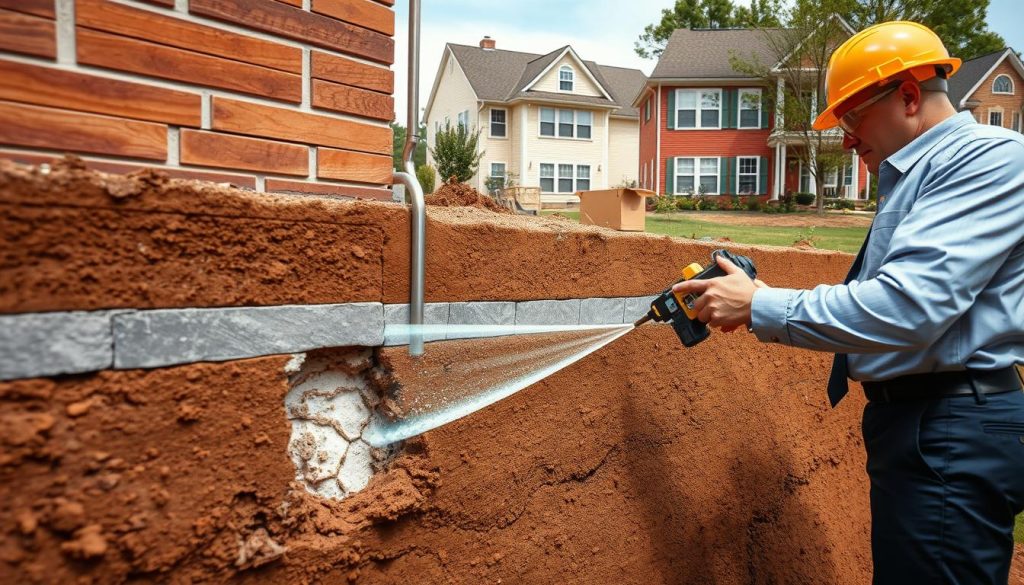
Resin injection uses small‑diameter drill holes to place expanding resins. The resin fills voids, improves bearing and can quickly re‑level settled areas with low spoil and fast cure.
Concrete underpinning: when traditional mass concrete still fits
Concrete underpinning remains the right choice where mass support is required. We stage pours, monitor lifts and re‑grout holes on completion to leave foundations stable and tidy.
Screw piling for deeper support in difficult ground conditions
Screw piling transfers loads to deeper strata when near‑surface soils are unreliable. It is fast to install and reduces vibration and excavation time on site.
Wall crack repairs and re-levelling to restore stability
We combine methods when needed and include wall crack repair and re‑levelling to return your property to a safe, level state. Survey monitoring controls movement during the work.
- Benefits: low dust, low noise and fast cure options.
- Fixed‑price scope, certification and council‑ready documentation.
- Durable foundation repair and long‑term support for your home.
How we work near boundaries — our proven process
We begin every project with an engineer-led assessment of the building and ground. That gives you clear answers and a safe scope of work.
Free structural assessment, levels check and engineering input.
Free assessment, levels survey and engineering
We provide a no-cost inspection and a levels survey. Our team confirms causes before any foundation repair is proposed.
GPR scanning and service locating
We map utilities with GPR and service locating to avoid strikes on site. This step protects services and keeps drilling safe.
Targeted injection or footing support with continuous monitoring
Injection points are marked and 16 mm holes are drilled to the target depth. Survey instruments track lift in real time.
Certification, documentation and council-ready reporting
- We record readings and photographs to support certification.
- Holes are re-grouted, the area is cleaned and surfaces reinstated.
- You receive council-ready reports, VBA-compliant certification and warranty documents.
| Stage | What we do | Benefit |
|---|---|---|
| Investigation | Site check, optional soil testing, levels survey | Clear cause and accurate scope |
| Preparation | GPR scanning, utility mapping, mark injection points | Safe drilling and minimal disruption |
| Execution | Drill 16 mm holes, targeted injection or footings, staged works | Controlled movement and quick outcomes |
| Close-out | Monitoring logs, re-grout, cleaning, reporting | Certification and peace of mind |
We plan time and access to suit occupied homes. For an indicative figure use our underpinning cost calculator.
Costs, timelines and access — what to expect
Before work starts we explain likely costs, how long the job will take and what access we need. This gives you clear choices and reduces surprises.
Cost underpinning house: factors at boundary sites
Cost depends on the extent of settlement, ground conditions and access constraints on the area around your house. Tight access or congested services increases labour and staging needs.
Resin-based approaches are often more cost-effective than full excavation. They lower labour and reinstatement costs and shorten time on site.
Time on site, noise and surface reinstatement
We outline expected time, noise levels and how surfaces will be reinstated. Concrete methods can take longer. Resin work usually finishes faster with less mess.
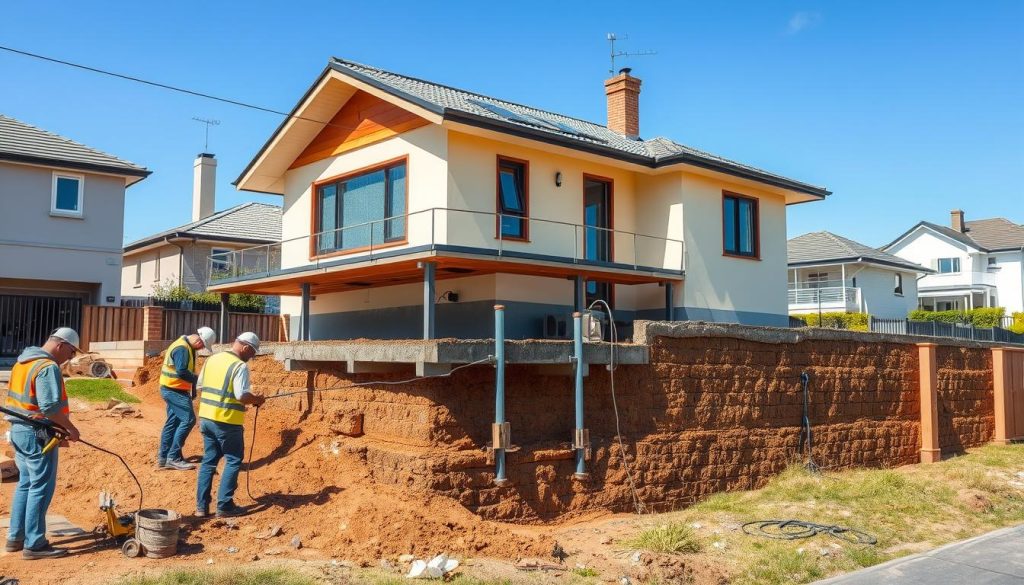
- Boundary works cost varies with movement, access and method chosen.
- Tight access, party walls and service congestion influence cost and time.
- We provide a fixed-price quote after inspection and levels checks.
- You get a free quote and clear inclusions before approving any services.
- We schedule works to suit neighbours, shared driveways and an occupied house.
For a fast booking or technical guidance, Call Chris: 1300 970 930 or Email Chris: chris@underpinning-melbourne.com.au.
Why choose Underpinning Melbourne for boundary works
Experienced crews and clear processes keep projects safe, compliant and predictable.
We are VBA-registered, insured and carry 20+ years of experience. Our team delivers modern, non-invasive ground improvement with full engineering oversight. That approach produces fast, clean outcomes and protects your property value.
We give honest assessments and a fixed-price quote. If you do not need work, we will say so. Our service avoids upselling and focuses on long-term quality.
Documentation and permits are handled by us. We manage engineering coordination, monitoring and certification for every project so neighbours and councils are satisfied.
- 20+ years experience and a specialist team focused on structural preservation.
- VBA-registered, insured and council-compliant on every project.
- Fixed-price quote, transparent scope and minimal disruption to daily life.
- Free no-obligation assessment — ask for a free quote and fast site visit today.
- We safeguard foundations, party walls and neighbour relations with monitoring and certification.
Call Chris: 1300 970 930 or Email Chris: chris@underpinning-melbourne.com.au for a free quote and prompt site visit.
Conclusion
We deliver engineered foundation work that restores safety and long‑term stability to your home.
Our team diagnoses soil and slab issues, then selects the right method — from resin injection to concrete or piling. The process is staged, monitored and documented to control time and risk.
We focus on bringing floors and walls back to level while repairing cracks and settlement. You receive council‑ready paperwork and a fixed price quote.
Get a free quote and fast guidance today. Call Chris: 1300 970 930 or Email Chris: chris@underpinning-melbourne.com.au.
Read our restumping vs underpinning guide for more on options and timing.