
We protect Melbourne homes from foundation failure. Underpinning is an engineered process that strengthens a weak foundation by transferring load to firmer soil. You get a clear, certified plan that prioritises safety and lasting stability.
We explain how new support is added beneath an existing foundation using concrete, screw piles, or resin injection. The work is staged in pins to keep the building stable and may gently lift a structure to close gaps and cracks where safe.
Our approach is practical and VBA compliant. We pair structural assessments with fixed-price quotes and certified engineering reports. This helps you choose the right solution and types of underpinning for Melbourne’s reactive clays, drought effects or nearby excavation.
We offer free, no‑obligation assessments and insured works with 20+ years’ experience. Call Chris: 1300 970 930 or Email Chris: chris@underpinning-melbourne.com.au.
Key Takeaways
- Underpinning strengthens a failing foundation to restore structural integrity.
- Work is staged and engineered to protect your home during repairs.
- Options include concrete pins, screw piles with footings and resin injection.
- We provide VBA‑compliant reports, fixed‑price quotes and insured installation.
- Assessment guides the chosen solution — it is not a one‑size‑fits‑all fix.
Understanding the basics: what is underpinning
The process creates fresh load paths that let a house rest on stronger soil. We explain this plainly so you feel confident about the repair plan.
Underpinning extends the depth and breadth of support under an existing foundation. Work uses staged excavation (pins) and new footings to move loads away from weak layers. This staged approach keeps your home stable while works proceed.
How the method stops movement and protects value
The technique transfers load from failing soil to deeper, stable strata. It can use mass concrete, beam‑and‑base or mini‑piles/screw piles depending on site tests.
Sometimes we can re‑level sections. Other times the goal is permanent stabilisation only. A structural engineer decides the right option for your issues.
- Protection: staged works preserve the existing foundation.
- Choice: engineer‑led design, VBA‑compliant reports and certified installation.
- Local proof: proven methods for Melbourne’s reactive clays.
- Low disruption: planned access, clear timelines and site management.
| Aspect | Purpose | Outcome |
|---|---|---|
| Staged excavation (pins) | Protect existing foundation during works | Continuous support; minimal settlement |
| New footings / beam‑and‑base | Spread load to stronger soil layers | Long‑term stability and reduced movement |
| Mini‑piles / screw piles | Reach deeper, stable strata where available | Suitable in tight access and variable sites |
For a clear comparison of restumping and underpinning options, see our guide on restumping vs underpinning.
Call Chris: 1300 970 930 or Email Chris: chris@underpinning-melbourne.com.au.
Why foundations move in Melbourne’s soils
Melbourne homes face seasonal ground shifts that can move footings and stress foundations. Reactive clay here shrinks in drought and swells after rain. That cycle forces footings to lift, drop or tilt.
Reactive clay, drought, flood and leaking services
Reactive soil changes volume with moisture. Prolonged dry spells cause shrinkage and subsidence under footings.
Conversely, heavy rain or flooding can exceed original design assumptions. Leaking pipes wash away ground and create soft pockets beneath a foundation.
Fill, erosion, slope creep and nearby excavation
Poorly compacted fill often settles under building loads. Erosion and tree roots can remove lateral support.
Slope creep slowly moves soils downhill on sloping blocks. Excavation next door can strip support from your ground and start movement.
We reassure homeowners by diagnosing causes early and planning controls that suit local conditions.
- Common links to house issues: cracking, sticking doors and uneven floors.
- Preventive step: early assessment reduces repair time and limits damage.
| Cause | How it affects foundations | Typical sign at home |
|---|---|---|
| Reactive clay | Volume change with moisture; footings move | Cracks in walls; uneven floors |
| Leaking services | Washout and soft ground under footings | Local settlement; sinking slabs |
| Poor fill / erosion | Progressive settling or loss of support | Gaps at skirtings; doors stick |
| Slope creep / excavation | Lateral loss of support; gradual tilt | Cracked brickwork; leaning features |
Call Chris: 1300 970 930 or Email Chris: chris@underpinning-melbourne.com.au.
Clear signs your home may need underpinning
Visible changes at walls and floors often point to deeper movement beneath the footing.
Early checks give you facts, not worries. Note where cracks form, how doors behave and if skirtings pull away. Track changes over weeks to see if the problem grows.

Cracks in walls, brickwork and slabs
Significant cracks in plaster, render, tiles, brickwork or slabs that widen or lengthen indicate active movement. Stepped cracks through bricks are a clear red flag.
Out‑of‑level floors and sticking doors/windows
Floors that slope or bounce, and doors that stick or won’t latch, show misalignment. These functional signs often accompany structural issues rather than cosmetic shrinkage.
Gaps, separation and ongoing subsidence indicators
Gaps at skirtings or between walls and joinery, and widening separations at external walls, suggest ongoing subsidence. Keep dates and photos to help our assessment.
Practical checklist:
- Stepped brick cracks, widening plaster splits and slab fractures.
- Sticking doors/windows and misaligned latches.
- Out‑of‑level floors and skirtings opening from walls.
- Measure and record crack width every month to spot active movement.
- Fix leaks and drainage issues while you wait for an inspection.
| Sign | Likely meaning | Immediate action |
|---|---|---|
| Stepped brick cracks | Active lateral movement | Photograph, date, book assessment |
| Widening slab crack | Subsidence or soil loss | Check drains, record measurements |
| Doors sticking | House out of level | Monitor, note when started, request survey |
We provide calm, practical checklists and clear, honest advice. If these signs match your home, book a free assessment. Call Chris: 1300 970 930 or Email Chris: chris@underpinning-melbourne.com.au.
How to assess the problem the right way
A local engineer-led inspection provides the facts needed to choose a safe repair path. We begin with measured data, not guesses. That keeps risk low and decisions clear for you.
Step one: engage a registered structural engineer
Start with a registered structural engineer experienced in Melbourne soils. They inspect damage, review drawings and note service locations.
We coordinate engineering reports and ensure the design meets VBA requirements. You get a clear scope and evidence-based advice.
Floor surveys, soil testing and service checks
Surveyors record floor levels to map movement. Deep soil testing often reaches 6–8 m. Moisture profiles are taken every 500 mm to find competent layers.
We also check drains and pipes. Leaks and poor drainage often mimic foundation problems and must be fixed first.
When underpinning is appropriate — and when it isn’t
Underpinning suits active, persistent movement tied to poor soils or loss of support. It is not always needed if movement may reverse.
- Alternatives include moisture control, adjustable stumps and flexible joints for timber floors.
- We explain when you may not need underpinning and present fixed‑price quotes only after diagnosis.
Call Chris: 1300 970 930 or Email Chris: chris@underpinning-melbourne.com.au.
Types of underpinning and stabilisation methods
Here we map the common stabilisation choices and when each approach suits a building. Each method has distinct access, soil and outcome considerations.
Concrete and beam‑and‑base
Mass concrete underpins enlarge support beneath existing footings. Work proceeds in staged pins to keep the building safe.
Beam‑and‑base adds reinforced beams to transfer loads to new bases. This suits shallow competent soil and standard council conditions.
Screw piling and mini‑piles
Screw piles and mini‑piles are steel elements driven or screwed to deeper, stable soils. They connect to footings or new footings and suit sites with variable ground or where deeper support is needed.
Resin injection — targeted use and limits
Injection resin expands to densify loose ground and can lift light settlement. It offers low disruption but has limitations in reactive clays and must follow engineering approval.
- Access: concrete needs room for excavation; screw piles need machine access.
- Soil profile: shallow competent soil favours beam‑and‑base; deep unstable soil favours steel piers.
- Outcome: choose long‑term stability over quick fixes.
- Staging: works are staged to maintain continuous support under the building.
- Compliance: every method follows VBA and council requirements from design to certification.
| Method | Best for | Key limitation |
|---|---|---|
| Mass concrete | Shallow, competent soil | More excavation; longer timeframes |
| Beam‑and‑base | Standard footings needing spread support | Requires skilled reinforcement and pour |
| Screw piles / mini‑piles | Deep, stable strata access | Site access for machinery |
| Resin injection | Localized void fill; light lifting | Not for reactive clays or large load transfer |
We select methods to suit your foundation, not the other way around. That keeps disruption minimal and ensures certified, council‑compliant construction and performance.
Concrete underpinning
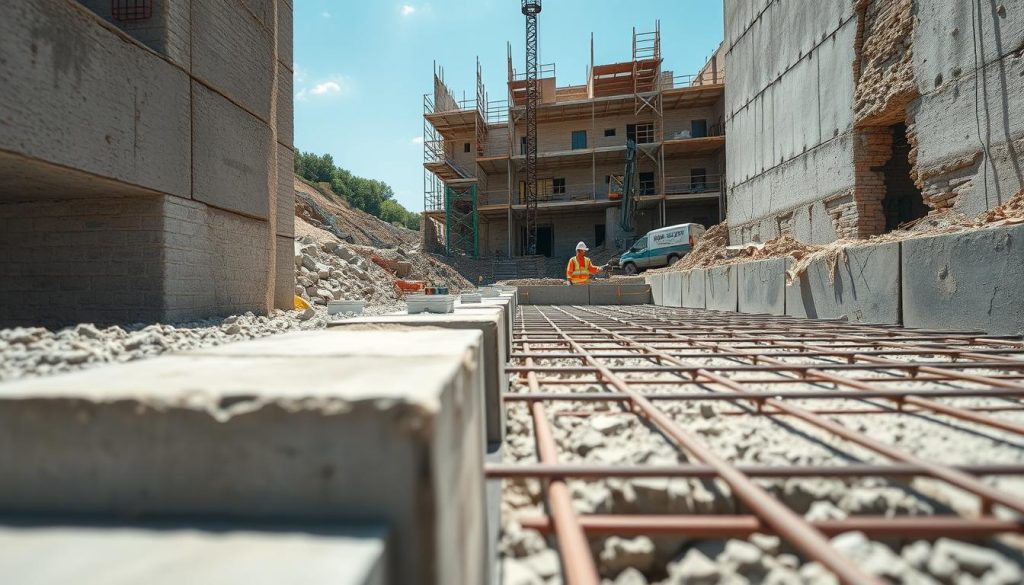
Concrete pins form a staged support system beneath affected footings to restore load paths safely. We carry out works in short runs so your building stays supported at all times.
How the staged works run and controlled jacking
Work proceeds pin by pin, typically at 2–3 m centres. We excavate each location with shoring where needed for safety.
An engineer inspects every excavation before we place concrete. After the concrete cures, we leave jacking pockets for gentle lift where feasible.
Not every crack will close fully; the goal is lasting stability and reduced movement.
Pros, cons and typical timeframes
Pros: robust, familiar method with predictable costs where access is good.
Cons: more excavation than steel piers, slower in tight sites and weather can affect progress.
- Access, spoil removal and reinstatement of paths or gardens are planned and quoted.
- Small programmes (up to 10 underpins) often take about two weeks.
- Whole‑house works generally run close to a month, depending on site conditions and time of year.
- We provide certification at completion and clear, honest timeframes.
| Aspect | Typical outcome | Note |
|---|---|---|
| Pin spacing | 2–3 m centres | Maintains continuous support |
| Engineer inspection | Quality control before pour | Mandatory for VBA compliance |
| Jacking | Controlled lift where feasible | Cosmetic repairs may still be needed |
We aim for minimal disruption and honest timelines. Call Chris: 1300 970 930 or Email Chris.
Screw piling for deeper support
Screw piling brings deep, engineered support to foundations that need to bypass weak upper soils. We install helical or steel piers to reach competent layers and bracket them to existing footings. This method suits sites where shallow soils cannot carry the required load.
Helical and steel piers with concrete footings
Helical piers are screwed to firm strata and fastened with brackets to the foundation. Where needed, a concrete footing or short beam ties the pier into the footing for a continuous support path.
Installation uses measured torque to confirm capacity. We record test data on every pile for the engineer to verify.
Benefits for access, load and long‑term stability
Minimal excavation and small plant reduce disruption to gardens and paths. Portable rigs access tight areas around the building.
- Predictable load performance and reduced excavation volume.
- Suitable for uneven ground and partial re‑levelling.
- Pile locations planned to minimise disruption and protect landscaping.
- Engineer‑verified test records and final certification on completion.
| Feature | Benefit | Note |
|---|---|---|
| Steel helical piers | High axial capacity | Torque logged during install |
| Bracketed to footings | Direct load transfer to firm ground | Works with concrete connection |
| Small plant access | Low site disturbance | Suits tighter Melbourne blocks |
We offer screw piling where deeper strata are required. Call Chris: 1300 970 930 or Email Chris: chris@underpinning-melbourne.com.au.
Resin injection explained
Resin injection uses small‑diameter holes to deliver an expanding polymer into loose ground beneath a house. The material displaces voids and compacts surrounding soil. Works are quick and tidy compared with deep excavation.
How it works in practice
Technicians drill a grid of small holes around the affected area. Injection points, pressure and volume follow an engineer’s plan.
Controlled expansion densifies loose soil and can lift small slabs or step sections. Installers log injection pressures and volumes for monitoring.
Ground conditions where resin can and can’t help
Resin suits localized voids, sandy fill, and small isolated settlement. It provides a fast solution where access and speed matter.
Limits: resin is not a cure‑all for reactive clay movement that changes with moisture. In those conditions a structural method that reaches deeper ground may be required.
- Drilling pattern and injection controls follow engineer specifications.
- Expansion compacts loose soil and can offer small lifts.
- Engineer‑led trials and monitoring must precede full works.
- Resin has limited reversibility if the outcome falls short.
- Use resin as part of a broader solution, not the sole fix for major foundation issues.
| Aspect | Best for | Key limitation |
|---|---|---|
| Injection pattern & controls | Targeted void filling | Requires engineer design and trial |
| Effect on ground | Local densification and light lift | Not for deep load transfer |
| Access & disruption | Minimal; suitable for tight sites | Not suitable where deep underpinning needed |
Balanced advice: we never upsell. If resin can safely solve your problems, we offer a monitored trial. If deeper support is needed, we recommend engineered underpinning for permanent performance.
Call Chris: 1300 970 930 or Email Chris.
The underpinning process step‑by‑step
From survey to certification, we coordinate the whole repair journey for you. You get clear stages, VBA‑compliant documents and regular updates. Our team keeps safety and quality front of mind at every stage.
Engineer’s report and design
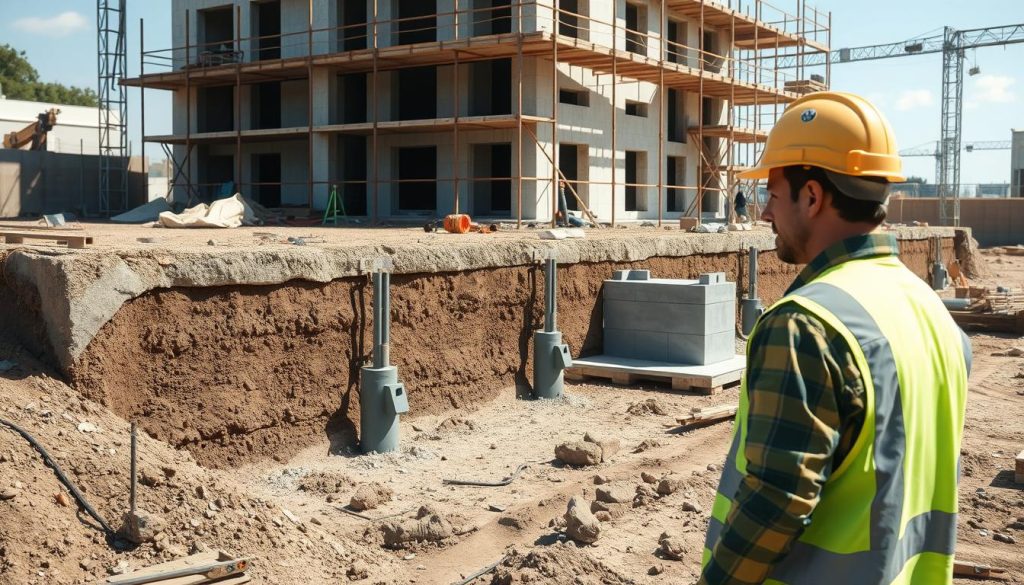
An initial inspection by a registered structural engineer diagnoses causes and sets a design. Reports state location, spacing and depth for the works.
All designs meet VBA requirements and form the basis of approvals and construction drawings.
Soil testing, approvals and site setup
We arrange deep soil tests to 6–8 m with moisture readings every 500 mm. Those results confirm competent strata and inform the final design.
We lodge necessary approvals, plan access, check services and set safety controls before works start.
Excavation, pours, jacking and certification
Construction is staged with engineer inspections before each pour. Controlled jacking follows concrete cure where the design allows.
We restore surfaces, verify final floor levels and issue certification on completion.
- Typical steps: engineer report, soil testing, approvals, staged excavation, engineer‑witnessed pours, jacking, reinstatement, certification.
- Time: small projects ~ two weeks; larger works take longer depending on site conditions and construction scope.
| Step | Purpose | Outcome |
|---|---|---|
| Engineer inspection | Diagnose and design | Clear VBA‑compliant scope |
| Deep soil testing | Locate competent strata and moisture profile | Informs depth and method |
| Staged excavation & pours | Maintain continuous support | Safe load transfer to firm ground |
| Jacking & certification | Controlled adjustment and compliance | Final levels and signed certification |
We keep you informed. Call Chris: 1300 970 930 or Email Chris: chris@underpinning-melbourne.com.au.
Costs, time and variables homeowners should know
Cost estimates depend on site access, soil depth and how widespread the settlement has become. We give clear, fixed‑price quotes after investigations. That avoids surprises and helps you budget with confidence.
Access, soil conditions and extent of damage
Site access affects plant choice and labour. Tight backyards raise costs compared with open driveways.
The soil profile and depth to competent material determine method and time. Deeper competent strata often need piles or screw piers.
Extent of damage and active settlement drives how many underpins or piles the design requires.
- Key factors: access, soil profile, scope and reinstatement.
- Permits and service checks: we include allowances for council approvals and safe service locations in our pricing.
- Foundation type: slab versus strip footings can change methodology and cost significantly.
Whole‑of‑home vs targeted underpins
Targeted works suit localised problems. They often cost less and finish sooner.
Whole‑of‑home stabilisation suits widespread movement. It reduces long‑term risk to your property and may offer better value over time.
Typical timeframes: small groups of underpins — about two weeks; whole‑house works — around a month. Time aligns to the engineer‑specified scope.
| Variable | How it affects cost | Typical impact on time |
|---|---|---|
| Site access | Tight access requires smaller plant; adds labour and handling | May add days to programme |
| Soil depth to competent layer | Deeper strata require piles or longer underpins; higher material cost | Longer installation and testing time |
| Extent of damage / settlement | More underpins increase materials and labour | Proportionally longer works |
| Foundation type (slab vs strip) | Slab repairs may need different connection details; strip footings suit traditional pins | Method affects staging and reinstatement time |
We commit to fixed‑price quotes once investigations finish. Our reports set scope, so you know exactly which factors drove the price. We help you balance budget, risk and long‑term performance for your house and property.
Why choose Underpinning Melbourne for structural preservation
Choose a team that pairs long experience with clear, engineer‑led guidance for every repair.
We are fully VBA registered and insured. Our team has 20+ years’ experience protecting the home and property of local owners. We work with a trusted structural engineer on every job to ensure the design meets regulations and delivers lasting integrity.
20+ years’ experience, VBA registration and insurance
Proven track record: two decades of construction and foundation care.
Regulated practice: VBA registration and full insurance cover for peace of mind.
Free no‑obligation assessments and fixed‑price quotes
Start with facts, not fear. We offer free assessments and fixed‑price proposals after testing. You get an engineer‑coordinated report and a clear scope before any work begins.
Minimal disruption, council‑compliant methods and honest advice
We plan works to minimise disruption to your building and neighbours. All methods follow council rules and carry final certification. We never recommend unnecessary work and always give straight, evidence‑based advice.
- Specialists in structural preservation with deep local experience.
- Partnered with registered structural engineer professionals.
- Free assessments, clear fixed‑price proposals and certification.
- Council‑compliant methods and respectful site management.
- We handle soil testing, approvals and full coordination.
| Feature | Benefit | Outcome |
|---|---|---|
| VBA registration & insurance | Regulation and cover | Work done safely and certified |
| Engineer‑led reports | Design accuracy | Permanent structural integrity |
| Fixed‑price quotes | Budget certainty | No hidden costs after investigation |
| Planned staging | Minimal site disruption | Neighbours and landscaping protected |
Ready to act? Book a free assessment, send photos or ask questions. Call Chris: 1300 970 930 or Email Chris.
Conclusion
A clear, certified repair plan brings back stability and reduces future risk to your property. Underpinning adds deeper support with concrete, beam‑and‑base or piles to address subsidence and ongoing movement beneath the original foundation.
Our staged, engineer‑designed process targets causes, not just cosmetic cracks. That means the slab, footings and other elements regain lasting performance.
We offer a free assessment and a fixed‑price quote. Let us review your house for settlement and provide a practical solution. Check costs with our cost calculator, then Book a free inspection. Call Chris: 1300 970 930 or Email Chris.