

We provide engineered solutions to stabilise made ground and protect your home from foundation failure. Our team specialises in calm, engineering-led repairs that keep your building safe and VBA‑compliant.
Cut-and-fill is a common construction method. It moves soil from one spot to another to reshape a site. This process can leave made ground that affects structural performance.
With 20+ years’ experience, we explain how historical excavation and backfill in developing area create unstable ground. We offer clear steps from a free assessment to a fixed‑price proposal.
Our services include underpinning, restumping, resin injection and screw piling. You deal with a senior specialist from start to finish, not a salesperson. Call Chris: 1300 970 930 or Email Chris: chris@underpinning-melbourne.com.au.
Key Takeaways
- Made ground can cause early foundation issues; investigate promptly.
- We use engineered solutions tailored to soil and building conditions.
- Free, no‑obligation assessments and fixed‑price quotes provide certainty.
- Senior specialists manage your project for quality and accountability.
- We are fully VBA registered, insured and council‑compliant.
What is fill and made ground in Melbourne construction?
On many sites builders move excavated soil and rock to create level platforms for construction. This simple way reshapes sloping blocks so houses, driveways and pads suit design and access.
Cut-and-fill basics: excavation, placement and compaction
Cut-and-fill is the process of excavating higher areas and placing that material in low spots. Heavy equipment such as bulldozers and excavators places and compacts layers to form a new ground surface.
Quality of compaction and the type of material used control long-term stability. Poorly compacted or mixed material reduces bearing capacity and raises settlement risk under walls and slabs.
How variable materials affect bearing capacity and stability
- Made ground often contains mixed soil and debris that change how loads transfer to subsoil.
- Small voids or soft spots concentrate stress and cause cracking and uneven floors.
- Erosion and water movement can wash out fine particles, creating hidden weaknesses.
We assess the type of backfill, density and moisture response to advise on suitable foundations or designs that bridge through poor ground to competent rock or soil. Our approach focuses on safety, compliance and permanent performance for your home.
fill land melbourne foundations — risks, signs and when to act
Seasonal soil movement and wet-weather rise in groundwater often trigger the earliest signs of structural stress. We explain the common risks in plain terms and show when you should act.
Common issues in expansive clay soils, high water tables and variable depths
Expansive clay soils shrink and swell with moisture. That movement stresses a shallow foundation on mixed ground and causes uneven settlement. High water tables reduce bearing capacity and can cause erosion of fine particles.
Sudden changes in fill depth across a site lead to differential movement. That shows as stepped cracking or tilted structures. Our engineers assess soil conditions and recommend depth and detailing for durable solutions.
Warning signs at home: cracks in walls, uneven floors, sticking doors
- Cracks in internal and external walls or cornices.
- Doors and windows that stick, or floors that feel bouncy.
- Gaps at brick bases, tilting paths or ponding near footings.
- Movement around service trenches where backfill settles differently.
If signs appear or worsen after heavy rain or drought, act early. We offer a free assessment and VBA‑compliant solutions ranging from targeted resin ground improvement to underpinning or screw piling.
Ground engineering solutions matched to your site conditions
Practical ground solutions begin with pinpointing what the soil will, and will not, bear. We carry out a targeted assessment and match methods to the problem. This keeps repairs permanent and low-impact.
Concrete underpinning for long-term structural support
Concrete underpinning transfers loads to competent soil or rock. It suits subsided footings and offers durable support.
Resin injection methods: deep injection, deep lift and slab lifting
Deep injection densifies loose soil to improve bearing capacity without major excavation.
Deep lift and slab lifting relevel sinking slabs and footings. These methods restore function fast and limit disruption.
Screw piling for immediate load transfer with minimal excavation
Screw piles give instant support. They require little excavation and are council-friendly.
Wall crack repairs and water-stop measures to prevent further damage
We repair structural cracks and inject water-stop material behind walls. This prevents recurring water ingress and ongoing movement.
- Materials: concrete, polyurethane resin and cementitious mixes chosen by soil type.
- Equipment: compact rigs sized for tight access and live homes.
- Process: clear scope, VBA compliance and fixed-price quotes.
| Method | Primary Benefit | Access Impact | Suitable Soil Types |
|---|---|---|---|
| Concrete underpinning | Long-term load transfer | Moderate excavation | Mixed fill, firm subsoil |
| Deep injection (resin) | Densifies and raises | Low disruption | Loose, granular fill |
| Deep lift / slab lifting | Restore level and function | Minimal surface work | Sinking slabs, shallow soil |
| Screw piling | Instant load support | Very low excavation | Variable soil depths, soft topsoil |
We address root causes, not cosmetic fixes. For a quick estimate use our underpinning cost calculator. Call Chris: 1300 970 930 or Email Chris: chris@underpinning-melbourne.com.au.
Deep foundation systems for challenging Melbourne soils
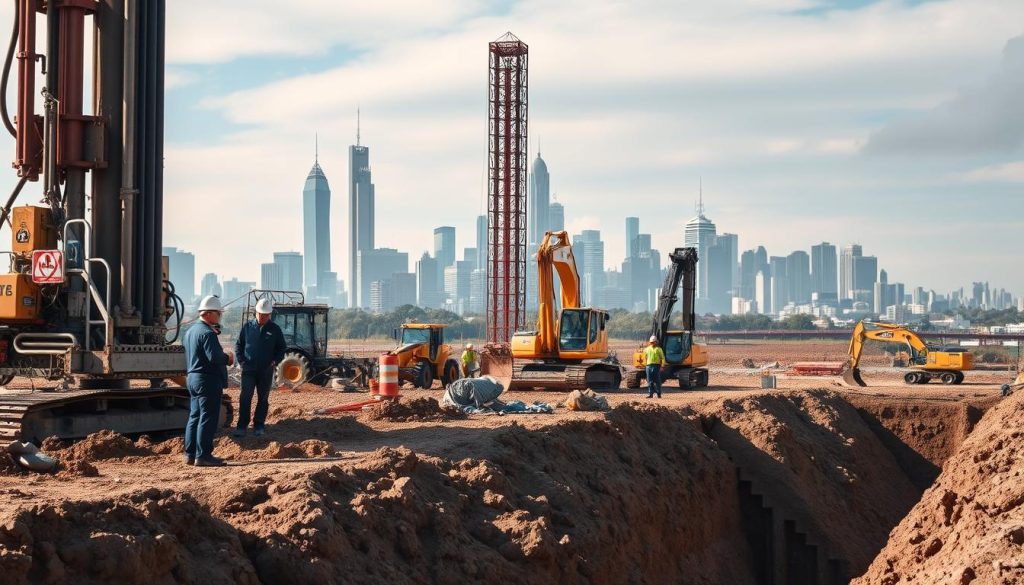
Where shallow ground is unreliable, deep supports secure buildings to competent strata. Deep systems carry loads to firmer layers or rock. We design and coordinate these works so you get VBA‑compliant certification and lasting stability.

Pile and pier solutions: when depth, rock and lateral loads matter
Pile elements are long, slender columns driven or drilled to transfer load to deep soil or rock. Pier systems (drilled shafts or caissons) use large concrete elements for high capacity and low settlement.
- We specify piles or piers where competent material sits at depth or lateral loads demand stiffness.
- Drilled concrete piers suit buildings and structures needing high capacity.
- Proper head detailing is critical to transfer load into the superstructure.
Screw piles: fast installation, low impact and council‑friendly
Screw piles are steel shafts with helical plates installed by torque. They give immediate capacity with minimal excavation and tidy sites.
- Ideal in established areas with tight access and when site disruption must be low.
- We select the type based on verified capacity, corrosion protection and council requirements.
- We coordinate testing to confirm torque, capacity and quality before handover.
| Type | Primary benefit | Best where |
|---|---|---|
| Piles (driven/drilled) | Deep transfer of load | Variable soil, deep rock |
| Drilled piers / caissons | High capacity, minimal settlement | Buildings needing strict control |
| Screw piles | Rapid install, low mess | Tight access, existing yards |
Deep foundation choices depend on soil profiles, rock depth, groundwater and your project constraints at the site. Expect a clear comparison of solutions, cost and program so you can decide with confidence. Call Chris: 1300 970 930 or Email Chris.
Our calm, engineering-led process to stabilise your building
We use an engineering-led process that turns concern into a clear plan. Our approach is methodical, compliant and focused on permanent outcomes. We assess the soil, the symptoms and the site to decide the right step.
Free no-obligation structural assessment and photo review
First step is a free assessment or photo review. This helps us understand the site, soil and visible symptoms quickly.
VBA-compliant design, engineering report coordination and fixed-price quote
We coordinate any required structural report and prepare a VBA-compliant design. You receive a fixed-price quote that lists inclusions, exclusions and timeframes.
Execution with the right equipment, materials and access methods
- Our team selects equipment suited to tight sites to reduce disturbance.
- Materials are chosen for the soil and moisture requirements to ensure durability and quality.
- We plan access, utilities protection and staging so you can stay at home during works.
- Every step is documented for quality control and certification at handover.
- We provide daily updates and remain available for support throughout the project.
We focus on doing the job right the first time. Proper installation and quality checks prevent future failure and save time. To book your free review, book your assessment or Call Chris: 1300 970 930 or Email Chris: chris@underpinning-melbourne.com.au.
Costs, timeframes and what influences your project
Estimating time and money for structural repairs depends on what sits beneath your home.
We provide transparent fixed-price quotes. First, we inspect the site and test soils. Then we list requirements, inclusions and likely time on site. This keeps surprises to a minimum.

Key factors that shape price and program
- Ground conditions: reactive or high-water soils need more work and testing.
- Depth and foundation type: deeper supports cost more but add long-term stability.
- Access and excavation: tight yards increase labour and staging time.
- Quality and compliance: engineering, testing and certification are included in our quotes.
| Factor | How it affects cost | Typical time impact |
|---|---|---|
| Shallow resin works | Low cost for small repairs | 1 day–2 days |
| Underpinning or piers | Higher upfront cost, long-term value | Several days–weeks |
| Screw piling | Moderate cost, low site impact | 1–3 days |
We balance upfront cost against lifecycle value. Choosing a lower initial price can mean repeat repairs later. We help you compare options by durability, safety and long-term cost.
To discuss a quote or book an assessment, Call Chris: 1300 970 930 or Email Chris: chris@underpinning-melbourne.com.au.
Compliance, quality and minimal disruption guaranteed
We combine certified processes and careful communication to protect neighbours and property.
Our team is VBA‑registered and fully insured. That means your project meets compliance from start to finish.
VBA-registered, insured and council-compliant methods
We use council‑friendly methods that suit established area streets. Permits and inspections are coordinated by us.
Materials and equipment are chosen for safety and speed. This delivers quality outcomes on active sites.
Low-impact installation to protect services, landscaping and neighbours
Low‑impact techniques protect buried services, paving and gardens. We manage dust, noise and access with a documented process.
- Water ingress is controlled with proven water-stop measures behind walls.
- Projects include quality assurance checks and clear handover documentation.
- We give straightforward advice on maintenance to protect long-term performance.
| Compliance feature | Benefit | Site impact |
|---|---|---|
| VBA registration & insurance | Meets legal and safety standards | Administrative, no disruption |
| Council‑compliant methods | Smoother permits and approvals | Minimal delay |
| Low‑impact installation | Protects landscaping and services | Very low on-site disturbance |
For a clear, compliant plan visit our main site at Underpinning Melbourne. Call Chris: 1300 970 930 or Email Chris: chris@underpinning-melbourne.com.au.
Why choose Underpinning Melbourne for structural preservation
Good structural preservation starts with an honest assessment and a plan you can rely on. We bring calm, practical advice and a clear path from diagnosis to handover.

20+ years’ experience, honest assessments and no upselling
Our team has over 20 years working on homes and buildings across varied areas. We give straight advice. There is no sales pressure.
We reduce risk by following engineering specs and using the right material and equipment.
Full-service support: underpinning, restumping, resin, screw piling, reports
Our services cover underpinning, restumping and reblocking, resin injection, screw piling, wall repair and engineering reports.
- Speak directly with a specialist who scopes and delivers your job.
- We provide diagnosis, design, permits and certification for each project.
- Honest advice focused on the best solutions and budget for your structure.
- We stand behind work with documentation and responsive aftercare support.
Speak directly with a specialist
Call Chris: 1300 970 930 or Email Chris: chris@underpinning-melbourne.com.au to discuss your issues. We will outline clear options and timing for your job or project.
Conclusion
A timely, engineered response prevents small movement becoming major structural failure.
We deliver VBA‑compliant, permanent foundation solutions that suit expansive clay and high water table sites. Deep supports and targeted ground improvement stop settlement and protect your building and structures.
Expect clear cost and time estimates, fixed‑price quotes and a free assessment to start. Our team guides you through site testing, design, approvals and repairs with minimal disruption.
Act now if your foundation shows movement in fill or cracks in walls. Book a free assessment and fixed‑price quote today. Call Chris: 1300 970 930 or Email Chris: chris@underpinning-melbourne.com.au.