

We provide engineered underpinning services to stop movement and secure your retaining structure, with clear quotes and VBA‑compliant certification.
We are Underpinning Melbourne, Structural Preservation Specialists. Our team offers a calm, engineering‑led approach that protects your home and property. We assess issues quickly and explain practical options in plain language.
Underpinning transfers loads to stable ground to halt subsidence and restore structural integrity. We use mass concrete pins, piles, resin injection and screw piling to suit site conditions and structure types.
From free no‑obligation assessments to fixed‑price quotes and engineering reports, we manage every stage so you get one accountable team. Check our cost guidance to plan your project with confidence.
Call Chris: 1300 970 930 or Email Chris: chris@underpinning-melbourne.com.au
Key Takeaways
- We deliver engineered solutions that protect your home and property.
- Work includes assessment, design, execution and certification.
- Methods include concrete pins, piles, resin and screw piling.
- We provide fixed prices, clear timelines and a single point of contact.
- Engineering reports and VBA compliance are coordinated by our team.
Structural preservation for failing retaining walls across Melbourne
Reactive clay cycles in our region place repeated strain on wall footings and nearby foundations. Wet seasons make soils swell. Dry spells make them shrink. These swings create movement, cracks and leaning if ignored.
Poor drainage and trapped water increase lateral pressure while erosion removes supporting soil. The result is progressive damage that affects your property and home safety. We assess the root causes and plan works to stop further harm.
Our process balances speed with safety. We work to council rules and supply drawings and documentation for insurance and permits. You get a clear timeline, expected time on site and any short access limits at your home.
- We stabilise structures under local soil and weather conditions that amplify movement.
- Works target water pressure, variable foundations and other core issues to prevent repeat damage.
- We design solutions suited to tight suburban sites and landscaped areas, with minimal disruption.
VBA‑registered and insured, we provide honest assessments and council‑compliant methods so you retain peace of mind.
What is underpinning for retaining walls?
Underpinning extends or augments an existing foundation so the structure sits on firmer ground. This stops settlement, controls movement and restores reliable support behind a gravity or masonry barrier.
How underpinning stabilises foundations under lateral loads
We change the load path so pressure from saturated or shifting soil is taken by deeper, competent strata. That increases bearing capacity and prevents further movement.
Our engineering design shows the load path and safety factors. We monitor movement during works to protect your property.
When mass concrete, resin or piles are used
Mass concrete involves staged excavation beneath footings and pouring concrete where access allows. It suits gravity and masonry types with room to work.
Resin injection (polyurethane compaction grouting) densifies loose soils, fills voids and can lift settled sections using small 16 mm injection holes to about 1500 mm depth.
Screw piles transfer loads to deeper strata with minimal excavation. We pick the right method based on soil conditions, site constraints and long‑term durability.
- Process highlights: GPR service locating, small drill holes and monitored lift where applicable.
- Materials: durable concrete, polymers or steel piles chosen to suit local council requirements.
- Outcome: a compliant, least‑disruptive solution that restores foundation support.
Clear signs your retaining wall needs attention
Early movement often appears as stepped cracking, subtle bows or a gentle lean in a barrier that once looked straight. These visual cues are the most direct signs that soil or footing support is changing.
Operational hints often arrive next. Gates and doors may begin jamming. Windows and doors can stick or stop closing squarely. Fence rails go out of line and posts tilt as the ground shifts.
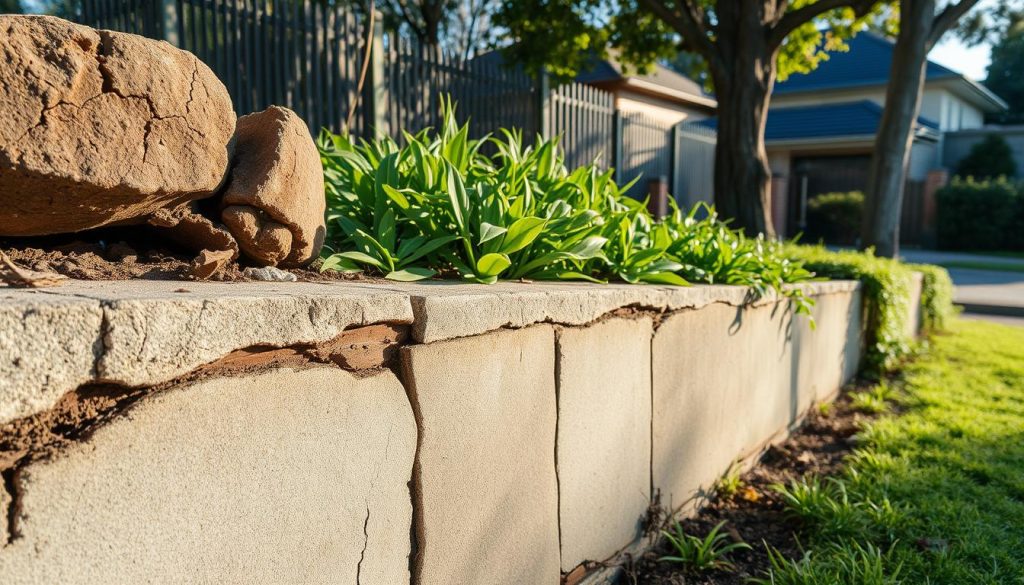

Check the ground behind the structure. Ponding water, erosion channels or soil voids raise lateral pressure and wash out fines. You may see sinkage in paths or paving where the soil has been removed.
- Watch for stepped cracks that widen along mortar joints.
- Note any bowing or leaning, even slow movement.
- Record new issues with dated photos to track change.
- If structural damage is active, call us early to limit repair scope and cost.
- We offer a free no‑obligation assessment to confirm whether underpinning is required or if improved drainage will fix the issue.
Honest advice only. We give a clear plan for remediation and monitoring, so you can protect your house and stop further structural damage.
Why retaining walls fail in Melbourne conditions
Seasonal clay movement is the most common cause of progressive damage in suburban barriers. Wet periods make clay expand. Dry spells make it shrink. That cycling stresses footings and nearby foundations.
Reactive clay cycles: expansion in wet, contraction in dry
Melbourne’s clay can heave when wet and subside in drought. Repeated change causes cracking and gradual loss of support. Simple monitoring can spot early movement.
Poor drainage and water erosion increasing lateral pressure
Ponding raises hydrostatic pressure behind a structure. That pushes soil outward and washes fines away. Erosion creates voids that lead to local collapse.
Load and design issues: surcharge loads, inadequate founding depth
Extra loads from driveways or stored materials can exceed bearing capacity. Shallow founding depth leaves concrete elements vulnerable to seasonal movement. AS 2870 sets minimums for founding and fill preparation.
Neighbouring works, undermining and poor workmanship
Excavation next door can remove support below your base level. Poorly compacted fill or incorrect construction practices cause settlement and lasting issues.
- Practical steps: improve drainage, manage loads and review founding depth.
- Early assessment and timely underpinning reduce progressive repair costs.
- We propose compliant fixes that respect gardens and neighbours.
Our underpinning and stabilisation methods for retaining walls
We use targeted techniques that address soil weakness and restore long‑term support. Each approach is chosen to match the problem, site access and the foundation type. We are VBA‑registered and insured, and we never upsell; we match the method to the issue.
Concrete underpinning and restumping
Mass concrete works by staged excavation and pouring to strengthen footings. This concrete method suits accessible sites and heavy gravity or masonry barriers. It gives durable support using proven materials.
Resin injection (compaction grouting)
Two‑part polyurethane fills voids and compacts loose soil. Tiny 16 mm injection holes are drilled to about 1500 mm and monitored to measure any lift. This solution often relevels minor settlement with minimal excavation.
Screw piling and complementary works
Screw piles shift loads to deeper, stable strata with little disturbance. We combine methods when needed and add crack repairs, soil stabilisation and drainage upgrades to reduce water pressure long term.
- Survey control and QA confirm lift and stability during the work.
- You receive a clear scope, fixed price and a practical programme for the work.
Underpinning for retaining wall Melbourne
We design targeted foundation work that protects homes and gardens with minimal excavation and clear timelines.
Our team tailors solutions for timber, masonry and reinforced concrete walls. We match method to material and site access.
Two decades of local experience means we anticipate constraints early. That keeps time on site short and reduces reinstatement costs.
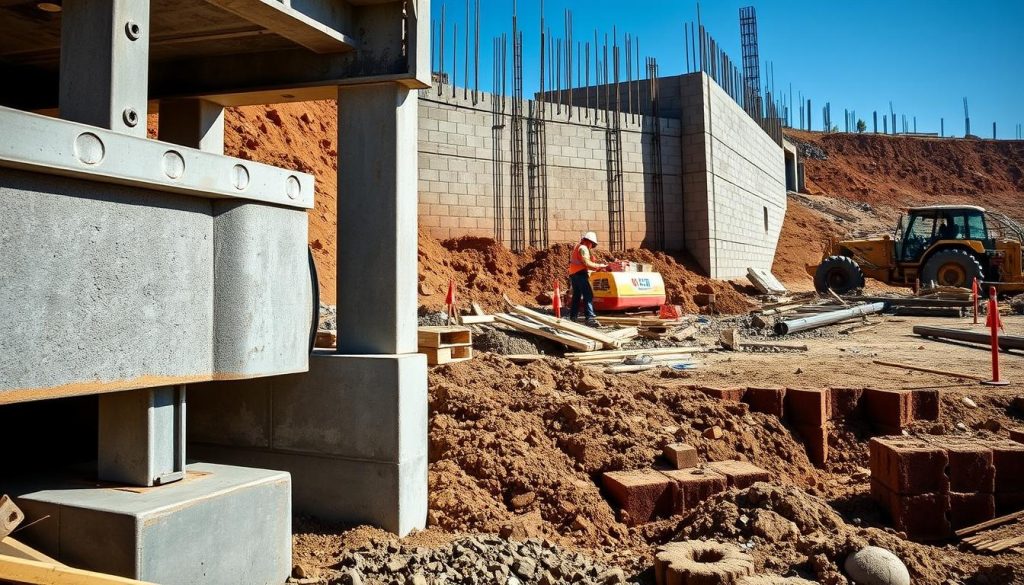
Tailored solutions for timber, masonry and reinforced concrete
Modern resin and piling systems limit landscape disturbance. Many projects proceed without vacating the property.
Minimal disruption methods suited to tight suburban sites
We monitor movement during works to ensure controlled correction and long‑term stability.
- Rapid response: we act when signs appear to control scope and cost.
- Neighbour and council liaison: we coordinate access and approvals.
- Fixed price and clear timeframes: realistic schedules for each work stage.
| Material | Common method | Disruption level | Typical outcome |
|---|---|---|---|
| Timber | Resin or screw piles | Low | Fast stabilisation, minimal dig |
| Masonry | Mass concrete pins or piles | Medium | Durable support, long life |
| Reinforced concrete | Deep piles and monitored grouting | Low–Medium | Controlled correction, lasting stability |
Our calm, engineering-led process
Our process begins with a calm, thorough inspection that pins down causes and options.
Initial assessment and report coordination
Initial assessment and structural engineering report coordination
We perform an on-site assessment and advise whether underpinning is required.
We coordinate a structural engineering report and clear documentation to meet council rules.
Custom solution design based on soil conditions and wall type
Design addresses soil conditions, wall type and adjacent loads.
We plan founding depth, pile positions or resin zones to suit the site.
Implementation: underpins, piles and resin delivered with QA monitoring
Work includes GPR service locating, safe access planning and soil testing where needed.
Injection holes are typically 16 mm and drilled to about 1500 mm when resin is used.
Survey monitoring checks lift and stability in real time.
Certification, final inspection and ongoing monitoring as needed
We finish with certification, photos, level checks and a clear maintenance note.
You get one project lead who explains time, staging and any temporary restrictions.
Our expertise and knowledge keep the process calm, transparent and safe.
- Assessment identifies cause and confirms need.
- We coordinate engineering reports and deliver fixed‑price quotes and free assessments.
- Final QA includes levels, documentation and a long‑term monitoring plan.
VBA and council-compliant retention and certification
We make sure every project is recorded, measured and approved so your home keeps long-term protection.
Working to AS 2870 principles and local council requirements
Our designs follow AS 2870 expectations for founding depths and fill preparation. This reduces the risk of settlement caused by poor site conditions.
We also plan drainage upgrades to limit water pressure and erosion behind structures.
VBA-registered, insured and documented for peace of mind
We are VBA registered and carry full insurance. You receive certified reports, measured levels and dated photos suitable for council and insurers.
- We design and build to AS 2870 and local council requirements.
- Our underpinning services include approvals and insurer-ready documentation.
- Certification verifies structural integrity and confirms measured levels.
- We assess foundations and supply supporting calculations where needed.
- Site conditions and construction steps are documented for transparency.
- We manage council liaison to streamline permits and inspections.
You get a complete assessment and record pack at handover. We stand behind our work with clear quality assurance and ongoing advice.
Benefits of timely underpinning vs risks of delay
Addressing foundation issues straight away limits crack growth and prevents hidden damage. Early action stops settlement spreading and reduces secondary repair work.
Restore structural integrity and avoid progressive structural damage
We stabilise quickly with engineered solutions that close or arrest cracks. This improves the function of doors and windows and restores safe use of your house.
Early intervention keeps movement small and measurable. That reduces the chance of long‑term structural damage and complex repairs.
Reduce lifetime repair costs and protect property value
Timely work lowers reinstatement time and the scope of on‑site repairs. You protect your property and limit ongoing maintenance.
- Quick wins: prevents small problems becoming major repairs.
- Safety: reduces risks to occupants and asset value.
- Assurance: certification and monitoring give peace mind.
- Clarity: we provide fixed pricing and a clear process so you decide with confidence.
| Action | Short‑term effect | Long‑term outcome |
|---|---|---|
| Early engineered works | Stops movement quickly | Lower lifetime repair costs |
| Drainage and soil stabilisation | Reduces lateral pressure | Fewer future interventions |
| Deferred action | Widening cracks and service issues | Higher repair bills and lost value |
Why choose Underpinning Melbourne
Choose a team that combines technical rigour with careful site care to protect your house and garden.
We bring 20+ years’ experience and deep local knowledge to every job. Our teams know reactive clay, erosion and surcharge impacts. That knowledge helps us pick the least‑invasive, long‑lasting solution.
Honest assessments — we never upsell. We give clear options, costed work programmes and independent advice. You only pay for what is necessary.
Structural Preservation Specialists deliver neat, safe sites. We use QA monitoring during work and provide certificate packs at handover.
- Years experience in design, delivery and certification.
- Services that resolve cracks and related damage with targeted methods.
- Minimal disruption to your home and property.
- Clear communication so you know what to expect and when.
- VBA registered, insured and council‑compliant documentation.
| Advantage | What it means to you | Proof |
|---|---|---|
| Local expertise | Work suited to Melbourne soils and weather | 20+ years’ experience and case records |
| Honest advice | No unnecessary works, clear choices | Independent assessments and fixed quotes |
| Compliance & QA | Safe, documented outcomes for your house | VBA registration, insurance and certification |
Call Chris: 1300 970 930 or Email Chris: chris@underpinning-melbourne.com.au.
Services we provide for retaining walls and adjacent structures
From initial survey to final certification, we manage every step so your structure regains safe, lasting support.
Our full-service offering covers assessment, engineered design and certified completion. We issue fixed‑price quotes and offer a free no‑obligation assessment so you can decide with confidence.
Concrete underpinning, restumping & reblocking
Concrete works suit heavy gravity and masonry barriers where excavation is viable. Restumping and reblocking repair adjacent house timber elements affected by movement.
Resin injection and soil stabilisation
We use expanding polyurethane to compact soils and fill voids. This method restores bearing capacity with minimal digging and quick reinstatement.
Screw piling and wall crack repairs
Screw piles bypass weak soil and carry loads to stable layers. We pair piling with targeted crack repairs using compatible materials for long‑term performance.
Structural engineering reports and council liaison
We coordinate in‑house engineering reports and council approvals. GPR locating and survey monitoring ensure safe, quality work and clear certification at handover.
- Tailored solutions to your property and local soil conditions.
- We manage the work programme to minimise disruption and waste.
- Clear scope across all related projects and structures.
- Free assessment and fixed‑price quotes available.
| Service | When used | Key benefit |
|---|---|---|
| Concrete underpinning & restumping | Heavy loads, accessible sites | Durable foundation support |
| Resin injection | Voids/loose backfill | Rapid soil densification, minimal dig |
| Screw piling | Shallow weak soils | Transfers load to stable strata |
| Crack repairs & reinstatement | Visible cracks and mortar loss | Long‑term, matching finishes |
Free assessment, fixed pricing and fast booking
Start with a free, clear site check so you know the true scope and likely cost before any work begins. We use photos to speed early advice, then arrange a timed inspection when needed.

Free no‑obligation structural assessment and transparent fixed‑price quote
Send photos to help us assess the issue quickly. Our intake often begins with a photo review, then an on‑site inspection, soil testing or GPR locating if required.
Book a site inspection or email photos today
We make the process simple:
- Book your free assessment to clarify scope, cost and time.
- Send images to speed early advice about your home and property.
- We give a fixed‑price quote so the project stays predictable.
- We explain whether you need underpinning or drainage‑only remediation.
- Our process is clear: assess, design, deliver, certify.
Call Chris: 1300 970 930 – chris@underpinning-melbourne.com.au
We schedule work to suit access and weather windows. We coordinate engineering reports and council liaison, act quickly when issues are active, and keep one experienced team on site from first call to final handover.
Conclusion
A timely, engineered response keeps your house safe and limits ongoing disruption.
We restore safety and peace of mind through targeted ground improvement, improved drainage and deeper load transfer where needed. Our team is VBA registered and insured. You receive clear documentation, levels and dated photos so every step is traceable.
If you see foundation issues near a barrier, act now to reduce risks and damage. We repair cracks, improve water control and stabilise nearby areas using concrete or pile options matched to soil and loads.
Call Chris: 1300 970 930 or Email Chris: chris@underpinning-melbourne.com.au.
Book a free no‑obligation assessment and fixed‑price quote. Visit our main site at Underpinning Melbourne for more details.