

We stabilise and restore foundations for homeowners who need a fast, certified solution and a free structural assessment.
We are Underpinning Melbourne, Structural Preservation Specialists with over 20 years of experience. We provide calm, engineering-led advice and VBA-registered oversight.
Our approach focuses on the foundation, not just visible cracks. We use non-invasive ground improvement and traditional underpinning where needed. This keeps disruption low and outcomes permanent.
Typical signs include cracked walls, sinking floors and jammed doors. We assess methodically, coordinate engineering reports and deliver fixed-price quotes with no upselling.
Get free no-obligation guidance today. Call Chris: 1300 970 930 or Email Chris: chris@underpinning-melbourne.com.au.
Key Takeaways
- We protect your property with engineered solutions that address the foundation.
- Over 20 years’ experience and VBA-registered expertise gives peace of mind.
- Minimal disruption options include non-invasive ground improvement and re-levelling.
- We offer transparent, fixed-price quotes after a free assessment.
- Certified, council-compliant work with coordinated engineering reports.
Trusted subsidence repair for Melbourne homes, delivered with engineering calm
Our team brings steady, engineering-led solutions to foundation issues affecting your home.
Underpinning Melbourne at a glance: 20+ years, VBA-registered, fully insured
Two decades of experience guide our decisions. We are VBA-registered and fully insured. That means compliant work and clear documentation for council and insurers.
What you can expect: safety-first, honest assessments, no upselling
We prioritise safety and the long-term integrity of your property. Our assessments are plain and honest. We explain why a method is chosen and when traditional underpinning is necessary.
- Engineering calm: licensed team, measured steps and practical solutions.
- Site-led methods: we match the approach to soil, drainage and access, not habit.
- Least invasive first: non-invasive options may let you stay in your home during works.
- Customer service: respectful communication with updates at every stage.
| Method | When it suits | Key benefit |
|---|---|---|
| Non-invasive resin | Shallow bearing problems, limited access | Fast re-levelling, low disruption |
| Traditional underpinning | Deep support required, unstable subsoil | Strong, long-term load transfer |
| Screw piling / piling | Need to reach stable strata | Minimal vibration, reliable deep support |
Our mission: safeguard your home’s foundation and your peace of mind
We deliver certified, engineering-led solutions that restore structural safety and confidence. Early professional insight helps us separate minor cosmetic movement from deep structural issues.
Wider, expanding cracks, leaning walls or gaping control joints suggest excessive differential movement and need prompt attention. We provide VBA-compliant certification and coordinate independent structural engineering reports when needed.
Every project starts with a careful assessment to confirm the right path. You get clear guidance on risks, options and expected outcomes before any works begin.
We design interventions that respect reactive soils and seasonal change. Our focus is prevention of further movement and permanent stabilisation of the foundation.
- Qualified engineering input to preserve structure and property.
- Documented levels, scope and QA checks to verify results.
- Transparent advice and timely communication so you stay informed.
For prompt help, book a free assessment and we will explain options tailored to your situation.
Know the signs of subsidence before damage escalates
Recognising early warning signs helps you act before damage grows. We teach simple checks you can do now. Early notice often limits cost and disruption.
Cracks in walls, ceilings and brickwork
Look for diagonal cracks around door and window openings. These are typical warning signs.
Sinking floors and unlevel building
Watch rooms for sloping floors or local dips. Gaps between skirting and floorboards are a clear clue.
Jammed windows and doors
Sticking frames mean the opening is out of square with the wall. Test doors and windows in different weather.
Driveways, patios and slab edges dropping
Uneven paving or stepped slabs often show early ground movement. Check external surfaces regularly.
Moisture ingress and widening fissures
Widening cracks or damp staining raises urgency. Book an assessment when several signs appear together.
- Diagonal cracks radiating from doors and windows.
- Local dips, slopes or skirting gaps in floors.
- Sticking doors and windows indicating warped frames.
- Raised or sunken driveways, patios or slab edges.
- Widening cracks and moisture staining — act quickly.
| Indicator | What to look for | Urgency |
|---|---|---|
| Wall cracks | Diagonal cracks near openings; expanding width | High — call for assessment |
| Floors | Local dips, slope between rooms, gaps at skirting | Medium — monitor and document |
| Frames | Sticking or misaligned windows and doors | High — affects function and indicates movement |
| External slabs | Sunken edges, stepped paving or open joints | Medium — early ground clues |


Book a free, no‑obligation assessment when multiple signs appear. Call Chris: 1300 970 930 or Email Chris: chris@underpinning-melbourne.com.au.
What causes subsidence in Melbourne’s ground conditions
Local ground behaviour drives most foundation movement in our suburbs.
Understanding the cause helps you act early and limit damage. Reactive clay, poor drainage, tree roots and added loads each play a part. We explain the simple mechanics so you can spot risks and choose compliant solutions.
Reactive clay — shrink and swell with moisture
Clay-rich soil expands when wet and contracts when dry. This repeating cycle creates uneven support beneath a house. Over time, that movement leads to differential settlement and visible cracks.
Water, leaking pipes and erosion under footings
Poor drainage and leaking pipes wash or soften bearing soil. Saturated ground loses strength and can collapse or slump. Fixing water paths early reduces ongoing movement.
Trees, nearby excavation and extra loads
Roots remove moisture and can locally destabilise soil. Excavation or adding an extension can disturb bearing layers and exceed shallow soil capacity. These changes often trigger sudden movement.
- Keep gutters and drains clear.
- Repair leaking pipes promptly.
- Assess large trees near footings.
- Seek ground advice before adding loads.
Early diagnosis reduces scope and cost. Use our underpinning cost calculator for a quick estimate and to plan the next step.
Our subsidence repair solutions for Melbourne properties
We offer a suite of engineered solutions tailored to the soil and structure beneath your property. Each option is chosen to limit disruption and deliver permanent support.
Concrete underpinning — traditional mass concrete and beam & base
Concrete underpinning suits deeper, staged support where design requires solid load transfer. It involves careful excavation, soil removal, concrete placement and curing to reach full strength.
Resin injection underpinning — fast, clean ground improvement and re-levelling
Resin injection uses small drill holes and fast‑curing resin to lift and improve bearing quickly. It is non‑invasive, tidy and ideal where access or speed matters.
Screw piling — transfer loads to deeper, stable strata
Screw piles bypass weak near‑surface soils and anchor into firm layers. They provide deep, reliable support with minimal vibration.
Restumping & reblocking — timber/steel stump replacement and levelling
We replace failing stumps and reblock floors to reset levels and renew load paths under timber houses.
Wall crack repairs — stitch, fill and stabilise after structural correction
Wall works follow structural correction to prevent recurring cracks. We stitch, fill and seal with certified materials.
Structural engineering reports — independent diagnosis and certification
Independent reports validate diagnosis and provide VBA‑compliant certification. We plan access, staging and service protection to keep your building safe.
| Method | When it suits | Key benefit |
|---|---|---|
| Concrete underpinning | Deep staged support | Long‑term load transfer |
| Resin injection | Shallow bearing problems, fast fixes | Low disruption, rapid cure |
| Screw piling | Weak surface soils; need to reach strata | Reliable deep anchoring |
Subsidence repair Melbourne
We tailor methods to each house so the solution fits the site and the soil. Our approach uses local knowledge across inner and outer suburbs.
Fast, low‑impact options often let a home be re‑supported in a day. Injection‑based ground improvement cures quickly and allows same‑day use on many residential sites.
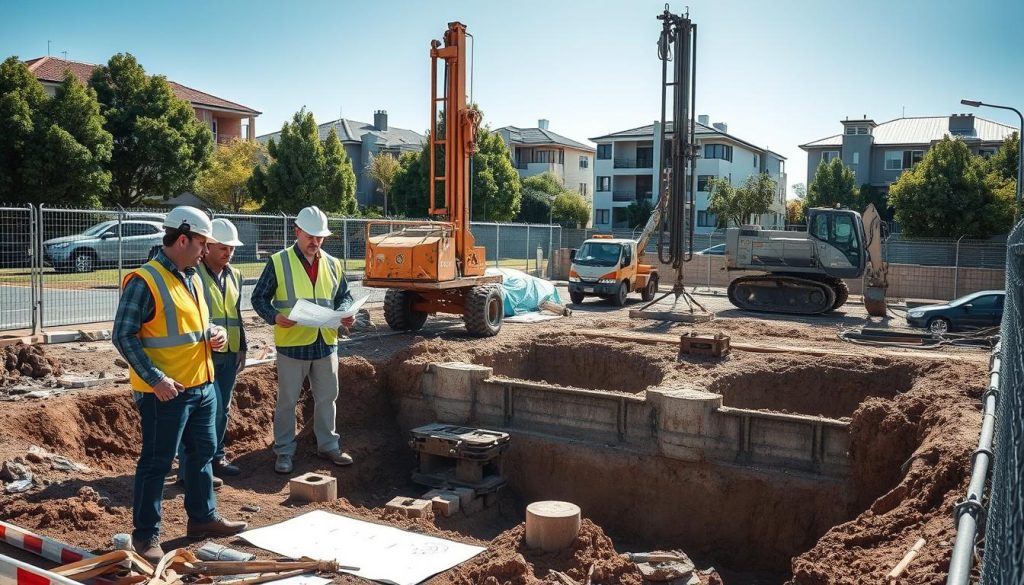
Local expertise across suburbs — tailored to your soil and site
Our team assesses ground behaviour at the address. We match method to access, load and soil type. That reduces unexpected time on site and lowers cost.
Minimal disruption methods — many homes re-supported in a day
- We work across inner and outer suburbs with local soil insight.
- Many houses can be stabilised within a day using non‑invasive techniques.
- We protect gardens, paths and services while on site.
- Level and crack monitoring verify improvement after works.
- Get free triage from photos, then a site visit for a firm scope if needed.
| Method | Typical time on site | Primary benefit |
|---|---|---|
| Resin injection | Same day for many homes | Rapid cure, low mess |
| Concrete underpin | Several days to weeks | Deeper, staged support |
| Screw piling | One to two days | Reliable deep anchoring |
Resin injection vs traditional underpinning: the right method for your home
We weigh speed, access and soil behaviour to recommend the safest approach for your house.
Non-invasive resin injection — tiny holes, rapid curing, cost-effective
Resin injection uses small-diameter holes, often under 16 mm. The material expands to fill voids and increase bearing quickly. Cure can take around 30 minutes, so lifts and re-levelling happen with minimal disruption.
Concrete underpinning involves larger excavations and staged pours. The concrete needs days to reach design strength. This method suits sites where deeper bearing or progressive support is necessary.
Choosing the method — soil reactivity, access, load paths and timelines
We consider soil reactivity, access, existing loads and the movement pattern. Drainage, nearby trees and recent excavations also influence the decision.
| Factor | Resin injection | Traditional underpinning |
|---|---|---|
| Disruption | Low — small holes, quick cure | Higher — excavation and curing time |
| Depth reached | Shallow to moderate | Deep, staged support |
| Typical time on site | Same day for many jobs | Several days to weeks |
- We model load paths to choose the safest option.
- We explain pros and cons clearly so you can compare cost, time and disruption.
- Our recommendation matches the ground, the structure and your timeline.
How we bring your building back to level
Our process starts with a clear, photographed record to speed diagnosis and guide action. Send photos for a fast triage and we will advise next steps.
Assessment and site inspection
We follow with a focused site inspection to confirm scope. Our assessment checks levels, drains and any hidden constraints.
Targeted drilling and resin injection
We place small-diameter access points only where needed. Then we use controlled injection to densify the ground beneath and fill voids.
Lift and re-level
We lift in measured stages while monitoring levels in real time. Doors and windows are checked as we adjust floors.
Finish and certify
Engineers verify results and confirm movement has arrested. We seal holes, tidy the site and provide VBA-compliant documentation and maintenance guidance.
- Free photo triage to speed time to inspection.
- Engineer oversight during lift and verification.
- VBA documentation supplied on completion.
| Step | Purpose | Result |
|---|---|---|
| Photo triage | Initial diagnostic feedback | Faster site booking |
| Injection | Fill voids, improve bearing | Immediate strengthening |
| Verification | Engineer-monitored levelling | Certainty for your foundation and floors |
Book a free assessment: Call Chris: 1300 970 930 or Email Chris: chris@underpinning-melbourne.com.au.
Why choose Underpinning Melbourne
Choosing the right team makes a big difference when your house needs expert foundation care. We combine licensed oversight, skilled technicians and modern equipment to target specific areas precisely. That keeps disruption low and outcomes permanent.

VBA-registered, insured and council-compliant methods
We are VBA-registered and fully insured. Work is documented to meet council and insurer standards. We coordinate engineers and approvals so the process is smooth.
20+ years’ experience, engineering-led, honest advice
Our experience spans thousands of assessments across local soils. Engineers oversee lifts and verification. You get clear advice, not sales pressure.
Calm, customer-first service — clear communication, no pressure
We listen to your needs and protect your property value. Our customer service is responsive, respectful and plainspoken.
| Assurance | What it means | Benefit |
|---|---|---|
| VBA registration | Compliant documentation | Council and insurer acceptance |
| Engineer oversight | Measured levelling & QA | Long-term stability |
| Modern equipment | Targeted, low-impact work | Minimal disruption to your home |
| Aftercare | Transparent guidance | Confidence in results |
Contact us: Call Chris: 1300 970 930 or Email Chris: chris@underpinning-melbourne.com.au.
Pricing clarity and getting a free quote
Clear pricing removes uncertainty when your house needs foundation work. We provide a plain path from initial photo triage to a firm, fixed-price proposal.
How we issue quotes
Fixed-price, transparent quotes after assessment
We only offer fixed-price quotes once we complete an assessment. That ensures the scope, inclusions and any allowances are written and specific.
Cost drivers you should know
Typical drivers include the chosen methods, soil behaviour and access at the site. The extent and pattern of movement determine staging and time on site.
- Method choice: injection or concrete underpinning affects time and cost.
- Soil and access: reactive clay or tight access increases scope.
- Extent of damage: wider movement needs more staged work and verification.
Value beyond price
We explain how speed, minimal disruption and durable outcomes save money long term. Non-invasive methods often reduce reinstatement and disruption.
| Cost driver | How it affects price | Typical impact |
|---|---|---|
| Method | Injection is usually faster; concrete needs staging and curing | Low to high |
| Soil behaviour | Reactive soils need more intervention and monitoring | Medium to high |
| Access & site constraints | Tight sites can increase labour and equipment needs | Medium |
| Extent of damage | Wider or deeper movement increases scope and verification | Medium to high |
Get started — we offer free, no‑obligation assessments and written quotes. Send photos for a quick triage or book a site visit to get a free quote. Ask us to coordinate an engineering report so you have clear, compliant documentation.
Call Chris: 1300 970 930 or Email Chris: chris@underpinning-melbourne.com.au.
Book your free assessment today
Book a free assessment and we’ll start with a quick photo triage to fast‑track advice. Send images and a brief description of the issue. We’ll review them and tell you the likely next steps.
Call Chris: 1300 970 930 | Email: chris@underpinning-melbourne.com.au
Prefer a site inspection? Book a visit for a fixed‑price, written quote after our assessment. We answer your questions and tailor the plan to your needs.
Send photos for a quick review or book a site inspection
- Send photos for fast triage and practical guidance.
- Book inspection to receive a free quote and written scope.
- We coordinate independent engineering reports with fast turnarounds.
- Our team schedules works promptly and keeps you informed.
Fast turnarounds on engineering report coordination
We coordinate engineers and documentation so your site can move from assessment to action quickly. Many injection‑based stabilisation jobs are scheduled fast because they need minimal excavation and cure rapidly.
| Action | What you get | Typical timing |
|---|---|---|
| Photo triage | Initial guidance and likely scope | Same day to 48 hours |
| Site inspection | Fixed‑price, written quote | 1–7 business days (by booking) |
| Engineering report coordination | VBA‑compliant documentation | Fast tracking on request |
| Scheduling works | Planned timing, clear updates | Prompt — depending on method and access |
Start now to get free clarity and a free quote without pressure. For a quick triage or to book a site visit use our contact page at Underpinning Melbourne or call/email Chris directly.
Conclusion
Early assessment gives clear steps to protect your foundation and property value. Acting sooner limits structural damage and reduces the chance of invasive building works.
We stabilise the ground and the foundation to halt ongoing movement. That approach protects floors, walls and window frames while preserving your house value.
Our mission is to deliver engineered, compliant repairs that last and to explain each step in plain language. We match methods to local soil behaviour and aim for the least disruption possible.
For trusted subsidence repair melbourne homeowners can call for a free assessment. Call Chris: 1300 970 930 or Email Chris: chris@underpinning-melbourne.com.au.