

We explain the facts so you can choose the right foundation solution for your home or building.
We are Underpinning Melbourne, Structural Preservation Specialists. Our focus is on safe, certified work that stops foundation movement and restores long‑term stability.
This introduction outlines two common approaches: resin injection (polyurethane) and traditional concrete underpinning. We compare speed, disruption, compliance and when each method suits specific soil and structure issues.
Our engineering-led process starts with a free, no‑obligation assessment. We use site investigation, GPR services, drilled injection points and surveyed lift monitoring to guide foundation repair and ensure VBA‑compliant certification.
We prioritise clear communication, minimal disruption and honest advice. Call Chris: 1300 970 930 or Email Chris: chris@underpinning-melbourne.com.au.
Key Takeaways
- Resin injection is faster and cleaner for many void and settlement issues.
- Concrete underpinning suits deep footing support and certain soil profiles.
- We base the method on soil profile, structure behaviour and long‑term stability.
- Our work is VBA registered, council‑compliant and backed by engineering reports.
- Expect a clear process: assess, test, plan, execute and certify.
- Free assessments and fixed‑price quotes keep decisions simple and honest.
Understanding the problem first: foundation movement in Melbourne homes
Identifying why a foundation moves is the vital first step to a permanent repair. We diagnose movement calmly and thoroughly. Our focus is on protecting your home and investment with VBA‑compliant solutions.
Melbourne’s reactive clay soils change volume with moisture. In drought, clays shrink and cause settlement. After heavy rain they can swell and cause heave.
Poor drainage, leaking pipes and erosion wash out fines and create voids under footings. Overloaded concrete and uncontrolled fill that does not meet AS 2870 also trigger movement.
Even a 5 mm crack in concrete can reduce capacity by up to half. That is why our process begins with site investigation, soil testing and moisture tracking.
- We separate cosmetic cracks from structural issues to target the right fix.
- Soil profiles and moisture data inform an engineered plan for long‑term stability.
- Our clear reports explain risks to your house and building value without alarm.
You get a practical, staged plan to stabilise foundations and prevent further subsidence. Call Chris: 1300 970 930 or Email Chris: chris@underpinning-melbourne.com.au.
Signs you may need underpinning or slab lifting
Small faults in daily use often reveal larger foundation issues. We respond quickly to homeowner concerns and explain options clearly. We never upsell.
Doors and windows sticking or out of square
Sticking doors and misaligned windows point to uneven movement in frames.
Twisted door frames make doors jam or not latch. That is a reliable early indicator.
Cracks in walls, sloping floors and sinking concrete slabs
Cracks walls near openings and sloping floors suggest the foundation is moving.
Sinking concrete slabs outdoors or in garages often mean there are voids or weak soil below.
How to tell if your home may need underpinning versus repair
Some cracks are cosmetic; others signal structural risk. We check doors, windows, wall lines and floor levels to map distortion.
- Sticking doors and misaligned windows show uneven frame movement.
- Cracks in walls near openings and sloping floors suggest active movement.
- Sinking concrete slabs indicate voids or poor founding below.
- Progressive movement that affects structural elements usually means you may need underpinning.
- If movement has stabilised and the cause is minor, targeted repairs may be enough.
We document findings and explain options in plain language for your home. You get clear advice on whether resin injection or traditional methods suit the pattern of movement and a written quote that covers scope, costs and compliance. See our comparison tool for more detail: restumping and underpinning tool.
Why Melbourne foundations move: soil, water and workmanship
Foundations shift for three main reasons: soil changes, water movement and poor construction practice. We explain each cause so you can prevent recurring problems and choose effective repairs.
Reactive clay behaviour in droughts and heavy rain
Clay in many suburbs absorbs moisture and expands. In dry spells it contracts and reduces support.
That cyclic change can cause heave in wet periods and subsidence in drought. Repeated movement stresses concrete and joins in the building.
Flooding, leaking pipes and erosion
Ponding and leaking pipes wash fine sand and silt away. Voids form under footings and concrete.
Once voids exist, parts of the ground lose bearing capacity and settlement follows.
Poor construction, overloading and non‑compliant fill
Incorrect construction or fill that fails AS 2870 raises long‑term risk. Overloading slabs with heavy loads can crack concrete and press soil down.
We inspect drainage, plumbing and original construction details to find the root cause.
- Prevention: fix drainage, manage trees and ensure correct site grading.
- Repair focus: combine drainage correction with structural stabilisation for durable outcomes.
Call Chris: 1300 970 930 or Email Chris: chris@underpinning-melbourne.com.au.


What is traditional concrete underpinning?
Concrete underpinning extends a foundation downward to reach firmer soil by installing new concrete supports beneath existing footings.
Our method uses staged excavation to expose small sections of the original footing. We place reinforcement, pour concrete pins or mass pads, and allow proper curing before moving to the next bay. This controlled process repeats until the required bearing level is achieved.
Method and excavation process to strengthen foundations
The excavation is localised and staged to protect the structure. We set out access, spoil removal and temporary supports. We specify reinforcement, bearing levels and curing times to secure the new support.
Pros, cons and when concrete underpinning is suitable
- Proven technique: predictable behaviour when engineered and built correctly.
- Best use: small, well-defined jobs or where hard strata is close.
- Downsides: more excavation, site mess and longer time on site.
- Limitations: it adds concrete and steel but does not improve surrounding ground conditions, so drainage and water issues must be fixed separately.
We deliver concrete underpinning when it is the right option. We plan access, stage the work and communicate program and access clearly. Call Chris: 1300 970 930 or Email Chris: chris@underpinning-melbourne.com.au.
What is slab lifting with resin injection underpinning?
A controlled resin injection process rebuilds support beneath concrete with minimal disruption. Also known as polyurethane underpinning, the method uses small, precise injections to fill voids and compact the ground.
How the resin compacts soil, fills voids and lifts concrete
We drill 16 mm holes and set ports beside footings or through slabs. A two‑part resin is injected under pressure. The resin expands, fills voids and compacts surrounding soil to form a stable base.
Speed, minimal excavation and reduced disruption
This process is quick. Many resins cure in about 15 minutes, so you can reoccupy areas fast. GPR locates services before we drill and survey monitoring controls every lift.
Limitations where deep support is required
Large voids may consume a lot of material and affect cost efficacy. Deep weak layers often need piles or another engineered solution. We coordinate engineering, offer fixed‑price quotes and test to ensure an excellent job.
| Feature | Resin Injection | Excavation | Best use |
|---|---|---|---|
| Hole size | 16 mm ports | Minimal | Slabs, paths, warehouses |
| Cure time | ~15 minutes | Low site impact | Fast reoccupation |
| Depth reach | Up to ~1500 mm | No trenches | Voids & compaction |
Slab lifting vs underpinning Melbourne
When foundations show movement, choosing the right repair method shapes cost, disruption and long‑term stability.
We compare options objectively so you can pick the right fit for your home or building.
Timeframes, cost considerations and site access
Resin injection is typically faster and causes less site disruption. It cures quickly, so businesses and households return to use in short order.
Concrete underpinning can take longer. Excavation, reinforcement and curing add time and site activity.
- Time: resin injection often wins on speed.
- Costs: small, simple jobs may favour concrete underpinning; large voids can raise resin volumes and cost.
- Access: resin uses small rigs and 16 mm ports; concrete underpinning needs clear excavation access.
Ground conditions, depth of support and long‑term performance
If the near surface is weak, concrete underpinning can extend support to firmer layers. For deeper failure, screw piles are often the correct engineered solution.
Long‑term performance depends on fixing water and drainage as well as the structural work. Both methods can stabilise ground and prevent further subsidence when combined with good site management.
Residential vs commercial and industrial concrete slabs
Residential projects value minimal mess and fast completion. Commercial and industrial work often favours quick cure resin to limit business down‑time.
We offer transparent fixed pricing and a planned program of work. Call Chris: 1300 970 930 or Email Chris: chris@underpinning-melbourne.com.au.
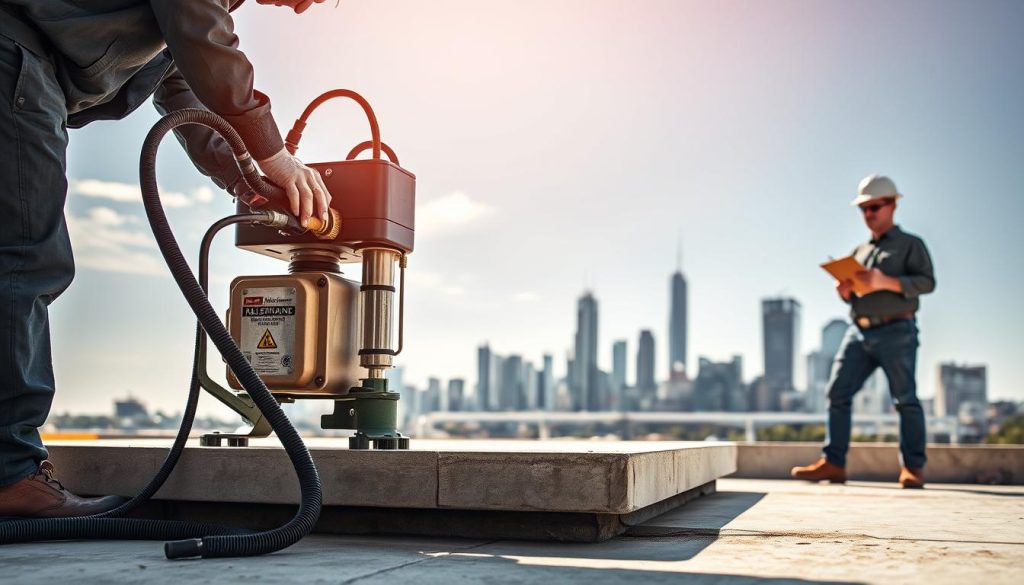
Where screw piling fits in the underpinning methods toolbox
When near‑surface soils cannot bear load, screw piling offers a practical route to deep, reliable support. We specify screw piles where shallow fixes are not enough. They give a firm base for a building and work with engineered plans.
Screw piling bypasses weak layers and transfers loads to competent strata. That makes it ideal for extensions, new construction and severe subsidence repairs. Installations are precise and minimise spoil on tight sites.
We design piles from soil data. We pick types, lengths and capacities to suit each foundation need. Approvals and inspections are handled to meet council and code requirements.
- Deep support: piles reach consistent bearing when surface soil is poor.
- Integration: piles tie into existing footings, slabs and new works under engineer design.
- Efficiency: reduced spoil and fast installation on constrained sites.
- Compliance: full pile logs, capacities and certification supplied at close out.
We brief you on method, sequence and tolerances before work starts. Call Chris: 1300 970 930 or Email Chris: chris@underpinning-melbourne.com.au.
Engineering, compliance and documentation that protect your home
We focus on measurable checks and formal certification to protect your property long term.
We are fully VBA registered and insured. Our calm, engineering-led approach puts safety and compliance first.
Structural engineers design the scope and verify capacity and movement. We coordinate reports, council lodgements and the final certification you need.
VBA-registered methods and council-compliant certification
Our methods follow council rules and VBA requirements. You receive drawings, engineering reports and a clear record of the work done.
Monitoring, testing and final records
Best practice guides our process. We conduct site investigation, soil testing and moisture tracking. We use GPR to locate services and survey monitoring during work.
- We record baseline levels and monitor movements throughout the process.
- Quality assurance includes injection logs, regrouting holes and level checks.
- We give drainage recommendations to reduce repeat issues.
Clear communication is constant from quote to handover. You get a tidy site, certified paperwork and the evidence needed for insurance, sale or future maintenance.
Call Chris: 1300 970 930 or Email Chris: chris@underpinning-melbourne.com.au.
Underpinning Melbourne’s approach: calm, engineering-led structural preservation
We take a methodical, engineering-first stance to protect homes from ongoing foundation problems.
Our mission is clear: safety, structural integrity and certification so you can have peace of mind.
Our mission: safety, integrity and peace of mind for worried homeowners
We deliver measured work that puts safety first. Our team provides engineered solutions and clear certification.
This reduces stress and helps you plan confidently.
Core services
- Concrete underpinning and engineered pads for deep support.
- Resin injection for quick, low‑disruption foundation repair.
- Restumping, reblocking and screw piling for structural stability.
- Wall crack repairs and structural engineering reports to document the job.

Free assessments, fixed-price quotes and clear communication
We offer free, no‑obligation assessments and fixed‑price quotes. Our scope notes make decisions simple.
Communication is direct. We explain issues, timelines and the expected work clearly. We never upsell; we recommend only what your home needs.
- We protect homes with permanent, engineered solutions.
- We coordinate structural engineering and full certification.
- We keep sites tidy and sequence work to minimise disruption.
We are VBA registered and insured with 20+ years’ experience. Call Chris: 1300 970 930 or Email Chris: chris@underpinning-melbourne.com.au to book a free assessment and get a great job done.
Our process from assessment to completed work
We follow a clear, staged pathway from investigation to certified handover. The aim is a structured, stress‑free underpinning process that protects your home and gives certainty.
Site investigation, soil profile and moisture tracking
We start with a level survey and a detailed site investigation. Soil tests and moisture monitoring identify the drivers of movement.
Designing the solution and mapping injection points with GPR
Engineers design the scope and mark drill locations. GPR locates services so we avoid cables and pipes and reduce risk.
Undertaking resin injection or concrete works
For resin injection we drill 16 mm holes, often to about 1500 mm, place ports and inject to compact the ground. For concrete work we excavate, form and pour to specification.
Surveyed monitoring, quality assurance and tidy handover
Survey gear controls any movement in real time. We cut rods, regrout holes and complete rectification. We leave a tidy site and document all work done.
- We begin with investigation and surveys.
- We design the right process and map services with GPR.
- We execute resin or concrete solutions with survey monitoring.
- We finish with a clear close‑out pack of photos, logs and recommendations.
Call Chris: 1300 970 930 or Email Chris: chris@underpinning-melbourne.com.au. To book a free assessment use our contact page.
Preventing further subsidence and keeping your house stable
A proactive aftercare plan keeps soil conditions stable around your home. Small actions reduce the chance of recurring foundation issues and give you peace of mind.
Drainage fixes, managing trees and avoiding moisture swings
Improve drainage to stop ponding near footings and slabs. Check downpipes, stormwater and soakage regularly.
Inspect and repair leaking water or sewer pipes promptly. Erosion of fines in silty or sandy clays creates voids and weakens support.
Manage trees and vegetation near the house. Keep irrigation away from the perimeter to reduce moisture swings in reactive soil.
Aftercare, communication and when to call for a review
We provide a simple seasonal checklist you can follow. Watch for new cracks in walls, sticking doors or windows as early warning signs.
- Maintain drains and gutters to protect soil conditions.
- Repair leaks quickly to avoid voids beneath footings.
- Keep garden watering even and away from foundations.
- If signs return, call us for a review before problems escalate.
We explain when a targeted repair is enough and when you may need underpinning. Good communication keeps your home stable over time.
Call Chris: 1300 970 930 or Email Chris.
Conclusion
A clear engineering plan turns uncertainty into a reliable, long‑term foundation solution.
Both resin methods, also known as polyurethane, and traditional underpinning restore stability when matched to soil and site. The right choice depends on ground behaviour, depth and the building’s needs.
We went beyond surface fixes by addressing causes, not just symptoms. Our engineering‑led process saves time and protects finishes and services. You receive full documentation and a tidy close‑out of the job.
Ready for calm, expert advice for your concrete slab or footings? Call Chris: 1300 970 930 or Email Chris. Book a free assessment and fixed‑price quote via Underpinning Melbourne.