

This guide compares concrete underpinning and resin injection so you can choose the right foundation solution for your home.
We are Underpinning Melbourne, Structural Preservation Specialists. We protect Melbourne homes from foundation failure with an engineering focus and VBA‑compliant certification.
Concrete underpinning is the traditional method with excavation and concrete pours. It can suit deep repairs but is slower, heavier and may need more restoration.
The modern option, resin injection, uses small access holes and expanding material. It is often faster, less disruptive and allows occupants to remain in the house.
We explain when each method fits local soils and AS2870 risks like differential movement. Our service includes free no‑obligation inspections, fixed quotes and coordinated engineering reports.
For a quick estimate, use our cost calculator or book a free inspection.
Call Chris: 1300 970 930 or Email Chris: chris@underpinning-melbourne.com.au.
Key Takeaways
- We compare concrete underpinning and resin injection for Melbourne foundations.
- Resin injection is often quicker and less disruptive for many issues.
- Concrete underpinning suits some deep or heavy‑load repairs.
- All works follow VBA standards and include engineering reports.
- Free inspections, fixed quotes and no‑upsell assessments are available.
Choosing the right foundation fix for Melbourne homes today
Start with facts, not fixes: identify the cause before picking a foundation solution for your home.
Cracks near windows and doors, sloping floors and sticky joinery are common signs of foundation issues. Each symptom points to movement, but not always the same cause.
We take a calm, engineering‑led approach. First, we inspect the site, assess soils and check building age and access. Then we match the repair to the issue.
Quick remedies can stabilise ground in a day or two with minimal disruption. Traditional concrete underpinning suits deeper or heavier support needs but takes longer and needs excavation.
- Identify cause, not just the visible problem.
- Consider site conditions, access and future risk before recommending underpinning.
- We supply VBA‑compliant documentation, fixed quotes and free assessments.
| Feature | Fast, low disruption | Deep, structural support |
|---|---|---|
| Time on site | 1–2 days | Weeks |
| Disruption | Minimal, occupants usually stay | Excavation, reinstatement work |
| Best for | Settled slabs, local voids | Deep footings, heavy loads |
Our advice is independent and practical. We plan the work sequence so you know timing and site impacts. This protects property value and gives you clear peace of mind.
What are we comparing? Concrete underpinning and resin injection explained
Here we describe each repair method and how it addresses different causes of subsidence.
Concrete underpinning in a nutshell
Concrete underpinning involves excavating beneath an existing footing and pouring concrete to deepen or widen support. It suits footings that need added bearing at specific points.
This process can be labour‑intensive and slow. It may need reinstatement work after completion. We only recommend it when site conditions and footing layout require deep, solid support.
Resin injection (chemical underpinning) in a nutshell
Resin injection uses engineered expanding material injected through small holes, often around 16 mm. The resin compacts loose soil, fills voids and can gently lift settled parts of the structure.
The material cures in minutes and often allows occupants to stay in the house. Laser monitoring guides precise levelling during the process.
How each method solves different causes of subsidence
We choose the best option after inspecting soils, drainage and existing foundations. Subsidence from washout or erosion often responds well to ground improvement using resin.
- Concrete underpinning: deep, point support where bearing must be increased.
- Resin injection: targeted ground improvement with small holes and fast cure.
- We document the process and coordinate structural engineering reports when required.
Call Chris: 1300 970 930 or chris@underpinning-melbourne.com.au
Concrete underpinning: traditional method, modern expectations
When footings need added bearing depth, a mass concrete approach is still a reliable option. We pair practical staging with engineering oversight to ensure a council‑compliant outcome.
Process and engineering approach
Mass concrete underpinning uses staged pits, reinforcement and concrete pours. Each stage cures under QA checks and structural monitoring.
We coordinate engineers, plan safe excavation around services, and supply fixed‑price quotes and clear timelines.
Benefits: proven longevity and suitability for specific footings
Proven track record: concrete gives robust, permanent support for heavy or deep footings.
Engineered solution: design is tailored to soils and load, with documentation for council approval.
Limitations: excavation, timeframes, mess and added weight
Works involve excavation, noise and spoil removal. Pits and holes often affect gardens and hardscapes.
Important: added concrete weight can worsen movement on reactive soils, so AS2870 guidance is considered in every project.
Costs and project impacts in local contexts
Typical pricing is per‑metre for mass concrete, with labour a key driver. Programmes can run to weeks depending on access and length.
- We explain line‑by‑line costs, including reinstatement and spoil removal.
- We detail QA steps, curing verification and site safety plans.
- Where a less invasive option suits, we will recommend alternatives such as restumping or other methods.
| Feature | What to expect | Planner notes |
|---|---|---|
| Time | Weeks | Depends on length and access |
| Disruption | High (excavation) | Landscaping impacted |
| Suitability | Deep/heavy footings | Engineer‑led design required |
Call Chris: 1300 970 930 or Email Chris: chris@underpinning-melbourne.com.au.
Resin injection: fast, precise ground improvement
We deliver a low‑impact solution that stabilises and lifts settled areas in hours. This approach suits owners who want a quick, documented fix without major excavation.
Process: small access holes, controlled expansion and laser monitoring
We survey the site and mark points before drilling small access holes, usually about 16 mm. The injection material expands, compacts loose ground and fills voids under a slab or footing.
Laser monitoring guides lift to millimetre accuracy. The material cures in minutes, so most areas are usable within the same day or the next days.
Benefits: non‑invasive, quick curing, minimal disruption
Minimal mess: no large pits, little dust and no water on site. We often complete works while you remain at home.
Fast and targeted: the process treats edges, corners and panels precisely. We provide before/after surveys and a completion record for your files.
Limitations: volume and cost for large voids
Large underground voids need more material. That raises costs and may make a deeper solution more suitable.
Where this method shines
- Slabs, driveways and settled corners.
- Compact loose ground in clay zones affected by moisture cycles.
- Targets small areas quickly with low added weight.
We minimise disruption and supply clear documentation and certification. Call Chris: 1300 970 930 or Email Chris: chris@underpinning-melbourne.com.au.
Melbourne soils and AS2870: reactive clay realities
Seasonal moisture swings in local clay mean that a safe fix must treat the ground as well as the footing.
Why reactive clays complicate mass concrete underpins
Melbourne has widespread clay soils that show high shrink‑swell behaviour. This changes bearing conditions under footings through the year.
AS2870 warns that adding rigid, heavy concrete can create differential movement. An underpinned section may move differently to the rest of the structure.
Differential movement risk and seasonality
Seasonal wetting and drying opens and closes gaps beneath slabs. That cycle loads connections and can reopen cracks.
- We assess drainage, tree roots and plumbing leaks that alter soil moisture.
- Our inspections record history, prior repairs and current foundation condition.
- Where appropriate, resin ground improvement treats the soil to reduce movement rather than adding weight.
| Factor | Mass concrete effect | Soil improvement approach |
|---|---|---|
| Shrink‑swell cycles | Rigid sections may separate from slabs | Stabilise moisture response and fill voids |
| Added weight | Can increase settlement on softened soil | Minimal added load, targeted compaction |
| Long‑term control | May need jointed repairs later | Designs that keep support uniform |
We prioritise safety, compliance and durable outcomes. Call Chris: 1300 970 930 or Email Chris: chris@underpinning-melbourne.com.au.
Cost, time and disruption: side‑by‑side factors that matter
Knowing what a project will cost, how many days it will take and what will be disturbed helps you plan with confidence. We give clear, fixed‑price quotes and outline timeframes up front.


Typical spend ranges and what drives price
Pricing depends on method, access, length of treatment and ground condition. Mass concrete work is usually quoted per metre and is labour‑intensive.
Restoration and spoil removal add to final cost. That often makes modern ground improvement more cost‑effective when you include reinstatement.
Time on site: days versus weeks
Resin programmes often finish in a day or two. Laser surveys and QA checks record measurable results the same week.
Concrete underpins commonly run to weeks. Excavation, curing and staged pours extend the timeline.
Occupancy, gardens and hardscape impacts
Resin uses small holes and rapid curing. Occupants usually stay at home and downtime is minimal.
Excavation affects gardens, driveways and paths. Reinstatement is part of the quoted work and schedule.
- Pricing varies with access, length and soil conditions.
- We define inclusions, exclusions and contingencies before we start.
- Level surveys and QA checks are included so you see measurable outcomes.
- Subsidence history, plumbing or drainage repairs can change cost and days on site.
- We schedule works to minimise disruption to your building and property.
Call Chris: 1300 970 930 or Email Chris: chris@underpinning-melbourne.com.au.
Match the method to the symptoms and site
Every house shows clues; our job is to interpret them and pick the least invasive fix.
We give honest assessments and never upsell. We recommend the option that protects your home and value.
Cracks near windows, doors and corners
Diagonal or stepped cracks close to openings often point to differential settlement in walls.
We measure crack width and pattern to map movement. This helps us choose a targeted repair.
Sloping floors, sticking joinery and voiding
Uneven floors and sticking doors usually mean settlement beneath a slab or footing.
Ground improvement can fill voids and relevel slabs with minimal disruption. Where point support is needed, we test the site for suitability and risk first.
- Cracks near openings often show differential settlement in walls.
- We measure patterns to understand the movement mechanism.
- Sloping floors and sticking joinery signal slab settlement issues.
- We address drainage and leaks to stop recurrence.
| Symptom | Likely cause | Usual preferred approach |
|---|---|---|
| Diagonal cracks at window/door | Local differential settlement | Targeted ground repair and monitoring |
| Sloping floors | Voids or soft soil under slab | Fill voids and relevel the slab |
| Widespread heavy movement | Deep footing or reactive clay risk | Engineer‑led point support after testing |
We match method to symptoms, soil type and cause. You receive a clear repair sequence, timing and documentation. Call Chris: 1300 970 930 or Email Chris: chris@underpinning-melbourne.com.au.
Engineering, compliance and documentation in Victoria
Before any site work begins, we confirm registrations, insurance and council requirements. We aim to remove uncertainty and give you clear, recorded outcomes.
VBA registration, council‑compliant methods and certification
We are fully VBA Registered and insured. You receive our registration details and proof of cover before works start.
All methods follow council rules and AS2870 guidance for residential slabs and foundations. Certification is issued on completion to support future property transactions.
Structural engineering reports and monitoring
Engineers define scope, acceptance criteria and monitoring needs. For resin work we record injection points, volumes and lift results.
- Laser monitoring and documented level surveys verify outcomes.
- Traditional staged excavation uses shoring plans and concrete QA checklists.
- We deliver a consolidated compliance pack: drawings, levels, photos and notes.
We remain available post‑completion to answer questions and provide monitoring records. Call Chris: 1300 970 930 or Email Chris: chris@underpinning-melbourne.com.au.
| Control | What we supply | Why it matters |
|---|---|---|
| Registration & Insurance | VBA details, policy evidence | Supports council and insurance needs |
| Monitoring | Laser levels, surveys, photos | Verifies lift and stability |
| Completion Pack | Reports, drawings, certificates | Clears future building checks |
underpinning vs resin injection melbourne: which should you choose?
The right choice comes down to site needs, speed and long‑term risk. We help you weigh disruption, performance and soil response so you can decide with confidence.
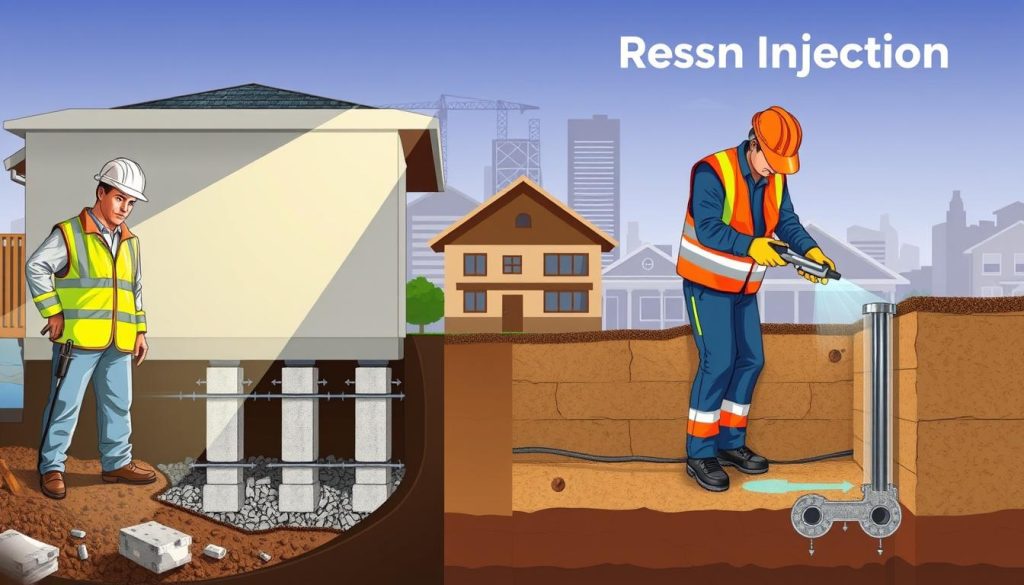
If you need speed and minimal disruption
Choose a fast ground improvement when you want same‑day reoccupation and minimal mess. The material cures within minutes and often allows occupants to stay on site.
This suits slab and driveway settlement, small voids and targeted lift work.
If excavation access is available and long set times are acceptable
Select a mass concrete approach where footings require deeper, point support. Expect staged excavation, longer programmes and reinstatement work.
Use this where footing design or heavy loads demand engineered, point‑bearing strengthening.
Soil conditions, footing type and future movement risk
Reactive clay raises differential movement risk for heavy concrete repairs. That makes ground improvement preferable for many suburban slabs.
Assess access, spoil handling and total reinstatement cost, not just the upfront price. Our engineer will compare foundation performance, drainage and movement risk for your site.
- Choose quick ground methods for speed, precision and low disruption.
- Use concrete solutions only when footings need deepened support.
- Consider soil reactivity and long‑term movement before deciding.
- Compare total programme, reinstatement and future risk, not just initial cost.
- We provide a written comparison and a fixed‑price proposal tailored to your site.
Call Chris: 1300 970 930 or Email Chris: chris@underpinning-melbourne.com.au.
When alternatives make sense: screw piling and restumping
Not every problem needs a heavy concrete repair; other methods can deliver lasting stability. We assess the cause and propose a tailored approach that fits your site, budget and long‑term needs.
Screw piling to deeper stable strata
Screw piles transfer loads to deeper, stable layers when near‑surface ground is weak. They bypass soft topsoil and support existing footings with minimal excavation.
Benefits: reduced sensitivity to seasonal moisture, quick installation and low surface disruption. Screw piling is often the right choice where access limits large excavations.
Restumping and reblocking for timber floors
Restumping replaces failed stumps under a timber house and can relevel the structure. It fixes decay or movement and restores floor levels without full footing works.
- Screw piling transfers loads to deeper layers when shallow ground is weak.
- Restumping addresses decay under timber floors and relevels the house.
- These options can be quicker and less disruptive than full excavation under walls.
- Where a slab remains nearby, targeted injection or resin treatments can complement pile or stump work.
- We map services and confirm clashes before any work proceeds.
We compare these alternatives with underpinning for durability and lifecycle cost. Our goal is a stable, durable result without unnecessary scope or cost. Call Chris: 1300 970 930 or Email Chris: chris@underpinning-melbourne.com.au.
Why choose Underpinning Melbourne for advice and works
Choose a team that pairs engineering rigour with clear, practical advice.
Our mission: safety, structural integrity and peace of mind
We protect your home and property with engineered certainty. Our approach focuses on lasting stability and minimal disruption.
20+ years’ experience, fully VBA Registered and insured
We bring over 20 years of local experience. Our team is VBA registered and fully insured for council‑compliant delivery.
No upsell, honest assessments and council‑compliant delivery
Our expert advice is independent. We give clear scopes, free assessments and fixed‑price quotes. We do not push unnecessary work.
- Core services: concrete underpinning, resin injection, screw piling and restumping.
- Wall crack repairs and coordinated structural engineering reports for full compliance.
- Laser monitoring on resin projects gives millimetre control and allows occupancy during works.
| Feature | Detail | Why it matters |
|---|---|---|
| Experience | 20+ years | Proven, local knowledge for reactive soils |
| Registration | VBA Registered & insured | Council‑compliant documentation supplied |
| Outcomes | Measured before/after levels | Verified, traceable results for your property |
We plan works to minimise disruption and we follow AS2870 guidance on reactive sites when choosing methods. Call Chris: 1300 970 930 or Email Chris: chris@underpinning-melbourne.com.au to get started.
Get a calm, engineering‑led assessment today
Start with a calm, engineering review so you know exactly what your home needs.
Free no‑obligation assessment. We inspect signs such as cracks near windows and doors, sloping floors and sticking joinery. This helps us spot subsidence, likely damage paths and the right repair options.

Ask us questions and get straight, engineering‑led answers without pressure. If you need clarity on foundation performance, we will inspect and explain options clearly.
- We assess subsidence indicators and identify causes of movement.
- You receive repair options with pros, cons and expected outcomes.
- Our fixed‑price proposal includes scope, QA steps and certification.
- We coordinate any required structural engineering report for compliance.
- Send photos to speed diagnosis before we attend site.
Resin often cures quickly and allows reoccupation the same day. Traditional methods can need longer on site and more reinstatement. A documented assessment clarifies scope and method so you decide with confidence.
Book a site inspection or send photos now: contact us. Call Chris: 1300 970 930 or Email Chris: chris@underpinning-melbourne.com.au.
Conclusion
Fix the ground, protect the building — that is our practical aim.
Both solutions work when matched to site facts. One method is fast, precise and low‑impact. The other is proven where footings need deep concrete support and excavation.
We address soil causes, drainage and moisture to reduce repeat damage. Our team plans each project with safety, certification and clear cost and time estimates.
If you see cracks, subsidence or wall movement, ask your questions now. For a calm, compliant repair pathway book a free assessment and a fixed‑price quote. Call Chris: 1300 970 930 or Email Chris: chris@underpinning-melbourne.com.au.